"Korean Beef for Dinner Tonight" - Drawn in by Half-Price Deals, but... "What Else Is There to Buy?" at 'Empty' Homeplus
Stores Quiet on Weekend Just Two Months After Reopening
Estimated Payment Volume Down 10.7% Month Over Month in September
E-Mart Discount-Store Sales Up 9.9% in Q3
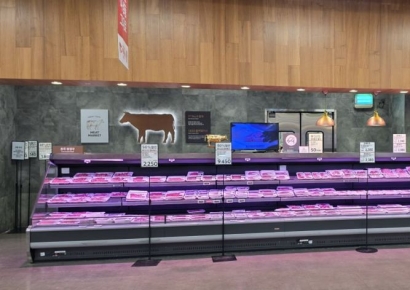
At 2 p.m. on October 17, Homeplus Gangseo in Seoul was quiet. Although it was a weekend afternoon, fewer than 50 customers were shopping in the store. Homeplus was offering discounts of up to 50% on all Korean beef products, selling sirloin for 9,450 won per 100 grams, but the meat counter was quiet. Things had been different two months earlier. On August 13, when Homeplus resumed operations at 67 stores nationwide, its Gangseo store recorded daily sales in the 200-million-won range. Customers and shopping carts crowded the meat counter, and a long line formed at the checkout. At the time, the number of in-store customers was up 15% from a year earlier.
The effect of Homeplus's "Supportive Grocery Shopping" campaign is fading just two months later. Despite steep discounts, a limited product selection is keeping customers from returning, while weak sales appear to be causing a shortage of cash needed to purchase merchandise. Concerns about a return to normal operations are growing as salary payments have once again been delayed.
From October 15 to 21, Homeplus is holding a special sale for members, featuring "half-price Korean beef." But customer traffic has not returned to the level seen when stores reopened. "Customers won't come back if the products they need aren't available," a large discount retailer industry official said. "Homeplus missed out on sales of Chuseok gift sets, and its product range is still limited, so it will be difficult to increase sales."

Reopening Boost Fades as September Payments Decline
According to Mobile Index, a company that analyzes app and payment data, estimated payments at Homeplus rose 43.8% from 57.6 billion won in July to 82.8 billion won in August, but fell 10.7% to 74 billion won in September. By contrast, payments at E-Mart rose 11.8%, from 939.6 billion won in August to 1.0507 trillion won in September.
From October 1 to 16, estimated payments totaled 41.3 billion won at Homeplus and 390.5 billion won at E-Mart. Their respective daily averages were 2.58 billion won and 24.41 billion won, a gap of about 9.5 times. Homeplus did not even reach half of the average daily sales of 10 billion won per store nationwide specified in its rehabilitation plan. The number of monthly active users (MAU) of the Homeplus app was about 1.06 million in September, down 13.4% from the previous month. The E-Mart app had about 3 million users over the same period.
The main obstacle to bringing customers back is product supply. Credit transactions with suppliers have yet to return to normal, so Homeplus must pay cash upfront to bring in merchandise. The company needs to stock its shelves to increase sales, but a lack of cash is making it difficult to secure products, creating a vicious cycle. Homeplus CEO Jo Joo-yeon acknowledged these difficulties at a National Assembly audit by the Political Affairs Committee on October 12. She said the company had planned to increase inventory and expand sales through credit transactions, but continued advance payments and cash transactions were constraining sales growth.

Homeplus has unveiled a strategy to improve operating efficiency by converting its existing multilevel stores into single-floor stores of about 1,000 pyeong, and focusing on food, private-label (PB) products, and fast-moving household essentials. However, sales reportedly fell short of expectations after the initial reopening period. Sales in mid-September were only about 40% of the original target, and the target attainment rate reportedly fell to around 30% early this month.
Cash-flow problems are also affecting salary payments. Homeplus had originally planned to pay 25% of the unpaid August salaries on October 21, but will make the payment on October 23 instead. The company plans to pay the remaining 75% on October 30, but says it will provide further notice depending on its financial situation. No payment date has been set for overdue Chuseok bonuses, either. There are concerns that a prolonged slump in business could deplete even the 200 billion won in emergency debtor-in-possession (DIP) financing that the company managed to secure.

The checkout counters at Homeplus Gangseo in Seoul were quiet on the afternoon of the 17th.
View original imageSearch for New Owner Stalls as Rival Retailers Benefit
Homeplus is making an all-out effort to find a new owner. It is pursuing the sale of its headquarters, online business, and 67 hypermarkets as a package, and plans to receive letters of intent by the end of October. It also plans to sell the real estate of 19 company-owned stores among those slated for closure separately to secure funds for repayment. However, a successful sale is far from certain. Hyundai Department Store Group and GS Retail, both mentioned as potential buyers, have denied rumors that they are interested in acquiring the company. The need to invest not only in the purchase price but also in product supply and the restoration of normal operations is another burden. To complete a sale, Homeplus needs to demonstrate that its business can recover, but even bringing customers back is proving difficult.
Rival hypermarket chains are benefiting in turn. E-Mart's total sales in the third quarter of this year rose 11.1% year over year to 4.7468 trillion won. Of that, sales in its discount store business increased 9.9% to 3.2621 trillion won. The discount store business's monthly sales growth was 7.8% in July, 11.8% in August, and 10.1% in September. "Sales growth was driven by benefits from the Homeplus situation, the People's Livelihood Recovery Support Fund, and a base effect resulting from the difference in the timing of Chuseok," E-Mart said.
Hot Picks Today
 "Korean Beef for Dinner Tonight" - Drawn in by Half-Price Deals, but... "What Else Is There to Buy?" at 'Empty' Homeplus
- “I Thought It Was Just Inflammation”: 70 Men Have Died of Breast Cancer in This Country in 5 Years
- "I Should Enjoy It After Retirement": Prices Quadruple... Memberships Over 100 Million Won Popular, but Closures Mount
- "A Gift to Myself: Using Up Every Last Day of Annual Leave on an Overseas Trip" Year-End Bookings Surge 138%... Thought It Was Japan Again, But...
- "Come Live With Me on My Farm": Man Sells Everything and Travels 1,930 km, Trusting a Beautiful Woman
The burden on employees who are on temporary leave is also growing. According to the Homeplus union, staffing at the Busan Asiad store increased to about 320 after employees from closing stores were reassigned there, but only 70 to 80 people are working in the store, while the rest are on temporary leave. "It is difficult to make ends meet even when employees on leave receive about 70% of their salaries," said Choi Cheol-han, secretary-general of the Homeplus branch of the Mart Industry Union. "The company has accepted the union's demands and plans to introduce a rotation system starting next month, alternating between working and temporary leave in line with the circumstances at each store."
© The Asia Business Daily. All rights reserved. Unauthorized AI training and use prohibited.