China's Q3 Growth at 4.5%... Experts: "Economic Imbalances Deepening" (Comprehensive)
Domestic Demand Remains Sluggish... Exports Are the Only Bright Spot
Real Estate Investment Plunges 21%
Chinese Authorities Also Say, "Domestic Demand Remains Insufficient"
Fueled by export growth amid the global boom in the artificial intelligence (AI) industry, China’s gross domestic product (GDP) grew 4.5% year-on-year in the third quarter of this year. However, experts said the imbalance in China’s economy is worsening as the country becomes increasingly reliant on exports and advanced manufacturing while weak domestic demand persists.
Exports and Manufacturing Drive Third-Quarter Growth

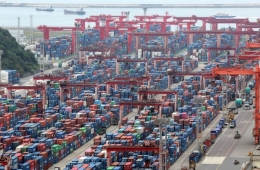
Containers are stacked near a port in Yantai, Shandong Province, eastern China, on the 14th (local time). AP-Yonhap News.
View original imageAccording to the South China Morning Post (SCMP), a Hong Kong daily, Xinhua News Agency and other outlets on October 19, China’s National Bureau of Statistics announced that the country’s GDP rose 4.5% year-on-year in the third quarter. This was 0.2 percentage points higher than the 4.3% growth recorded in the second quarter and also exceeded the market forecast of 4.41% compiled by Wind, a Chinese financial information provider.
China’s cumulative economic growth rate for January through September this year was 4.6%, within the government’s target range of 4.5% to 5.0% for the year. China lowered its annual growth target this year from the “around 5%” target it had maintained in recent years.
Exports and manufacturing supported growth. China’s exports in September surged 36.3% year-on-year, far exceeding market expectations. Strong global demand for AI and advanced technology products is believed to have driven the export performance. Industrial output also rose 5.5% that month, accelerating from 5.2% in August.
In contrast, the recovery in domestic demand remained sluggish. Retail sales, an indicator of consumer activity, increased just 1.1% year-on-year in September. Although this was above the market forecast of 0.7% and the 0.4% increase in August, the recovery in consumption remained limited.
Investment also remained weak. Fixed-asset investment fell 7.2% year-on-year from January through September this year. Real estate investment plunged 20.6%, with the decline deepening from the cumulative 19.9% drop recorded from January through August. The prolonged downturn in the property market is weighing heavily on China’s economy.
The labor market showed a slight improvement. The surveyed urban unemployment rate was 5.2% in September, down 0.1 percentage points from 5.3% the previous month.
Concerns Over China’s “Excessive Reliance on Exports”

Humanoid robots transport materials at a factory near Hangzhou, Zhejiang Province, on the 19th. AP-Yonhap News
View original imageExperts said China’s economy has an imbalanced growth structure, relying excessively on exports and advanced manufacturing. Zhang Yuhan, chief economist at the Conference Board’s China Center, told the UK’s Financial Times (FT), “China’s economy is still driven by the supply and production sides,” adding that “household consumption and consumer confidence need to be strengthened for a balanced recovery.”
Zhang also said, “The Chinese government’s active industrial policy is encouraging investment in areas such as artificial intelligence (AI) and advanced manufacturing, known as ‘new quality productive forces.’” The term, which emerged in 2024, refers to new productive capabilities based on technological innovation, including AI and advanced manufacturing.
Australian financial group ANZ also said the latest government data had heightened concerns about imbalances in China’s economy. According to The New York Times (NYT), ANZ Research said in a report on October 19, “Exports have acted as a key buffer, but they are unlikely to fully offset weakness in other parts of the economy.”
The Chinese government also acknowledged concerns over weak domestic demand. Mao Shengyong, deputy head of the National Bureau of Statistics, said at a news conference in Beijing on October 19, “Despite mounting pressures, China’s economy pursued innovation-driven development and high-quality growth in the first three quarters of this year.” He added, “The international environment is highly volatile, and domestic demand remains insufficient.”
Hot Picks Today
 He Left It in the Car and Forgot... "I Nearly Collapsed with Joy": Man Wins $1.48 Million Lottery
- "Maybe I'll just go to Japan," they'll say... Why are foreign visitors to Korea "flooding with complaints"? [2026 National Assembly Audit]
- "'Nodding Off' on the Subway? Here's Why Koreans Are Getting Even Less Sleep"
- [Asia Business Daily-Realmeter Poll] President Lee's Approval Rating Falls 2.0 Percentage Points to 35.3%
- Beachgoer Finds 'Plastic' That Turns Out to Be Perfume Ingredient Worth More Than Twice as Much as Gold
The Chinese government is accelerating bond issuance and introducing measures such as large-scale infrastructure construction plans and interest subsidies for mortgage loans to support an economic recovery. However, fiscal policy and international energy prices are cited as factors weighing on economic growth. In a recent report, Goldman Sachs said that although weather conditions in the third quarter were more favorable to economic activity than in the second quarter, fiscal tightening and rising international energy prices were constraining growth.
© The Asia Business Daily. All rights reserved. Unauthorized AI training and use prohibited.