NH-Amundi's 'Growth-Driven Korea Fund' Marks First Anniversary... "Materials, Parts and Equipment Needed to Generate Alpha"
NH-Amundi Asset Management Holds Fund's First-Anniversary Briefing on Oct. 19
"Operating profit growth at Samsung Electronics and SK hynix is slowing
Small- and mid-cap materials, parts and equipment stocks needed to generate additional alpha"
NH-Amundi Asset Management said at a press conference marking the first anniversary of the Growth-Driven Korea Fund, held at FKI Tower in Yeouido, Seoul, on October 19, that it plans to shift its portfolio, currently focused on Samsung Electronics and SK hynix, toward semiconductor materials, parts and equipment companies.
Choi Chihyeon, deputy general manager of Equity Management Division 2 at NH-Amundi Asset Management, which manages the fund, said, "The growth rates of operating profits at Samsung Electronics and SK hynix are slowing. Maintaining some exposure to the two stocks remains a valid strategy, but to generate additional alpha, we need stocks with greater growth potential. A strategy focused on small- and mid-cap stocks could be effective next year."

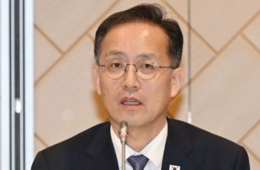
Park Jinho, head of equity management at NH-Amundi Asset Management (left), and Choi Chihyeon, deputy director of Equity Management Division 2, answer questions at a press conference marking the first anniversary of the Growth-Driven Korea Fund at FKI Tower in Yeouido, Seoul, on the 19th. NH-Amundi Asset Management
View original imageHe added, "With investment in front-end semiconductor equipment expected to increase significantly next year, materials, parts and equipment companies could lead the second leg of the semiconductor sector's rally. In IT hardware, we plan to maintain a high allocation to the packaging substrate sector, where substrates are becoming larger and more multilayered as semiconductor performance improves."
Established on October 14, 2025, the NH-Amundi Growth-Driven Korea Fund is an active equity fund that invests in companies leading the three major transitions driving growth in the Korean economy: the AI Transformation (AX), the Green Transformation (GX) and the Capital Market Transformation (CX). As of October 14, 2026, the fund had returned 84.86% in the year since its launch. It outperformed the KOSPI's 67.63% return over the same period by 17.23 percentage points.
The fund uses a core portfolio strategy centered on the semiconductor and IT hardware sectors. Choi said, "About 80% of our outperformance against the KOSPI came from the semiconductor and IT hardware sectors. Amid strong market concentration in certain stocks, financial sectors such as insurance and banking, as well as platform and software sectors, also contributed to our outperformance."
As a way to manage volatility, he proposed investing in the banking and insurance sectors to prepare for rising interest rates. Choi said that among financial stocks, he favors insurance companies, where underwriting results are improving and regulatory changes to surrender value reserves could create room to expand shareholder returns.
He added, "Although skepticism about the AI sector has grown, I don't think this is the time to reduce our focus on AI as a driver of growth. Given the high uncertainty in the macroeconomic environment, we will manage portfolio volatility through exposure to the financial and energy sectors."
At the press conference, Park Jinho, head of equity management at NH-Amundi Asset Management, presented his outlook for the domestic stock market. He pointed to profit-taking following the sharp gains of the past two years as a reason for the recent weakness in domestic memory semiconductor stocks.
He also said that, unlike GPUs and foundries, which are effectively monopolistic markets, memory is highly competitive and has become a larger share of system costs, adding to the pressure on memory stocks. "Unlike Nvidia and TSMC, there are many competitors in the memory market," Park said. "China's CXMT doubled its memory market share in just one year."
However, he said demand related to AI still exceeds supply, as the spread of AI agents is driving rapid growth in demand for tokens. "The AI capital expenditure (CapEx) cycle will not end even in 2028," Park said. "If it is clear that investment will generate returns, companies will continue investing even when interest rates are high."
He cited increased shareholder returns as a factor that could help put a floor under share prices. Park estimated that the two companies would provide combined shareholder returns of around 300 trillion won in 2027. "Semiconductors are a cyclical industry, but I believe the stocks will be rerated if the companies show that they are honoring their shareholder return commitments," he said. He also cited Apple as an example: the company delivered substantial shareholder returns when its profit growth slowed, after which its share price rose significantly.
As a base-case scenario for the stock market, he expects a gradual upward trend amid high interest rates and volatility. In line with this outlook, he proposed a two-track strategy that combines investment in the semiconductor-centered AI value chain with investment in high-quality stocks able to withstand high interest rates.
Hot Picks Today
 [Exclusive] "Do I really need to hear an explanation?" Pick what you want and head straight to checkout... Misuse concerns mount, but the government is "in the dark"
- President Lee’s Approval Rating Rebounds to Upper 30s... Internal Strife Rocks Democratic Party and People Power Party [Asia Business Daily-Realmeter Poll]
- "I thought getting into a big company was the goal"... The 'position' only 1 in 121 employees reaches
- "'No! Dad, Run!'... Father Moved by 5-Year-Old Son Who Shielded Him from Ghost at Korean Folk Village"
- "Jealous of Koreans" - Now a Must-Do on Every Trip... The Place Where Foreigners Spent KRW 229.8 Billion
He also identified the U.S. Federal Reserve's Federal Open Market Committee (FOMC) and Anthropic's initial public offering (IPO) as factors to watch in the fourth quarter. "We need to be cautious if the Fed signals a fundamental shift toward raising rates," Park said. "The reasoning behind that assessment is inflation, and Middle East risks are likely to account for more than 80% of inflation." He added, "If a major company goes public, investors could pull funds from markets such as Korea. In that case, foreign investors may sell somewhat more."
© The Asia Business Daily. All rights reserved. Unauthorized AI training and use prohibited.