Lee Heonwook: "Balanced Development Means Creating Regions Where Talent Want to Stay, Not Just Adding Jobs"
Daegu University Lecture... Highlights Limits of Job-Centered Balanced Development
"Jobs Are Merely a Report Card Showing Regional Competitiveness
An Ecosystem Is Needed Where Talent and Businesses Can Choose for Themselves, Including Education"
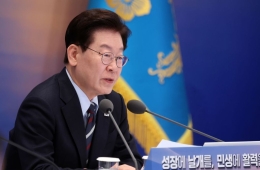
Lee Heonwook, president of the Korea Real Estate Board, stressed that the criteria for balanced national development policy should shift from allocating jobs to building talent ecosystems.
According to the Korea Real Estate Board on October 19, Lee recently gave a special lecture at Seongsan Hall at Daegu University, titled "Real Estate for Everyone, Great Cities," as part of a lecture series hosted by the Department of Real Estate at Daegu University's Graduate School. "For sustainable regional growth, building knowledge networks and talent ecosystems must come before increasing the number of jobs," he said. "Jobs are merely a report card showing a region's competitiveness."

Lee Heonuk, president of the Korea Real Estate Board (center), poses for a commemorative photo with attendees at the “Distinguished Guest Lecture for the Department of Real Estate, Graduate School of Daegu University,” held at Seongsan Hall at Daegu University on the 17th. Korea Real Estate Board
View original image"A country's competitiveness comes both from the quality of its cities and from the connections between them," Lee said. "A sustainable talent ecosystem can be built only when local universities, research institutions and businesses are closely connected so knowledge and talent can be exchanged, and when the living environment offers the education, transportation, medical care and culture that allow talent to stay and thrive."
He also proposed restructuring the country's spatial strategy by reorganizing the nation into "multi-centered, ultra-wide economic zones" focused on living and economic areas that cross administrative boundaries.
"Hub cities should not simply be places where jobs and industries are concentrated. They should become world-class knowledge hubs where universities, research institutions, businesses and talent connect to generate new knowledge and innovation," Lee said. "When these hubs are connected across wider regions, areas outside the Seoul metropolitan area can become real alternatives for talent and businesses now concentrated in the capital region."
Lee added, "The key to balanced national development is not allocating jobs among regions, but creating an environment where talent and businesses can choose regions for themselves. The focus of regional policy must shift to ecosystems where people and knowledge gather and connect."
Hot Picks Today
 Selling Like Crazy Every Year... 30-Year-Old Hetbahn Takes on a New Challenge: Tastes Better Than "Mom's Home Cooking" [On-Site Report]
- "Please Pay Me at Least 3 Million Won a Month": More Than Half of Young People Today Prioritize "Working Conditions" Over Company Size
- A 12-Year-Old Girl Went to the Hospital After Her Blood Pressure Hit 225 and Was Stunned: "What Is This Coral Reef-Like Thing in Her Aorta?"
- "Hey, Lady, Teach Your Kids to Behave!" ... 300,000 Won in Cash and a Bodily Injury Claim Demanded Over Child's Door Ding
- Beachgoer Finds 'Plastic' That Turns Out to Be Perfume Ingredient Worth More Than Twice as Much as Gold
"The Korea Real Estate Board will also continue to strengthen its role in supporting regional competitiveness and balanced development by closely monitoring local growth conditions and spatial changes," he said.
© The Asia Business Daily. All rights reserved. Unauthorized AI training and use prohibited.