Artificial Organs for Surgical Training, Vibration-Reducing Ship Propellers Win Republic of Korea Engineer Award
Aldeba CEO Kim Jino and Samsung Heavy Industries Professional Lee Taegu Selected
Artificial Organs Supplied to More Than 40 Countries... Propeller Excitation Force Cut by 20%
An entrepreneur who developed artificial organs for surgical training from natural materials derived from seaweed and crustaceans, and a researcher who reduced vibration by improving the shape of ship propellers, have been selected as recipients of the Republic of Korea Engineer Award.
The Ministry of Science and ICT and the Korea Industrial Technology Association announced on October 19 that Kim Jino, CEO of Aldeba, and Lee Taegu, a professional at Samsung Heavy Industries, had been selected as the October 2026 recipients of the Republic of Korea Engineer Award.

Kim was recognized for developing artificial organs and surgical simulators that mimic the elasticity of human tissue and its responses to incision and coagulation. To address the limitations of animal testing, which has traditionally been used to train medical professionals in surgery and treatment, he combined natural materials derived from seaweed and crustaceans with three-dimensional (3D) printing technology.
Aldeba was founded in 2022 by researchers from the Department of Materials Science and Engineering at the Korea Advanced Institute of Science and Technology (KAIST) through a government program supporting laboratory startups. The company has registered more than 20 domestic and international patents related to medical simulators and supplies its products to more than 40 countries, including the United States, Japan and India. It also works with global medical device companies, including Johnson & Johnson, and its revenue exceeded KRW 500 million last year.
"When medical professionals can receive effective training, patient safety and the quality of medical services can also improve," Kim said. "I will continue working to innovate medical education through new materials technologies developed in the laboratory."
Applying Aircraft Wing Technology to Ship Propellers
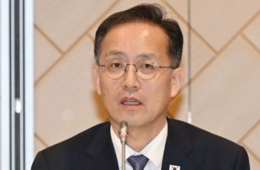
Lee Taegu, a professional at Samsung Heavy Industries' Daedeok Research Center, was recognized for improving propulsion performance by adapting the "winglet" structure used at aircraft wingtips for ship propellers.

Lee Taegu, senior engineer at Samsung Heavy Industries Co., Ltd. Provided by the Ministry of Science and ICT.
View original imageA winglet is a structure that reduces resistance by curbing vortex-like flows generated at a wingtip. Lee applied the design to the shape of ship propellers, reducing by 20% the excitation force that causes vibrations in a ship's hull. The improved shape also alleviated erosion, in which bubbles generated as the propeller rotates burst and damage its surface.
According to Samsung Heavy Industries, propellers using the technology achieved a propulsion efficiency of 85%. However, the improvement in efficiency compared with conventional propellers was not disclosed.
"I am pleased that our efforts to differentiate our technology in the shipbuilding and offshore industry have been recognized," Lee said. "I will continue contributing to maintaining world-class technological competitiveness."
Hot Picks Today
 [Exclusive] "Do I really need to hear an explanation?" Pick what you want and head straight to checkout... Misuse concerns mount, but the government is "in the dark"
- President Lee’s Approval Rating Rebounds to Upper 30s... Internal Strife Rocks Democratic Party and People Power Party [Asia Business Daily-Realmeter Poll]
- "I thought getting into a big company was the goal"... The 'position' only 1 in 121 employees reaches
- "'No! Dad, Run!'... Father Moved by 5-Year-Old Son Who Shielded Him from Ghost at Korean Folk Village"
- "Jealous of Koreans" - Now a Must-Do on Every Trip... The Place Where Foreigners Spent KRW 229.8 Billion
The Republic of Korea Engineer Award was established in 2002 to recognize engineers who contribute to technological innovation in industry. Each recipient receives a Minister of Science and ICT Award and KRW 5 million.
© The Asia Business Daily. All rights reserved. Unauthorized AI training and use prohibited.