AI Fears Mount Around 'KOSPI' as Bargain Buying Emerges (Roundup)
KOSPI Falls to Mid-5,000s Amid Concerns Over AI Investment Profitability
Foreign Investors Continue Net Selling as External Uncertainties Grow
Meta and Tesla's Third-Quarter Earnings on the 21st Key to a Rebound

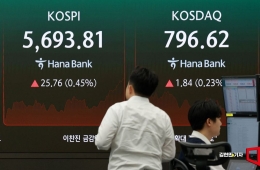
The KOSPI is displayed on an electronic board at Hana Bank's dealing room in Jung-gu, Seoul, on Oct. 19, after opening down 179.64 points, or 3.17%, at 5,488.41. The KOSDAQ opened down 21.72 points, or 2.73%, at 773.06. Oct. 19, 2026. Photo by Kim Hyunmin
View original imageThe KOSPI, which opened sharply lower amid concerns about the profitability of artificial intelligence (AI) investments, is attempting a rebound as bargain hunters step in. However, analysts say further declines in the KOSPI will be unavoidable if doubts about AI persist. Some expect earnings reports from U.S. big tech companies, including Meta and Tesla, scheduled for this week to provide a catalyst for a market turnaround.
AI Profitability Concerns Push KOSPI Down to the Mid-5,000s
The KOSPI opened at 5,488.41 on Monday, down 3.17% from the previous trading day, before reversing course. As of 10:23 a.m., it was trading at 5,698.63, up 0.54%. At the same time, the KOSDAQ was up 0.18% from the previous session at 796.24.
The KOSPI fell 14.4% last week, posting its biggest weekly decline of the year. On October 15, the KOSPI and KOSDAQ plunged by more than 7% each, triggering circuit breakers.
The early weakness in the Korean stock market on Monday reflected the impact of all three major U.S. stock indexes closing lower last Friday, as concerns about AI profitability came to the fore. The Dow Jones Industrial Average fell 0.34% from the previous session, while the S&P 500 and the tech-heavy Nasdaq Composite declined 1.09% and 2.15%, respectively. The Philadelphia Semiconductor Index plunged 3.83%. It fell for an eighth consecutive trading day, marking its longest losing streak since the U.S.-originated financial crisis of 2008.

The renewed focus on the credit risk of AI cloud provider CoreWeave (-11.91%) has been a major factor behind recent declines in domestic and overseas stock markets. Some analysts say the company has entered distressed territory, with the value of its corporate bonds plunging amid excessive debt. Micron (-5.63%), Broadcom (-4.52%), SK hynix American depositary receipts (-6.58%), and AMD (-5.95%) also fell sharply.
Samsung Electronics, which had plunged more than 6% early in the session, led the KOSPI's reversal, trading up 1.16% at 218,000 won as of 10:25 a.m. Its preferred shares, which gained on expectations of share buybacks and cancellations as well as dividends, were trading up 3.29% at 172,700 won. Other semiconductor stocks, including SK hynix (-2.12%), SK Square (-1.91%), and Samsung Electro-Mechanics (-4.04%), were weak. By contrast, battery-related stocks were strong, including LG Energy Solution (3.60%), Samsung SDI (3.21%), EcoPro (2.34%), and EcoPro BM (1.50%). Foreign investors were net sellers of about 30 billion won worth of KOSPI shares, while individual investors were net sellers of 390 billion won. Institutions were net buyers of 300 billion won.
Analysts say the KOSPI, which has a high weighting of memory chipmakers, will remain on a downward trend if concerns about AI persist. Some have raised the possibility that the index could fall below 5,000 in the worst-case scenario. Jo Ain, an analyst at Samsung Securities, identified 5,000 as a support level, saying, "Investor sentiment has deteriorated sharply, and heightened volatility may persist in the short term." She added, "Until foreign selling subsides and external uncertainties ease, it would be appropriate to avoid aggressively increasing exposure and focus on risk management."
Lee Jaeman, head of the Global Investment Analysis Office at Hana Securities, said, "The current downturn is expected to attempt a W-shaped rebound, with the second low estimated at around 5,300." He added, "For the KOSPI to turn around, oil prices, interest rates, and exchange rates need to stabilize, and foreign selling needs to subside."

Upward Revisions to U.S. Big Tech Earnings Forecasts Seen as Key to Rebound
Markets are watching earnings reports for the third quarter from major U.S. companies scheduled for this week, October 19-23. Analysts say the stock market could find a catalyst for a turnaround if U.S. big tech companies report earnings above expectations.
Meta and Tesla will report earnings after the U.S. market closes on October 21. Meta's expected revenue is about $63.3 billion. Its recently launched AI agent, Muse, has received favorable reviews, but the key question is whether the company can absorb the cost burden from increased investment in AI infrastructure.
Tesla is expected to report revenue of $27.9 billion and earnings per share (EPS) of $0.45. Although third-quarter vehicle deliveries exceeded market expectations, the profitability of its automotive business and the investment burden of its autonomous-driving and robotaxi businesses are seen as key variables. Major technology companies including IBM, Texas Instruments, and Lam Research will also report earnings on the same day. Their results are seen as key indicators of future semiconductor demand and capital investment prospects.
Han Jiyoung, an analyst at Kiwoom Securities, said, "Third-quarter earnings from U.S. big tech companies such as Meta, Tesla, and Lam Research will be an important test of whether market confidence in AI can recover." She noted, "For Meta in particular, the key question is not just whether it delivers an earnings surprise or raises its capital expenditure (CAPEX) guidance, but whether AI-driven improvements in advertising efficiency can translate into revenue growth in its core business."
Hot Picks Today
 [Exclusive] "My paycheck fell short, and I couldn't get a card loan either" More people in their 40s and 50s turn to 'cash advances'; "debt-investing woes" put long-term delinquency among those in their 20s and 30s on red alert
- "It Just Flies, So Why Keep Blasting Air?"... Startup Says Tesla Is Still No. 2
- "May Have Only Two Weeks to Live"... Bukangi Hits Head Against Wall: What's Going On?
- "Never Fall for a Pretty Woman"... OpenAI on High Alert After Listening Device Found in Toilet Paper, Warns of Industrial Espionage
- "Come Live With Me on My Farm": Man Sells Everything and Travels 1,930 km, Trusting a Beautiful Woman
Kyle Rodda, a senior analyst at Capital.com, told Bloomberg, "This is a time of heightened market uncertainty." He added, "With AI companies' earnings reports approaching, uncertainty over interest rates continues, and the U.S. midterm elections are just a few weeks away."
© The Asia Business Daily. All rights reserved. Unauthorized AI training and use prohibited.