Lee Hyungil: "Growth in the mid-3% range this year... will end the second-half economic strategy and increase forecasts from twice to three times a year"
Signals a shift in key tax policies following real estate measures
Optimistic on macroeconomy, sees potential growth rebound nearing
Ends second-half growth strategy, shifts to on-demand responses... expands sovereign wealth fund's reach
Lee Hyungil, Deputy Prime Minister and Minister of Finance and Economy, signaled a flexible shift in the government’s position on tax policy, stepping back from its previous stance on other tax issues after proposing conditional tax benefits for privately rented apartments. Regarding taxation of virtual assets, which is scheduled to take effect in 2027, Lee said, “As I answered during the parliamentary audit, I said I would listen once again to the views of various people, and I am continuing to do so. We will make a decision after reviewing those opinions.” He also said, “We will communicate with electric vehicle manufacturers and hear their views,” adding, “I plan to visit a production site in early November to hear from them.” In its tax reform proposal, the government previously selected six sectors for the domestic production tax credit. Electric vehicles were left off the list, prompting continued calls from the related industry to include them.
Macroeconomic optimism... sees growth in the mid-3% range and exchange rate returning to normal

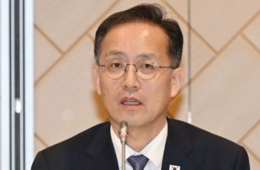
Lee Hyung-il, Deputy Prime Minister and Minister of Finance and Economy, meets with reporters on Oct. 16 (local time) in Bangkok, Thailand, where he is attending the IMF-World Bank Annual Meetings, the G20 Finance Ministers and Central Bank Governors Meeting, and the G7 Finance Ministers and Central Bank Governors Meeting. Ministry of Finance and Economy.
View original imageWhile showing flexibility on tax issues, Lee struck an optimistic note on macroeconomic indicators. “After rising sharply to 1.8% in the first quarter and 0.6% in the second, exports and facility investment are also performing very well in the third quarter,” he said. “Unless an external event with a major impact occurs during the remaining period, growth of 3.4% to 3.6%—in the mid-3% range—may be possible.” That would exceed both the government’s 3.0% growth forecast in its second-half economic growth strategy and the 3.3% forecast recently issued by the International Monetary Fund (IMF).
“Demand for semiconductors remains high, but supply is insufficient, so efforts to close the supply gap are continuing,” Lee said. “Looking at recent growth and its composition, potential growth could rebound after breaking out of its ongoing downward trend, and I believe that time is approaching.” Commenting on the won-dollar exchange rate, which recently hit its lowest level in nearly two years, he said, “It reached 1,550 won in July, but that level was actually out of line with our economic fundamentals. The exchange rate is now in the process of returning to levels consistent with those fundamentals.”
Lee also highlighted the results of using excess tax revenue to stabilize the government bond market. “We used KRW 5 trillion in excess tax revenue to reduce government bond issuance. While interest rates have risen in other countries, ours have fallen, so we are seeing the effects of having reduced the volume of issuance at the time,” he said. On further measures, he said, “In addition to a KRW 3.5 trillion buyback, we plan to continue monitoring market conditions and decide on the scale of any emergency buybacks.”
With the fundamentals of the economy confirmed, the government’s approach to economic policy will also undergo a major overhaul. “Starting in 2027, we will increase the number of economic forecasts from twice a year to about three times a year,” Lee said. “Rather than undertaking another large-scale exercise, it makes more sense to make the forecasts more accurate and develop responses to areas requiring additional support.” He added, “I don’t think we will see an economic growth strategy bearing the name ‘second half’ in 2027,” formally confirming the end of the second-half economic growth strategy and a shift to an on-demand response system.
On market volatility: “We will mobilize every tool, including the market stabilization fund, if necessary”

Lee Hyeongil, Deputy Prime Minister and Minister of Finance and Economy, meets with reporters on Oct. 16 (local time) during a visit to Bangkok, Thailand, to attend the IMF-World Bank Annual Meetings, the G20 Finance Ministers and Central Bank Governors Meeting, and the G7 Finance Ministers and Central Bank Governors Meeting. Ministry of Finance and Economy.
View original imageRegarding the recent sharp decline in the domestic stock market, Lee said, “It seems to be undergoing a correction amid concerns that global interest rate increases could become more frequent, questions about whether returns on investment in artificial intelligence (AI) and semiconductors can be sustained, and geopolitical risks in regions such as the Middle East.” However, he added, “Given the large current account surplus and other factors, our economy and stock market remain solid.” Asked about the possibility of short-term measures, such as deploying the market stabilization fund or temporarily banning short selling, he said, “We will use the tools available to us if necessary.” He added, “If we discuss them in advance, they may become less effective, so we will announce them at the most appropriate time as part of our market management efforts.”
On the polarization that prevents the benefits of economic growth from reaching society as a whole, Lee expressed his commitment to “pursuing three major social policies: housing, jobs, and financial services for ordinary people.” The Deputy Prime Minister will also personally oversee the Yeongnam regional initiative, one of three mega-projects, and lend it his support. “Unlike the southwestern and Chungcheong regions, which are overseen by the Ministry of Trade, Industry and Energy, the Ministry of Finance and Economy is responsible for the Yeongnam region,” Lee said. “I plan to directly oversee the Yeongnam Mega-Project Task Force and swiftly address its key challenges.”
Hot Picks Today
 "I Should Enjoy It After Retirement": Prices Quadruple... Memberships Over 100 Million Won Popular, but Closures Mount
- "I thought getting into a big company was the goal"... The 'position' only 1 in 121 employees reaches
- "Jealous of Koreans" - Now a Must-Do on Every Trip... The Place Where Foreigners Spent KRW 229.8 Billion
- “I Bought Big Packs to Stock Up Because They Were a Better Deal”... Why Are They Disappearing From Grocery Stores?
- "Please Let Me Go Home"... Customers Trapped in Department Store Parking Lot for 5 Hours Vent Their Anger
Regarding the creation of a Korean sovereign wealth fund, Lee said, “I met with the finance ministers of Saudi Arabia and Singapore and heard about how they operate their sovereign wealth funds. They said we should work together once the law is passed, and their response was very positive.” He added, “Even when foreign sovereign wealth funds want to invest in Korea, it can be difficult for them to understand the country, so they want someone to join them as an anchor investor. A sovereign wealth fund is what they want most.” An anchor investor is a major investor that accounts for a large share of an investment and has a significant influence on the decisions of other investors.
© The Asia Business Daily. All rights reserved. Unauthorized AI training and use prohibited.