National Museum of Korea Draws 6.5 Million, Faces Mounting Woes Ahead of Audit, Including Yoo Hongjun's "Pro-Japanese Collaborator's Calligraphy" Controversy
Oct. 19 parliamentary audit by the Culture, Sports and Tourism Committee to focus on the director's personal collection and how it was verified
"Ilbansigukeun," once attributed to an independence activist, confirmed as the work of pro-Japanese collaborator Park Jung-yang
BLACKPINK fan meeting access restrictions, MU:DS copyright issues and paid admission for permanent exhibitions also on the agenda
Visitors up 72% in a year; expanding facilities and artifact storage emerge as key issues
The National Museum of Korea, which emerged as one of the country's leading cultural attractions after welcoming more than 6.5 million visitors last year, is facing a series of controversies ahead of the parliamentary audit. It has emerged that an artifact displayed as the calligraphy of a Korean independence activist, but later found to be the work of a pro-Japanese collaborator, was part of National Museum of Korea Director Yoo Hongjun's personal collection. The controversy comes amid other issues, including restrictions on exhibition spaces for a BLACKPINK fan meeting, copyright concerns involving the popular cultural merchandise brand MU:DS, overcrowded storage facilities, and debate over charging admission for permanent exhibitions. The museum's overall operations and management are expected to become major issues in the audit.

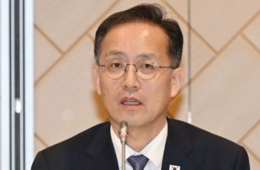
Yoo Hongjun, director of the National Museum of Korea, apologizes for the exhibition of calligraphy attributed to Park Wongun at the museum's auditorium in Yongsan-gu, Seoul. The museum removed the exhibit after an investigation found that the work, which it had introduced as the calligraphy of independence activist Park Wongun, was actually by a person with the same name who was known to have collaborated with Japan. Yonhap News Agency
View original imageAccording to the National Assembly's Culture, Sports and Tourism Committee, a parliamentary audit will begin at 10 a.m. on October 19 into 26 public and related institutions under the Ministry of Culture, Sports and Tourism, including the National Museum of Korea, the National Library of Korea, and the National Traditional Arts Middle and High School. Questions are expected to focus in particular on how Director Yoo recommended his own collection for display at the museum and why the creator of the work was misidentified.
At the center of the controversy is the calligraphy work "Ilbansigukeun," meaning "Even a single bowl of rice is the nation's grace," which was included in the special exhibition "Our Table" that opened in July 2026. It was initially introduced as the work of Park Wonkeun (1912-1950), a Korean independence activist from Boeun, North Chungcheong Province.
However, questions arose over whether the name "Park Wonkeun" written on the work was an alias used by Park Jung-yang (1874-1959), a pro-Japanese collaborator and anti-national actor. The museum removed the work on August 10, 2026, and began a new investigation. After verification by seven experts in calligraphy, modern and contemporary history, ancient documents, and conservation science, the museum concluded on September 7 that the work was by Park Jung-yang.
The issue also concerns who owned the work and how it was selected for the exhibition. According to documents submitted by the National Museum of Korea to Rep. Jeong Yeonuk of the People Power Party, a member of the National Assembly's Culture, Sports and Tourism Committee, the artifact was part of Director Yoo's personal collection. He had won it at an online auction in 2019 for 50,000 won.
In a written response submitted to the lawmaker's office, the museum said, "The work was borrowed and used in the exhibition through the proper procedures, following a recommendation by the director." The museum's explanation was that, because no personal belongings of independence activist Park Wonkeun had survived, it had identified the artist based on information including the owner's account.
Confirmation that Director Yoo both recommended and owned the work has intensified questions about whether the National Museum's artifact-verification process was appropriate. Key issues include the extent to which the museum director's personal judgment influenced the decision to exhibit the work and whether an independent verification process was in place when it was borrowed.
Before a special lecture on September 10, 2026, Director Yoo apologized, saying, "Failing to correctly understand the artifact's meaning was a lack of competence and a mistake." The museum also acknowledged shortcomings in its verification process and said it would develop measures to prevent a recurrence.
However, the museum did not disclose that the work was part of Director Yoo's personal collection while issuing apologies on several occasions. The museum said it had withheld the owner's information in accordance with the Personal Information Protection Act and the International Council of Museums (ICOM) Code of Ethics. It also said Director Yoo had purchased the work with the intention of donating it to the Buyeo area and had previously donated 865 works, including paintings, calligraphy, and ceramics, to support the establishment of the Buyeo County Art Museum.
The museum plans to strengthen its procedures to ensure adequate verification when it uses previously undisplayed works from private collections in exhibitions.
The BLACKPINK fan meeting held at the National Museum of Korea in August 2026 to mark the group's 10th debut anniversary may also be raised during the parliamentary audit. The event was for 40 fans selected through a lottery. Claims have been made that general visitors were barred from some exhibition spaces and that the event affected the schedule of existing educational programs.
The museum posted a notice on its website the day before the event saying that access to some exhibition spaces might be adjusted. However, it was criticized for not providing sufficient information about the event's name or the specific scope of the restrictions. A request for an audit was subsequently filed with the Ministry of Culture, Sports and Tourism, asking it to examine the approval process for the fan meeting, whether a facility-use fee was charged, and whether the restrictions on visitors were appropriate.
The complaint was assigned to the ministry's audit office; no audit has actually begun, and no unlawful or improper administrative action has been established. Key issues include the rental standards for private events at public cultural facilities and how to balance such events with the public's right to use those facilities.
Intellectual property issues surrounding MU:DS, the cultural merchandise brand operated by the National Museum Foundation of Korea, are also drawing attention. MU:DS generated more than 40 billion won in sales last year and has become one of the museum's signature success stories. However, questions have arisen over the scope of design-right protection for products that draw on cultural heritage, as well as disputes among vendors.
In August 2026, it became known that companies were involved in a legal dispute over the design rights to a brooch modeled on a Silla gold crown. Objections were raised after the foundation sought to place a product with a similar design in the museum shop. The foundation said it had suspended sales of subsequently registered products until a court ruling was issued.
Concerns have also been raised about counterfeit versions of popular MU:DS products, including miniature figurines of the Pensive Bodhisattva and a dancheong-patterned keyboard, being sold on overseas online shopping sites, including those in China. The foundation signed a business agreement with the Korea Copyright Commission and the Korea Copyright Protection Agency last year to strengthen intellectual property protection.
Expanding facilities to accommodate the growing number of visitors is another major challenge. According to data submitted by the National Museum of Korea to Rep. Lim Ohkyung of the Democratic Party of Korea, the museum received 6,507,483 visitors last year, an increase of about 72% from 3,788,785 in 2024. The number of visitors has continued to rise this year, prompting calls for mid- to long-term measures to address overcrowding and shortages of parking and other amenities.
The National Museum of Korea moved its opening time forward from 10 a.m. to 9:30 a.m. in March 2026. It plans to pilot an online reservation and ticketing system in the first half of 2027. However, some say that responding to the increase in visitors will require expanding space, staffing, and visitor amenities, rather than relying only on temporary changes to operating hours.
Charging admission for permanent exhibitions is also expected to be discussed again. At last year's parliamentary audit, Director Yoo acknowledged the need to charge for permanent exhibitions and said the timing and method were under consideration. The National Museum of Korea has offered free admission to its permanent exhibitions since May 2008, while charging admission only for some special exhibitions.
While some have called for generating revenue and improving the visitor experience through paid admission, others are concerned that doing so could restrict the public's greater access to culture, which free admission has made possible. No start date or admission fee for permanent exhibitions has been decided.
Insufficient storage for artifacts is also a pressing issue across the museum sector. According to data obtained by Rep. Kim Yundeok of the Democratic Party of Korea, storage capacity utilization has already exceeded appropriate levels at the National Palace Museum of Korea, at 171%; the Seoul branch of the National Museum of Modern and Contemporary Art, Korea, at 152.8%; and the National Jeonju Museum, at 113.3%. The stacks at the main building of the National Library of Korea were also at 100.74% capacity.
Construction projects for the National Art Storage and Conservation Center in Daejeon and a storage facility in Gyeongsan are undergoing feasibility reassessments due to rising project costs. As a result, their target completion date has been pushed back from 2027 to 2030. No budget for the related projects was included this year.
Rep. Kim plans to call for a joint survey of the institutions, a plan to expand storage facilities, and more regional shared storage facilities, saying that differences in how each institution calculates storage capacity make it difficult to accurately assess the country's overall storage capacity.
Hot Picks Today
 [Exclusive] "Do I really need to hear an explanation?" Pick what you want and head straight to checkout... Misuse concerns mount, but the government is "in the dark"
- President Lee’s Approval Rating Rebounds to Upper 30s... Internal Strife Rocks Democratic Party and People Power Party [Asia Business Daily-Realmeter Poll]
- "I thought getting into a big company was the goal"... The 'position' only 1 in 121 employees reaches
- "'No! Dad, Run!'... Father Moved by 5-Year-Old Son Who Shielded Him from Ghost at Korean Folk Village"
- "Jealous of Koreans" - Now a Must-Do on Every Trip... The Place Where Foreigners Spent KRW 229.8 Billion
The National Museum of Korea has achieved some of the most notable results among the country's cultural institutions, including surpassing 6.5 million visitors last year and the success of MU:DS. During the parliamentary audit, scrutiny is expected to focus not only on those achievements but also on accountability for the museum's overall management, including the credibility of its exhibition verification, equitable access to public facilities, protection of rights to cultural products, and capacity to accommodate visitors.
© The Asia Business Daily. All rights reserved. Unauthorized AI training and use prohibited.