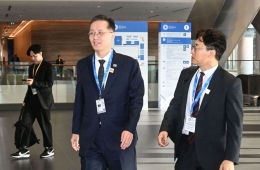
[Monetary Policy Board Poll] 1. "A hoe has already done the job" ... Hold rates this month, hike again in November
Asia Business Daily survey of 13 domestic and foreign economic experts
12 (92.3%) expect "October rate hold"... 6 expect a unanimous hold
Assessing the effects of preemptive back-to-back hikes; won's decline also weakens case for a hike
"Next hike in November"... Most see rates at 3.25% at year-end and 3.50% at the end of next year
U.S. rates to rise to 4.25% by year-end... Further hikes next year hinge on inflation and other factors
With the Bank of Korea Monetary Policy Board set to decide on the base rate on Oct. 22, most experts predicted it would hold the rate steady at 3.00% per year. Most respondents said that, after raising rates in July and August, the BOK would likely pause this month to assess the effects of the hikes.
The prevailing view was that the next hike would come in November, when the final rate decision of the year is scheduled. Most experts expected the rate-hiking cycle to continue next year, with the terminal rate reaching around 3.50%. Some also predicted that rates could rise as high as 3.75%.

Bank of Korea Governor Shin Hyun-song answers reporters' questions at a press conference following the Monetary Policy Board meeting on the policy direction at the Bank of Korea in Jung-gu, Seoul, on the morning of Aug. 27. Photo by Joint Press Corps
View original image"A stitch in time saves nine... no need for a spade: October hold to assess effects of back-to-back hikes"
In a survey conducted from Oct. 13 to 16 by The Asia Business Daily of 13 economists at domestic and foreign economic research institutes, securities firms and banks, 12 respondents (92.3%) expected the rate to remain at 3.00% this month. Six of them expected a unanimous decision to hold. Four thought there would be a minority opinion in favor of a hike, with most predicting that one board member, including Jang Yongseong, would dissent.
Those expecting a hold this month said that "a hoe has already done the job, so there is no need for a spade." Given that the BOK's July and August rate hikes were preemptive measures, they expected the central bank to pause for a beat in October and assess the effects of back-to-back hikes rather than raise rates again. They also said that a decline in the won-dollar exchange rate and the easing of additional upside pressure on prices, with the September core inflation rate falling to 2.8%, below 3%, had weakened the case for a hike this month.
Yoon Yeosam, a researcher at Meritz Securities, said, "The consecutive hikes have created room for maneuver in monetary policy, allowing the BOK to assess whether inflation is stabilizing and how vulnerable borrowers are affected by the consecutive hikes." He added, "Nonetheless, the BOK will emphasize the need for further rate increases, given the sound economic fundamentals." He expected the BOK to voice concern about improving domestic demand and rising demand-driven inflation, underpinned by an export boom led by semiconductors.
Jo Yonggu, a researcher at Daishin Securities, also said, "With real economic conditions improving rapidly enough to prompt a substantial upward revision to growth forecasts, and inflation expected to remain above target for a considerable period, the rate-hiking stance and cycle remain in place." He added, "The BOK is likely to see a need for a kind of pause to assess the effects of the consecutive hikes already implemented."
Some experts expected a rate hike this month. Han Junhee, a senior researcher at the NH Financial Research Institute, focused not on the fact that the September core inflation rate had fallen to 2.8%, but on the fact that it remained high. He said, "Demand-side price pressures are expected to intensify amid the semiconductor export boom and the launch of large-scale investment projects, so the BOK will make a preemptive additional rate hike this month."

"Next hike in November"... factoring in the possibility of a higher neutral rate
All 12 experts who expected a hold this month picked November as the timing for the next hike. Baek Yunmin, a researcher at Kyobo Securities, said, "We initially expected the rate-hiking cycle to end with an additional hike in the first quarter of next year. However, the likelihood of another rate hike by the U.S. Federal Reserve this year has increased since the September Federal Open Market Committee (FOMC) meeting. We therefore believe the BOK is now more likely to make one more rate hike this year, in November, to maintain the effects of its preemptive rate increases." Jo Yonggu, a researcher at Shinyoung Securities, said, "Taking into account strong growth, the BOK's concerns about demand-side inflation, its preference for preemptive financial stability measures, and the possibility of a higher neutral rate, monetary policy will remain restrictive overall, while maintaining the principle of providing targeted support to vulnerable sectors through fiscal policy."
Ahn Jaegyoon, a researcher at Korea Investment & Securities, said, "Factors supporting an additional rate hike remain, including continued increases in core goods prices, particularly for durable goods; the continued strong contribution of services prices to inflation; and the possibility that third-quarter gross domestic product (GDP) growth will exceed expectations." Heo Munjong, head of the Woori Financial Research Institute, also said "the BOK will raise rates again in November to stabilize inflation expectations, given core inflation above target, solid growth, rising home prices and the accumulation of household debt."

3.25% at year-end and 3.50% at the end of next year... 3.75% also possible due to inflation
All 13 experts expected the base rate to stand at 3.25% at the end of this year, 0.25 percentage points (25 basis points) above its current level after one more hike. The prevailing forecast was for the terminal rate next year to be 3.50% (11 respondents, 84.6%). Yoon said, "Stronger-than-expected export growth is likely to raise this year's economic growth forecast from 3.3% to as high as 3.6%, and next year's forecast from 2.9% to 3.1%. The BOK governor has also acknowledged the possibility of a higher neutral rate in line with the stronger growth trajectory, making another hike in November necessary." He added, "Although the government is controlling prices through a cap on the maximum price of oil, inflation is bound to remain above target through the first half of next year. As a result, the pace of rate hikes is likely to accelerate beyond the one hike in six months indicated by the dot plot."
Some predicted that rates would rise to 3.75% next year. Han said, "We expect another hike in the first half of next year as price pressures persist amid the semiconductor boom and increased investment." He added, "If price pressures continue after that, there is a possibility of one more hike."

"Inflation response": U.S. rates to rise to 4.25% by year-end... divided outlook for next year
Most respondents, 10 (76.9%), expected the U.S. policy rate, currently at an upper bound of 4.00%, to rise once more this year to 4.25% by year-end (three did not respond). The analysis was that another hike this year would be needed, as indicated by the dot plot, to address inflation. Moon Hongcheol, a researcher at DB Securities, said, "High inflation and the impact of investment in artificial intelligence (AI) will lead the United States to raise rates once more before the end of the year." Kang Seungwon, a researcher at NH Investment & Securities, also predicted a December hike, saying, "A prolonged war has made it necessary to respond to an extended period of inflation caused by supply shocks."
Hot Picks Today
 "Who'd Have Thought Gangnam, Real Estate's Undisputed No. 1, Would Be Overtaken?"... The Neighborhood Buyers Flocked to With Money in Hand [Real Estate A to Z]
- SpaceX Is Entering the Telecom Business... Will South Korea's Big Three Carriers Go Bust? [Weekend Money]
- Kim Younggwon Loses Suit to Cancel 800 Million Won in Comprehensive Income Tax; Supreme Court: "Country-by-Country Credits"
- "I Pay for Comfort"... China's Gen Z Secretly Spend Hundreds of Thousands of Won to Unburden Themselves [China.zip]
- "I Used to Eat This All the Time in Korea..." What Is This Snack Winning Over Taste Buds Worldwide? [K-Holic]
However, forecasts for the U.S. terminal rate next year were divided. Five respondents (38.5%) expected rates to rise to 4.25% by the end of this year and remain at that level next year. Three predicted a further 50 basis points of hikes next year, in two 25-basis-point increments, bringing the rate to 4.75%, while two forecast one more hike to 4.50%. Experts said that the path of developments in the Middle East and elsewhere, efforts to contain inflation expectations, and trends in growth and employment would determine whether the United States raises its policy rate further.
© The Asia Business Daily. All rights reserved. Unauthorized AI training and use prohibited.