Housing Prices, Han River Bus Dispute and Appeal Ruling... Oh Sehoon Faces a Hectic Week
Ruling and opposition parties to clash over housing supply and rising home prices on Oct. 19
Probe into alleged misuse of Han River Bus project funds and cover-up
Oh Sehoon’s appeal ruling due Oct. 23... All eyes on the outcome

Seoul Mayor Oh Sehoon is lost in thought during the 2026 parliamentary audit of the Seoul Metropolitan Government by the National Assembly's Public Administration and Security Committee, held at Seoul City Hall in Jung-gu, Seoul, on October 15, 2026. Photo by Kang Jinhyung.
View original imageThe ruling and opposition parties are set to continue their dispute over who is responsible for rising home prices at the Seoul Metropolitan Government's parliamentary audit on Oct. 19. The ruling party is expected to criticize Seoul Mayor Oh Sehoon for blaming the government for instability in the real estate market while ignoring his own authority and responsibility. Oh, in turn, is expected to argue that the government's owner-occupier-focused policies have fueled demand to buy homes. Allegations surrounding the Han River Bus project, which have recently emerged as an issue, and Oh's legal troubles are also major points of contention.
According to the National Assembly and the Seoul Metropolitan Government on Oct. 18, the National Assembly's Land, Infrastructure and Transport Committee will split its audit teams into Team 1 and Team 2 on Oct. 19 to audit the Seoul Metropolitan Government and Gyeonggi Province, respectively. Rising home prices are a major agenda item in the audit of Seoul. At the Seoul audit held by the National Assembly's Public Administration and Security Committee on Oct. 15, Democratic Party of Korea lawmakers criticized Oh, saying, "He is focused solely on private-sector housing supply and shows little commitment to policies for ordinary people and young people, such as public housing," and, "It's all the mayor's responsibility, but he keeps blaming others, saying, 'It's the central government's fault.'"
Oh, meanwhile, criticized what he called policy failures by the Lee Jae-myung government. "The most important thing is whether Seoul residents can have a clear outlook and confidence about housing supply," Oh said. He countered, "Because residents lack confidence [in housing supply], pent-up demand has emerged, with people thinking, 'I should buy before prices rise further.'"
Ahead of the Land, Infrastructure and Transport Committee's audit, the Seoul Metropolitan Government also revived the debate over responsibility borne by the late former Seoul Mayor Park Won-soon. At a briefing on Oct. 16 at Seoul City Hall to publish a white paper titled "A 20-Year Review and Reflection on Seoul's Housing Supply Policies," the city stressed that housing policies under Park had contributed to today's price instability. The white paper's main finding is that the cancellation of 389 redevelopment zones during Park's term, from 2012 to 2020, eliminated the foundation for supplying as many as 430,000 homes.
The Seoul Metropolitan Government said there was no special intention behind the timing of the white paper's publication. However, some analysts say the city is making a preemptive move ahead of the Land, Infrastructure and Transport Committee's audit, where a fierce battle over housing supply is expected. As the government, the ruling party and the Seoul Metropolitan Government continue to trade blame over the city's housing supply, the dispute between the ruling and opposition parties is expected to intensify at this audit.
Allegations surrounding the Han River Bus project, the biggest point of contention at the Public Administration and Security Committee's audit, are also expected to be revisited. The Democratic Party of Korea has raised the possibility that some of the project funds paid to Gadeok Heavy Industries, the company that built the Han River Bus, flowed to a senior executive at Seoul Housing & Communities Corporation (SH), an entity under the Seoul Metropolitan Government. It has also accused Oh of covering up the matter. The Seoul Metropolitan Government said on Oct. 16 that, as the controversy grew, it had halted its own audit and formally asked the police to investigate.

Seoul Mayor Oh Sehoon waits for the audit to begin after appearing at the 2026 National Assembly Public Administration and Security Committee audit of the Seoul Metropolitan Government at Seoul City Hall in Jung-gu, Seoul, on the 15th. Oct. 15, 2026. Photo by Kang Jinhyeong.
View original imageThe ruling party, however, is focusing on the fact that the Seoul Metropolitan Government had not asked for an investigation despite having learned of the allegations in advance. Referring to related media reports, Democratic Party lawmaker Park Jumin said, "The reports say that the results of the internal investigation were directly reported to Mayor Oh and that there had been discussion of requesting an investigation, but no request was made. They also say that related briefing materials and the request for an investigation were destroyed."
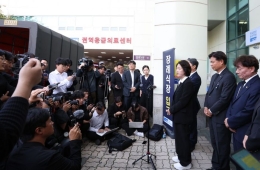
Democratic Party lawmakers on the Land, Infrastructure and Transport Committee announced plans for close scrutiny, calling for key figures in the case to be added as witnesses and for the submission of relevant documents. At a press conference at the National Assembly's Communication Hall on Oct. 16, lawmaker Heo Young said, "The People Power Party should cooperate in summoning additional witnesses, including the investigation division chief at the time and the former head of the Han River project task force, as well as having the public-interest whistleblower appear as a reference witness." He added, "The Seoul Metropolitan Government should submit key documents to the National Assembly, including the audit status report and the request for an investigation."
Hot Picks Today
 "I Ate It Often Because It Tasted Good"... This Eating Habit Linked to 40% Higher Odds of Asymptomatic Cerebrovascular Damage
- “Dad Just Gave It to Us as a Gift”... Scratched a Lottery Ticket at a Family Gathering and Hit a 1 Billion Won Jackpot
- "She's 7..." President Lee Left Speechless, Posthumously Awards Medal to Firefighter Killed in the Line of Duty
- Woman in Her 70s Assaults Sister in Her 80s: “She Had an Affair with My Husband”
- "We've gone this far to save on lunch"... Where office workers are flocking instead of restaurants
Even after the parliamentary audit concludes, the Seoul Metropolitan Government will find it difficult to let its guard down. An appellate court is scheduled to deliver its ruling on Oct. 23 in the case involving allegations that Oh had a businessman cover the cost of opinion polls conducted by Myung Tae-kyun. The trial court found Oh guilty of asking Myung to conduct five polls and arranging for businessman Mr. Kim, described as a longtime supporter, to cover their 21 million won cost. Oh was sentenced to a 10 million won fine. If the ruling is upheld, Oh will lose his office and be barred from running in the next presidential election.
© The Asia Business Daily. All rights reserved. Unauthorized AI training and use prohibited.