"Where You're Born Shouldn't Be a Limitation"... Choi Jeonghun Takes Aim at 'Educational Justice' with Data
Congratulatory Remarks at the Jeonnam Education Longitudinal Data Academic Conference
"Eight Years of Data Are a Compass for Legislation and Budgets," He Emphasizes
Choi Jeonghun, Chair of the Education Committee of the Jeonnam-Gwangju Integrated Special City Council, stressed the need for ordinances and budget support to help students grow and transform schools, drawing on eight years of accumulated education data.
His remarks reflected a strong commitment to ensuring equity in educational opportunities so that children can enjoy the best possible learning and care wherever they live, even as the region faces the threat of population decline.

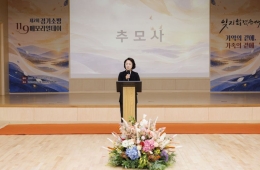
Choi Jeonghun, Chair of the Education Committee of the Jeonnam-Gwangju Integrated Special City Council.
View original imageChair Choi made the remarks on October 16 at the 4th Jeonnam Education Longitudinal Data Academic Conference, held at the Suncheon Bay Ecological Culture Education Center. Organized by the Education Policy Research Institute of the Jeonnam-Gwangju Integrated Special City Office of Education's Education Research and Information Institute, the event was held to share research findings from the Jeonnam Education Longitudinal Data collected from 2018 to 2025 and explore ways to apply the findings in the field and use them as a basis for policymaking.
"The core of legislative activities is to represent residents' voices and provide the right budget and systems where they are needed most," Chair Choi said. He described the long-term Jeonnam Education Longitudinal Data as "an invaluable legislative compass for the council as well."
He praised the value of data that has tracked students' psychological and emotional well-being, learning gaps, multicultural acceptance, and changes in schools over an extended period. He emphasized that the educational needs identified through research should be reflected in concrete policies and financial support.
He drew particular attention by identifying "equity in educational opportunities" as a key direction for education policy in line with the integration of Jeonnam and Gwangju. "True educational justice means ensuring that children can enjoy the best possible learning and care wherever they live, regardless of where they were born, amid the crisis of population decline in local regions and a sharp drop in the school-age population," Chair Choi said, underscoring the importance of closing educational gaps stemming from regional and circumstantial differences.
He also pledged to make the proposals put forward at the conference his top priorities in his legislative activities.
Specifically, he said he would devote every effort to legislative and budgetary support to ensure the stable implementation of policies urgently needed in the field, including building AI and digital learning environments, strengthening psychological safety nets, guaranteeing basic academic skills, and supporting multicultural education.
Hot Picks Today
 "Samsung Electronics Employees Commute by Shuttle Bus"... More Than 5,000 Homes to Be Supplied in Seoul and Busan [Real Estate A to Z]
- A 12-Year-Old Girl Went to the Hospital After Her Blood Pressure Hit 225 and Was Stunned: "What Is This Coral Reef-Like Thing in Her Aorta?"
- "Shares Hit Daily Limit on 56 Billion Won News"... Marubeni Launches Tender Offer for K-Beauty Firm of 'Chae Sira's Husband' Kim Taewook
- "If This Airs, I'm Dead"... Why a Restaurant Refused to Let Jeon Hyunmoo's Show Film
- "Who Paid 12 Billion Won for a Han River-View Unit on a 'Royal Floor'?"... Banpo Raemian One Bailey Sets New Record
Meanwhile, the Education Policy Research Institute of the Jeonnam-Gwangju Integrated Special City Office of Education's Education Research and Information Institute plans to actively use the conference's research findings as foundational material when reviewing key policy priorities for the integrated education office, including student growth, closing educational gaps, and school organizations.
© The Asia Business Daily. All rights reserved. Unauthorized AI training and use prohibited.