[2026 National Assembly Audit] Han Byeongdo: "Seoul National University should accept card payments for dorm fees"... Yoo Hongrim: "We'll consider it"
Seoul National University Delays Card Payments Over Processing Fee Concerns
43-Year-Old Dormitories Have Yet to Undergo Seismic Evaluations... Reconstruction Planned for Four Buildings
Han Byung-do, floor leader of the Democratic Party of Korea, called for improvements to the system on Oct. 16, pointing out that Seoul National University has not introduced credit card payments for dormitory fees. SNU President Yoo Honglim replied that the university would consider introducing installment payments by credit card if students requested them. Han also raised safety concerns about aging dormitories that have not undergone seismic performance evaluations and called for measures to address the issue.
During a parliamentary audit by the National Assembly’s Education Committee that day, President Yoo responded to Han Byung-do’s criticism of SNU’s failure to accept credit card payments for dormitory fees, saying, “In our case, students have been paying monthly through automatic CMS transfers.” He explained that “credit card transaction fees could become a factor in raising dormitory fees.” He added, “If students request it, we will also consider allowing them to pay in installments by credit card.”

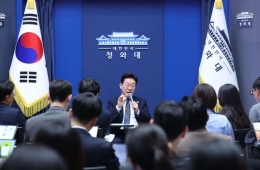
Democratic Party floor leader Han Byung-do asks a question during a parliamentary audit of the Ministry of Education. Yonhap News.
View original imageHan said, “It has been customary to pay the full amount for a semester’s dormitory fees all at once,” adding, “In February, the National Assembly amended the Higher Education Act to establish a legal basis for credit card payments for dormitory fees and allow students to split their semester’s fees into two or more payments.”
He pointed out, “The number of universities accepting credit card payments for dormitory fees was 43 in 2024 and 45 in 2026, remaining at around 15% of all universities for the third consecutive year. Private universities, which account for 86% of all universities, are at just 9%.” In fact, only about 6,000 of the 350,000 students living in dormitories were found to have paid their fees by card.
Han said, “SNU has 6,500 dormitory residents but still does not accept card payments,” and urged the university to “hurry with its preparations now that a legal basis is in place.”
Han asked SNU, Gyeongin National University of Education, Seoul National University of Education, and Hankyong National University to submit plans for introducing card and installment payments, along with schedules for amending their academic regulations, before the comprehensive audit. He also asked the Ministry of Education to conduct a full review of the status of implementation at each university and prepare a model amendment to academic regulations, measures to ease the burden of card fees, and ways to encourage private universities to participate. The ministry replied that it would review the situation.
Han also raised safety concerns about aging dormitories at SNU. According to Han, six student housing buildings and one welfare center at SNU’s Gwanak Campus were completed in 1983, making them 43 years old this year, but they were not built to seismic design standards and have not undergone seismic performance evaluations. The housing buildings alone have a capacity of 1,004 students.
Han criticized the university, saying, “SNU has completed evaluations of 151 of the 159 buildings subject to assessment. Seven of the remaining eight buildings are in this dormitory complex. Why are the places where students sleep among the last to be evaluated when nearly all the other buildings have been assessed?”
President Yoo responded, “I also visited the site myself,” explaining, “We began planning last year, and the plan is to start in earnest next year by rebuilding four of the buildings in the first phase.” He added, “Students will continue using the four buildings until February 2027, but if a structural safety inspection is needed before then, we will conduct it as soon as possible.”
Han said, “The plan is to demolish four buildings in 2027 and rebuild them in 2030, but there is no reconstruction schedule for the other two housing buildings or the welfare center.” He asked the university to submit, before the comprehensive audit, a schedule for seismic performance evaluations, an improvement plan, and measures for alternative housing and housing costs. President Yoo replied, “We will do so.”
Regarding aging dormitories nationwide, Han also stressed, “If universities continue using their current facilities without demolishing or building anew, the number of dormitory buildings more than 40 years old will reach 462 in 2035, about four times the current figure. We need to prepare in advance, before reconstruction projects at multiple universities and resulting housing shortages coincide.”
Hot Picks Today
 Changing Outfits and Snapping Photos in Hotels... "Please Don't Take Pictures": Europe Cracks Down on Influencers Over Privacy Concerns
- "Tried leveraged semiconductor stocks, watched 3.5 billion won shrink to 200 million won": Salaried investor in tears
- "Please Let Me Go Home"... Customers Trapped in Department Store Parking Lot for 5 Hours Vent Their Anger
- "I Should Enjoy It After Retirement": Prices Quadruple... Memberships Over 100 Million Won Popular, but Closures Mount
- "Come Live With Me on My Farm": Man Sells Everything and Travels 1,930 km, Trusting a Beautiful Woman
He called on the Ministry of Education to conduct a nationwide inspection of aging dormitories and prepare annual facility improvement plans and funding measures. A ministry official replied, “We will prepare them and report back.”
© The Asia Business Daily. All rights reserved. Unauthorized AI training and use prohibited.