AI Makes Decisions, Robots Build Cars... Hyundai Motor and Kia to Introduce Autonomous Factories in 2032
Host E-FOREST TECH DAY 2026
Present vision for the transition to software-defined factories
Develop virtual commissioning technology with NVIDIA
Improve equipment and robot validation efficiency... advance in-house manufacturing technology development
Hyundai Motor and Kia's factories of the future in 2032. Before introducing a new vehicle model to a production line, engineers will first validate the manufacturing process in a virtual space instead of modifying physical equipment. Robots and equipment modeled in the digital factory will run countless simulations, and if collisions or process errors are detected, their movements and work sequences will be adjusted before actual production begins.
Once a vehicle enters the production line, robots assemble its components while cameras and sensors inspect the body at every point. Artificial intelligence (AI) analyzes inspection data to identify potential defects and their causes, while logistics robots transport parts based on one another's routes and arrival times. If a problem occurs during production, AI analyzes relevant information and suggests causes and responses before staff have to compile the data manually. Workers focus less on repetitive operations and more on identifying process abnormalities and improving quality.
Hyundai Motor and Kia plan to begin deploying autonomous operations technologies in earnest from 2032, centering on new factories of the future. To support this shift on the production floor, they are developing technologies in stages, including digital twins, manufacturing AI, robotic automation, and an in-house vision inspection system.

Hyundai Motor and Kia unveil tunnel-type visual inspection technology at E-FOREST Tech Day 2026, held at their Uiwang Research Institute. Hyundai Motor and Kia
View original imageHyundai Motor and Kia will host E-FOREST TECH DAY 2026, a manufacturing technology exhibition, from October 19 to 21 at their Uiwang Research Institute in Uiwang, Gyeonggi Province. This year's event will showcase more than 200 technologies that are being applied or developed for manufacturing operations and present the direction of the transition to a Software Defined Factory (SDF).
One of the key technologies is digital twin-based virtual commissioning, which is being developed in collaboration with NVIDIA. It models and validates the movements of production equipment, robots, and control systems in a virtual space before an actual factory is built. Previously, equipment had to be installed before commissioning could take place at the site and errors could be corrected. Virtual commissioning can identify collisions between equipment and process errors in advance, reducing commissioning time and costs. Hyundai Motor and Kia plan to use the technology to prepare for new vehicle production at their Ulsan electric vehicle plant.
They will also showcase Polaris, an AI agent that analyzes manufacturing data. It analyzes production and quality data to identify causes of defects and ways to improve, and generates visualized reports and presentation materials. It can also share analysis results via email or collaboration tools. The aim is to reduce the time staff on the production floor spend compiling and analyzing data themselves, enabling them to respond to problems more quickly.
During a live demonstration, a worker said, "Tell me the overall production status." Polaris replied, "I'm finding the information you need based on what you asked," then organized the relevant information on screen and delivered it to the worker in just one to two seconds.

Weatherstrip automated installation technology is demonstrated at E-FOREST Tech Day 2026, held at Hyundai Motor and Kia's Uiwang Research Institute. Hyundai Motor and Kia
View original imageIn quality inspection, the companies are expanding the use of in-house vision technology. Hyundai Motor and Kia said they have relied on external solutions for more than 95% of the vision systems used at their domestic and overseas plants. They plan to strengthen their technological competitiveness by bringing image data generation, automated labeling, inspection algorithms, and smart vision sensors in-house.
A tunnel-type exterior inspection system captures about 5,000 high-resolution images of each vehicle to identify the locations and sizes of scratches and defects on its body. The system supplements visual inspections with data-based checks to improve the consistency of quality assessments. The companies are working to expand the technology to Ulsan and Asan after applying it at their Hwaseong electric vehicle plant.
They are also developing technology that automatically generates robot work paths. In vehicle body welding, robot paths must be set for more than 1,700 welding points. Previously, workers entered the paths one by one, but the new system uses AI to generate them and sensors to correct discrepancies between the actual work environment and the simulation. Hyundai Motor and Kia are considering applying the technology to mass production.

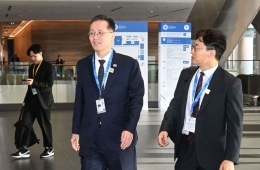
On the 16th, Choi Youngtae, executive director and head of the E-FOREST Center, presents Hyundai Motor Group's vision for future factories at Hyundai Motor and Kia's Uiwang Research Institute in Uiwang, Gyeonggi Province. Hyundai Motor and Kia
View original imageThey are also expanding automation in parts assembly. Kia plans to introduce automated door garnish installation technology at its Gwangju Plant 1 in December 2027. The system aligns and installs 19 clips that secure decorative parts to vehicle doors in stages, then uses sensors to check the assembly. The companies are also developing robotic technology for weatherstrip installation using 3D vision, flexible grippers, and pressure sensors.
Another key technology is HCS 2.0, a control system that centrally manages logistics robots in factories. It operates robots from different manufacturers within a single system and optimizes the flow of materials by predicting gridlock based on travel routes and estimated arrival times. Hyundai Motor and Kia aim to complete development by November 2026. They plan to begin mass-production validation at their Hwaseong plant in June 2027 before expanding the system to Ulsan and other locations.
Hyundai Motor and Kia plan to use the Hyundai Motor Group Innovation Center in Singapore (HMGICS) as a test bed for manufacturing technologies, then gradually apply validated technologies at new factories and existing production facilities.
This year's E-FOREST TECH DAY will also feature a new manufacturing technology presentation competition and a seminar for partner companies. Discussions will cover a range of topics, including physical AI, data-driven manufacturing innovation, and manufacturing AI, with the aim of raising technology standards and strengthening competitiveness across the industry.
Hot Picks Today
!["I Never Thought Gangnam Would Fall Behind"... 30s and 40s Flock to This Seoul Neighborhood With Cash [Real Estate A to Z]](https://cwcontent.asiae.co.kr/asiaresize/93/2026082518155892412_1787649358.jpg) "I Never Thought Gangnam Would Fall Behind"... 30s and 40s Flock to This Seoul Neighborhood With Cash [Real Estate A to Z]
"I Never Thought Gangnam Would Fall Behind"... 30s and 40s Flock to This Seoul Neighborhood With Cash [Real Estate A to Z]
- "When Will the Samsung-Hynix Rescue Team Arrive?" Stock Prices at Financial Crisis Levels... What Could Turn Them Around? [Weekend Money]
- Profanity, Sexual Harassment and Long Calls... 120 Dasan Call to End Calls After '20 Minutes'
- "Can They Really Be This Sweet?"... The Story Behind Convenience Store Honey Sweet Potatoes [Foodie X-Files]
- "I Used to Eat This All the Time in Korea..." What Is This Snack Winning Over Taste Buds Worldwide? [K-Holic]
A Hyundai Motor and Kia representative said, "It is meaningful to be able to showcase the excellence and practicality of the innovative manufacturing technologies developed by Hyundai Motor Group to the industry and our partner companies through this event. We will continue working to expand the areas where new technologies are used and apply them at our production plants."
© The Asia Business Daily. All rights reserved. Unauthorized AI training and use prohibited.


!["Please, Just Take Them Off" - They Made It All the Way to Bed... Then Fecal Bacteria Struck [Deep Scroll]](https://cwcontent.asiae.co.kr/asiaresize/307/2026101610053063338_1792112730.png)