[Chip Talk] "Research Is Over, Now They're Making Real Money"... Korean-Made NPUs Win Over Lisa Su as Monetization Begins in Earnest
Korean-Made NPUs Emerge as GPU Alternatives with Superior Power Efficiency
Rebellions, FuriosaAI and DeepX Enter Phase of Generating Tangible Business Results
Support from Optimization and Back-End Partners Also Helps Drive Commercialization
The most notable item on the schedule of AMD CEO Lisa Su, who visited Korea on Oct. 7, was a closed-door meeting with executives from leading Korean AI semiconductor startups. The list included some of the country's best-known fabless companies, such as DeepX, Rebellions and FuriosaAI. The reason the head of a global big tech company seeking to challenge Nvidia's dominance reached out to Korean fabless firms was clear: AMD plans to build a heterogeneous computing infrastructure that combines its central processing units (CPUs) and graphics processing units (GPUs) with Korean-made neural processing units (NPUs), in a bid to shake Nvidia's stronghold.
A fabless industry official said in a phone interview with The Asia Business Daily on Oct. 18, "Korean-made AI semiconductors, which were still at the level of 'test chips' for government-funded projects or public demonstration programs just one or two years ago, have entered a phase of generating tangible business results." The official said the chips had moved beyond the research stage to handle traffic from actual commercial services, and that their business profitability was beginning to be confirmed in figures as they were supplied to overseas data centers in mass-production orders worth tens of billions of won.

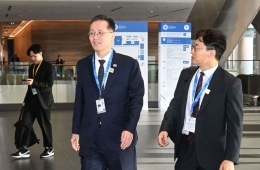
Lisa Su, chair and chief executive officer of AMD, greets representatives of South Korean AI companies at the “AI Semiconductor Company Roundtable” held at the Four Seasons Hotel in Jongno-gu, Seoul, on October 7, 2026. Photo by Kang Jinhyung.
View original imageThe shift in the AI market paradigm has helped Korean-made NPUs prove their commercial potential and attract interest from global big tech companies. In the early market for developing large language models (LLMs) such as ChatGPT, the focus was on "training," which involves feeding in vast amounts of data. More recently, "inference," the process of generating answers to actual user requests, has emerged as a key workload, accounting for more than 40% of data center power consumption and server capacity.
The problem is cost. GPUs, which also incorporate circuits for general-purpose graphics processing, consume more power and incur exponentially higher hardware operating costs, or total cost of ownership (TCO), when repeatedly performing inference tasks. By contrast, NPUs and application-specific integrated circuits (ASICs), designed specifically for AI computations such as matrix multiplication, are far more power-efficient than GPUs and can dramatically reduce chip acquisition and maintenance costs.
According to market research firm TrendForce, shipments of ASIC-based servers, including those powered by NPUs, are expected to grow 44.6% this year, nearly three times the 16.1% growth forecast for general-purpose GPU servers. The share of specialized semiconductors other than GPUs in the data center AI semiconductor market is also projected to grow from 18% last year to 41% by 2030. This is the structural reason big tech and cloud service companies have begun opening their wallets to Korean-made NPUs.
The performance of Korean AI semiconductor companies is becoming evident in the numbers. Rebellions, for example, has integrated its first-generation NPU chip, Atom, into key SK Telecom services such as A.Dot. The chip now processes an average of 14 million requests a day, equivalent to 4 billion computational tokens. This gives the company real-world operational data comparable to that of large-scale commercial deployments by big tech companies. Following its merger with Sapeon Korea, Rebellions is preparing its second-generation product, Rebel100, which combines Samsung Electronics' 4-nanometer (nm; 1 nm equals one billionth of a meter) process with 144 GB of fifth-generation high-bandwidth memory (HBM3E). The company has also finalized plans to supply the product to Saudi Aramco and deliver more than 100 racks to a data center in Tokyo, Japan.
FuriosaAI has also scored its largest export deal since its founding, supplying chips to an overseas data center. Its second-generation chip, Renegade (RNGD), which uses TSMC's 5-nanometer process and 48 GB of SK hynix HBM3, has completed mass production of its initial batch of 4,000 units and begun full-scale shipments. It consumes just 180 watts while running high-performance models. Its ability to be plugged directly into conventional air-cooled data centers, without separate liquid-cooling equipment, has become a decisive advantage. The company has also secured a foothold in the European market with a contract worth 123 billion won to supply more than 8,800 RNGD units to a single AI data center in Stockholm, Sweden.
DeepX has made gains in both yield and orders in the on-device and physical AI markets. The DX-M1, which powers robots, smart factories and intelligent CCTV systems at an ultra-low power consumption of around 1 to 5 watts, has reached a yield of about 90% since entering mass production. Building on this, the company has secured 77 purchase orders (POs) across nine countries and regions, including Korea, the United States, China and Europe, worth about $13 million, or approximately 17.5 billion won. DeepX has signed a three-year agreement with Taiwan's Eon to supply components for mass production and has also begun developing its next-generation product, the DX-M2, which will use Samsung Electronics' 2-nanometer process to run generative models in small-robot environments.
![[Chip Talk] "Research Is Over, Now They're Making Real Money"... Korean-Made NPUs Win Over Lisa Su as Monetization Begins in Earnest](http://www.asiae.co.kr/news/img_view.htm?img=2026101514364962237_1792042610.png)
Partners that provided software optimization and back-end process support also played a decisive role in helping Korean-made NPUs cross the threshold into commercialization. Nota, a specialist in AI model optimization, for example, has technology that reduces the size and computational workload of large AI models while maintaining their performance. The company has supplied this optimization software to FuriosaAI for its data center chips under a licensing arrangement, improving the compatibility of Korean-made chips.
ITEK, a semiconductor testing specialist, has worked with DeepX since the prototype development stage and is responsible for system-level testing (SLT), which precisely verifies semiconductor operation in real-world environments.
An industry official said, "The lack of software support and global references, which had long been cited as weaknesses of Korean AI fabless companies, is beginning to be addressed this year through actual traffic processing by telecommunications companies and export contracts."
Hot Picks Today
!["I Never Thought Gangnam Would Fall Behind"... 30s and 40s Flock to This Seoul Neighborhood With Cash [Real Estate A to Z]](https://cwcontent.asiae.co.kr/asiaresize/93/2026082518155892412_1787649358.jpg) "I Never Thought Gangnam Would Fall Behind"... 30s and 40s Flock to This Seoul Neighborhood With Cash [Real Estate A to Z]
"I Never Thought Gangnam Would Fall Behind"... 30s and 40s Flock to This Seoul Neighborhood With Cash [Real Estate A to Z]
- Why Did South Korean Stocks Plunge So Much? [Weekend Money]
- Ramen and Snack Prices Rise Again... These Companies Stand to Benefit [Weekend Money]
- "I Ate It Often Because It Tasted Good"... This Eating Habit Linked to 40% Higher Odds of Asymptomatic Cerebrovascular Damage
- "Can They Really Be This Sweet?"... The Story Behind Convenience Store Honey Sweet Potatoes [Foodie X-Files]
Park Changyun, a researcher at GL Research, said, "For Rebellions and FuriosaAI, we need to see whether service validation and supply contracts lead to full-scale adoption and expansion. For DeepX, we need to see whether design wins and initial orders lead to mass production of customer products and repeat orders." He added, "Whether order volumes and sustained revenue grow together will be the benchmark for determining whether Korean NPU companies have entered a phase of earnings growth."
© The Asia Business Daily. All rights reserved. Unauthorized AI training and use prohibited.


!["Please, Just Take Them Off" - They Made It All the Way to Bed... Then Fecal Bacteria Struck [Deep Scroll]](https://cwcontent.asiae.co.kr/asiaresize/307/2026101610053063338_1792112730.png)