KOSPI Plunges, Financial Firms Hit by Hacks in 'High Alert'... Will FSC's Move to Sejong Make It Miss the Golden Hour for Crisis Response?
Emergency meetings held during every crisis, from stock market plunges and cyberattacks to bank runs
91.6% of financial firms’ head offices are in the Seoul metropolitan area... Concerns over disruptions to on-the-ground communication and coordination<
With the Financial Services Commission's (FSC) relocation to Sejong in the second half of next year confirmed, concerns are growing that the financial authorities' ability to respond to crises could weaken. The move could disrupt efforts to quickly convene relevant institutions and formulate countermeasures when unexpected problems hit financial markets. Critics say that leaving Seoul, where financial companies and related institutions are concentrated, could make communication with the field more difficult and reduce the agility of the financial policy control tower.

Financial Services Commission Chairman Lee Eog-weon speaks at the "Emergency Meeting for All Financial Sector Institutions to Address Recent Cybersecurity Threats," held at the Government Complex Seoul on the afternoon of the 4th. Yonhap News.
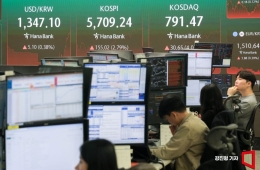
View original imageThe FSC has served as a firefighter, containing market uncertainty during major crises such as the savings bank failures, corporate restructurings and the Legoland crisis. In a recent example, when the KOSPI and KOSDAQ indexes plunged more than 8% on the 15th, the FSC held an emergency market review meeting at 2 p.m. that day, chaired by FSC Chairman Lee Eog-weon. As shares of "Samjeon-Nix" (Samsung Electronics and SK hynix), which account for about 48% of the KOSPI's market capitalization, fell more than 10% at one point during intraday trading and the market fell into a panic, the FSC urgently convened relevant market institutions, including the Korea Exchange, to discuss countermeasures.
An FSC official said, "When market volatility rises, Chairman Lee sometimes calls in securities analysts who cover the market to discuss the situation with them, or rushes to the secretary general's office with a one-page report. If the FSC relocates to Sejong, with working-level staff in Sejong and senior officials in Seoul, it could become difficult to report and discuss matters as quickly as we do now."
The same was true during the hacking incidents targeting the entire financial sector. As the attacks appeared to be spreading across the sector, Shin Jinchang, the FSC's secretary general, held a meeting with related institutions on Oct. 14 to devise measures to counter hacking threats driven by artificial intelligence (AI). On Oct. 4, during the National Foundation Day holiday, Lee and Financial Supervisory Service Governor Lee Chanjin also chaired an emergency review meeting at the Government Complex Seoul to address hacking threats.

With the KOSPI falling below the 5,600 mark during intraday trading, a display board at the dealing room of Hana Bank's headquarters in Jung-gu, Seoul, shows the KOSPI, KOSDAQ and won-dollar exchange rate on Oct. 15. The KOSPI opened at 5,673.01, down 335.8 points (5.59%) from the previous day's close of 6,008.81, and extended its losses. Oct. 15, 2026. Photo by Cho Yongjun
View original imageLooking further back, when concerns about a chain of bank runs (large-scale withdrawals of deposits) grew during the 2011-2012 savings bank crisis, the FSC held an emergency meeting early on a Saturday morning and suspended the operations of some savings banks facing serious liquidity problems. It acted preemptively before business opened to prevent depositors' anxiety from triggering further withdrawals.
During the 2022 Legoland crisis, the government announced liquidity support measures worth more than 50 trillion won on a Sunday, over the weekend, as the bond market rapidly tightened. The measures were announced before financial markets opened on Monday to prevent the uncertainty from spreading.
Corporate restructuring at large companies also requires close coordination between the financial authorities and creditor banks, as well as swift decision-making. When a company faces financial difficulties, decisions must be made quickly on matters such as how to share losses and whether to provide additional funding. The financial authorities therefore need to communicate smoothly with financial companies and monitor market conditions in real time.
The problem is that if the FSC relocates to Sejong, it may be difficult to maintain this kind of emergency response system. With 91.6% of financial companies' head offices and 72.7% of listed companies' headquarters concentrated in the Seoul metropolitan area, the FSC's move to Sejong could weaken its ability to respond on the ground and limit its capacity to formulate policies that reflect market needs. Critics also say that remote meetings make it difficult to accurately grasp complex conditions on the ground and constrain close communication, including efforts to coordinate the views of stakeholders.
Concerns are also growing that both institutions responsible for financial policy and supervision could leave Seoul if the Financial Supervisory Service is included among the public institutions slated for relocation, which is expected to be announced within the year. This could simultaneously increase the physical distance between financial markets and the authorities responsible for policy and supervision.
Hot Picks Today
 "The Inner Aisles Are Dangerous, I Never Buy These": 3 Foods a Doctor Warns Against
- A 700 Million Won Bonus Was Peanuts... 'This Company' Spent '4 Billion Won per Employee' Amid the AI Boom
- "Only 3-4 Years of Golden Time... China Will Take Over Everything" China’s All-Out Push Into the South Korean Market [China Shock, K-Industry on the Brink | Automobiles] 4
- "I thought I'd regret it if I were the only one who didn't buy one"... FOMO lottery ticket wins A$100 million jackpot
- Kang Minkyung Raved, "Worth the Money," Then It Sold Out in 10 Minutes... Convenience Store Collaborations Pay Off
A financial industry official said, "Since the financial institutions and companies that work with the FSC are all based in Seoul, the relocation could disrupt not only routine communication with the field but also swift responses in a crisis. It would also inevitably waste administrative resources as FSC officials travel between Seoul and Sejong." The official added, "The location of the financial authorities is not simply a matter of relocating administrative agencies as part of balanced regional development; it is directly linked to the development and stability of the financial market. Even if the move to Sejong goes ahead, the authorities should consider keeping some organizational units and key systems in Seoul to ensure the crisis response system continues to operate without disruption."
© The Asia Business Daily. All rights reserved. Unauthorized AI training and use prohibited.

!["Please Take Them Off!" They Made It All the Way to the Bed... Then "80% of Fecal Bacteria" Struck [Deep Scroll]](https://cwcontent.asiae.co.kr/asiaresize/307/2026101610053063338_1792112730.png)