Japan at 15x, Korea at 4x... Samsung Electronics and SK hynix Back to Levels Seen 8 Years Ago
KOSPI plunge leaves valuations at record lows
Driven by "doubts about future earnings" weighing on Korean chipmakers
Proving AI can generate returns and restoring long-term confidence are key
As domestic stocks have plunged and volatility has increased, South Korea's valuation has entered record-low territory compared with those of major global markets. In particular, the price-to-earnings ratios (PERs) of Samsung Electronics and SK hynix, which underpin the KOSPI, have fallen to levels last seen eight years ago, suggesting that distrust in the semiconductor market's future earnings has reached an extreme. Ultimately, proving that artificial intelligence (AI) investments can generate real returns and restoring confidence in the semiconductor earnings cycle beyond 2028 are expected to be key to a future rebound in stock prices.

According to Korea Investment & Securities on October 16, South Korea's 12-month forward PER and price-to-book ratio (PBR) stand at just 4.2 times and 1.34 times, respectively. These figures are far below the global averages of 16.2 times for PER and 3.24 times for PBR. They are also dramatically lower than those of the United States (19.4 times and 4.74 times), Japan (15.3 times and 1.83 times), Europe (13.9 times and 2.20 times), and China (10.0 times and 1.18 times).
The extreme undervaluation of the leading semiconductor stocks that support the market is cited as a key reason for the weakness in domestic stocks. According to FnGuide, a long-term analysis of trends since 2010 shows that Samsung Electronics' 12-month forward PER fell to 3.61 times as of October 14, well below its previous low of 6.19 times in October 2018. SK hynix's 12-month forward PER has also dropped to around 3.22 times, falling to a level similar to its reading in October 2018.

KB Securities said Samsung Electronics and SK hynix have such strong earnings power that their combined profits this year and next year, totaling approximately 1,600 trillion won, would be enough to retire more than half of their treasury shares. However, it said their low PERs indicate that investors still view semiconductors as a highly cyclical industry, swinging between severe booms and busts, and doubt the sector's ability to generate future earnings. Semiconductors are considered the "rice of industry" because they are essential to all products. As a result, they sit at the very upstream end of the supply chain and are strongly affected by the "bullwhip effect," in which changes in end-consumer demand are greatly amplified. With demand from AI data centers added to the mix, the bullwhip effect in the semiconductor industry is now being amplified to the extreme. This can drive a sharp increase in earnings during a boom, but it can also bring various adverse effects once bottlenecks ease. Overcapacity and excess inventory are prime examples; similar patterns emerged after the COVID-19 pandemic in diagnostic kits, masks and toilet paper, and container ships. Analysts say the possibility of long-term excess inventory and overinvestment in semiconductors should therefore continue to be monitored.
One of the main factors fueling market concerns about overinvestment is China's ChangXin Memory Technologies (CXMT) moving to expand supply. At the same time, concerns over U.S. interest rate hikes and uncertainty around AI companies' financing have combined to trigger a wave of selling across Asian markets. In Japan in particular, AI and semiconductor stocks that had driven the market's gains plunged, deepening the decline. With major stocks including Kioxia, Advantest, Tokyo Electron, and SoftBank Group weakening, the Nikkei 225 Stock Average, also known as the Nikkei Index, fell for a sixth consecutive trading day. On October 15, it dropped 4.90% from the previous trading day, marking its third-largest decline on record.
Hyundai Motor Securities noted that despite steady upward revisions to the KOSPI's 12-month forward operating profit estimates, supported by strong domestic memory semiconductor earnings, stock prices have remained weak. It said short-term increases in earnings estimates alone cannot resolve the market's doubts about future profits. The firm said the market has already priced in next year's earnings growth for South Korea's leading semiconductor stocks. When operating profit is expected to rise year over year, 12-month forward operating profit estimates are automatically revised upward as the year draws to a close, since they increasingly incorporate forecasts for the following year's earnings. Therefore, these revisions should not be interpreted in isolation as a genuine improvement in earnings expectations. In fact, operating profit estimates for Samsung Electronics and SK hynix for this year and next year have both been revised downward after reaching their peaks. This suggests the market is focusing more on the possibility that earnings will peak next year than on the strong results being posted now. The firm said that a genuine improvement in earnings expectations would require upward revisions to next year's underlying operating profit, rather than to the 12-month forward figures.
Analysts say confidence in 2028 earnings is ultimately needed to dispel concerns that corporate earnings have peaked. The reason stock prices have not responded to strong earnings growth at domestic semiconductor companies is that investors are not convinced that structural earnings growth will continue beyond 2028. Nvidia, too, saw its stock price correct from the second half of 2024 amid concerns that its revenue and profit margins would decline the following year. Although its 12-month forward estimates continued to be revised upward, its stock price kept falling. But in the second half of 2025, estimates for 2026 earnings, rather than the current year's earnings, began to rise substantially, helping the company overcome peak earnings concerns and stage a rebound.

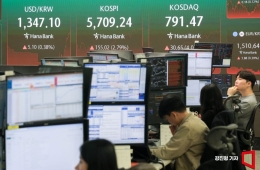
An electronic board in the dealing room at Hana Bank's headquarters in Jung-gu, Seoul, displays the KOSPI, KOSDAQ and won-dollar exchange rate on the 16th. The KOSPI opened at 5,653.99, up 1.80% from the previous trading day, while the KOSDAQ opened at 772.17, up 1.49%. Photo by Kang Jinhyung. 2026.10.16. Photo by Kang Jinhyung
The KOSPI opened at 5,653.99, up 99.77 points (1.80%).
Meanwhile, on October 16, domestic stocks appeared to be breaking a seven-trading-day losing streak and attempting a rebound for the first time in eight trading days. The KOSPI opened at 5,653.99, up 1.80% from the previous trading day, and was trading at 5,682.66, up 2.31%, as of 9:50 a.m. The KOSDAQ was up 3.24% at 785.44 at the same time. During the recent downturn, heavy foreign selling and net selling by pension funds, which were expected to act as a support for the indices, had added to downward pressure. According to the Korea Exchange, foreign investors recorded net sales of 18.3003 trillion won on the KOSPI market from October 6 to 15. Institutional investors, including pension funds, also recorded net sales of 126 billion won. Only individual investors absorbed the selling, recording net purchases worth 11.1823 trillion won.
Hot Picks Today
 "The Inner Aisles Are Dangerous, I Never Buy These": 3 Foods a Doctor Warns Against
- "Only 3-4 Years of Golden Time... China Will Take Over Everything" China’s All-Out Push Into the South Korean Market [China Shock, K-Industry on the Brink | Automobiles] 4
- "Female Teachers Must Wear Skirts in Class"... Outrage Erupts Over Principal's Demand: What's Happening in North Korea?
- "The leggings are all see-through. It's so embarrassing to look at," complaints prompt Lululemon to fire development staff.
- Kang Minkyung Raved, "Worth the Money," Then It Sold Out in 10 Minutes... Convenience Store Collaborations Pay Off
Han Ji-young, a researcher at Kiwoom Securities, said, "Investor sentiment among domestic market participants has cooled considerably after a series of sharp declines, but we should remain open to the possibility of a technical rebound in the short term." She added, "Given the seven consecutive trading days of steep declines, the potential for a technical reversal has risen substantially." She continued, "The KOSPI's forward PER is currently at its lowest valuation since 2000, but the market does not fully trust the high earnings estimates currently in place." She added that "there are limits to how far the market can move before third-quarter earnings reports from the three major U.S. big tech companies."
© The Asia Business Daily. All rights reserved. Unauthorized AI training and use prohibited.
!["Please Take Them Off!" They Made It All the Way to the Bed... Then "80% of Fecal Bacteria" Struck [Deep Scroll]](https://cwcontent.asiae.co.kr/asiaresize/307/2026101610053063338_1792112730.png)