Government Holds Emergency Review After Stock Market Plunge... "Real-Time Monitoring of Financial Market Volatility"
Joint Market Situation Review Meeting with Relevant Agencies
The government has decided to step up its monitoring of financial markets as a whole, including not only the stock market but also the bond, foreign exchange and short-term funding markets, in response to the recent sharp decline in domestic stocks. The move comes amid increased market volatility as rising U.S. Treasury yields, uncertainty over the outlook for the artificial intelligence (AI) and semiconductor industries, and geopolitical tensions in the Middle East converge.
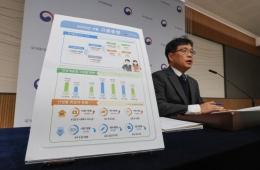
The Ministry of Finance and Economy said it held a joint Market Situation Review Meeting with relevant agencies at the Government Complex Seoul on the morning of Oct. 16, chaired by First Vice Minister Kwon Daeyeong, to discuss domestic and global financial market trends and response measures. Attendees included Second Vice Minister Heo Jang, Bank of Korea Deputy Governor Kwon Minsu, Financial Supervisory Service Senior Deputy Governor Lee Se-hun, and Financial Services Commission Secretary General Shin Jin-chang.

Kwon Daeyoung, vice minister of finance and economy, delivers opening remarks while chairing the Market Situation Review Meeting at the Government Complex Seoul on the 16th. Ministry of Finance and Economy.
View original imageParticipants assessed that external factors, including U.S. Treasury yields, the outlook for the AI and semiconductor industries, and geopolitical tensions in the Middle East, had heightened volatility and uncertainty in financial markets. In particular, given that the domestic stock market has recently shown relatively greater volatility than other markets, they agreed on the need to closely analyze domestic and external risk factors and adopt an integrated approach that also takes into account spillover effects across markets.
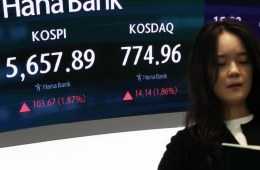
The KOSPI opened at 7,004 on Oct. 2 but continued to decline, falling to 5,554 on Oct. 15. This represents a drop of about 20% in less than two weeks. The KOSPI 200 Volatility Index (VKOSPI), a measure of stock market volatility, also rose from 43.0 at the end of September to 55.4 on Oct. 15.
The government attributed the recent stock market correction to expectations of rising global interest rates, uncertainty over investment and earnings prospects in the AI semiconductor sector, and increased risk aversion driven by higher international oil prices. It noted that although domestic stocks have been more volatile than other markets, partly because of differences in sector composition, the underlying economic and stock market fundamentals remain sound.
The International Monetary Fund (IMF) raised its forecast for South Korea's economic growth this year to 3.3% from 2.6% earlier this month. The country continues to post a substantial current account surplus, and operating profits at KOSPI-listed companies are forecast to increase from 312 trillion won last year to 969 trillion won this year.
Hot Picks Today
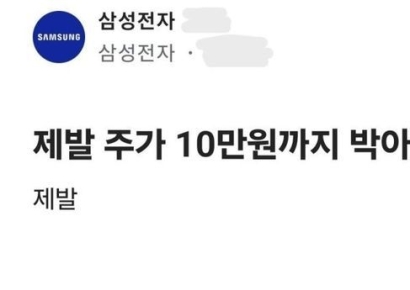 "Samsung Electronics, Please Fall to 100,000 Won"... Investors Fume Over Anonymous Post Welcoming Stock Decline
- "Female Teachers Must Wear Skirts in Class"... Outrage Erupts Over Principal's Demand: What's Happening in North Korea?
- "Makeup and Housework Keep Me Busier": Takaichi's "3-4 Hours" Remark Stirs Japanese Politics
- "I Put in 10 Million Won, but Only 2 Million Won Is Left" ... 77% Plunge Leaves Retail Investors in Samsung Electronics and SK hynix Leveraged ETFs Crying Out
- "The leggings are all see-through. It's so embarrassing to look at," complaints prompt Lululemon to fire development staff.
The government and relevant agencies agreed to jointly monitor financial market conditions in real time and respond firmly to market-disturbing activities, led by the financial authorities. They will also closely monitor whether stock market volatility spreads to the bond, foreign exchange and short-term funding markets. In addition, they will consistently pursue structural reforms to reduce volatility and enhance the growth potential of domestic capital markets, with the aim of strengthening the credibility and competitiveness of the domestic stock market.
© The Asia Business Daily. All rights reserved. Unauthorized AI training and use prohibited.