[Good Morning, Stock Market] U.S. Treasury Yields Fall, Three Major Indexes Rebound... What's Next for South Korean Stocks?
U.S. Treasury yields fall to the low 5% range
CoreWeave also rebounds to close higher
Hopes grow for a technical rebound in South Korean stocks

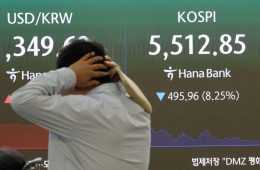
All three major U.S. stock indexes closed higher as Treasury yields fell. However, semiconductor stocks remained weak, drawing attention to whether South Korea's stock market will rebound. Although investor sentiment in the domestic market has cooled, analysts say the possibility of a short-term technical rebound remains.
On Oct. 15 (local time), the S&P 500 rose 0.33% from the previous session to close at 7,744.06 on the New York Stock Exchange (NYSE). The Nasdaq Composite, led by technology stocks, gained 0.08% to finish at 26,713.03. The Dow Jones Industrial Average rose 1.08% from the previous session to 52,177.69.
Major indexes rose, but concerns about artificial intelligence (AI)-related stocks persisted. Technology stocks remained weak despite solid earnings reports, amid concerns about the borrowing burden from large-scale capital expenditures and the outlook for profitability. Nvidia fell 1.84%, while foundry operator TSMC, which reported a record quarterly net profit, also declined 2.01%. AI server makers Dell Technologies and Hewlett Packard Enterprise fell 6.80% and 7.11%, respectively.
CoreWeave, a cloud computing company that sparked concerns about investment in AI infrastructure, fell nearly 10% early in the session. However, after Nvidia CEO Jensen Huang said at a Bloomberg event that "CoreWeave is getting more competitive every day," investor sentiment recovered, and the stock closed up 5.9%.
The decline in U.S. Treasury yields was also seen as helping the stock market rebound. The yield on the 10-year U.S. Treasury note fell 10.4 basis points (bp; 1 bp = 0.01%) from the previous day to 5.086%. This was its largest daily decline since Aug. 1. The move was attributed to increased demand for safe-haven assets amid unease over technology stocks, which pushed bond prices higher.
However, economic indicators heightened concerns about further monetary tightening. The U.S. Producer Price Index (PPI) for September, released that day, rose 1.3% from the previous month, its largest increase since March 2022, and far exceeded market expectations. The year-over-year increase was 6.3%. Retail sales also rose 0.8% month over month, while initial weekly jobless claims stood at 199,000 for the week ended Oct. 10. With inflationary pressure mounting while consumer spending and employment remain resilient, the Federal Reserve (Fed) continues to face pressure to tighten policy. According to CME FedWatch, interest rate futures that day priced in about a 27% chance that the Fed would raise its benchmark rate this month.
The iShares MSCI South Korea ETF, which closely tracks the domestic stock market, fell as much as 6.33% intraday from the previous day before trimming its losses to close down 2.26%. The Philadelphia Semiconductor Index also plunged 4.39% intraday, but narrowed its losses to close down 0.88%.
South Korea's stock market is therefore expected to stage a technical rebound. Analysts say a seven-session losing streak is unprecedented in the market's history and that the potential for a technical recovery has increased relative to the risk of further declines.
Hot Picks Today
 "There's a Drink Like This?"... Chinese Beverage With "Korean" in Its Name Rakes in 85 Million Won in Monthly Sales
- "Samsung Electronics at 70,000 won, SK hynix at 200,000 won"... Why the gloomy outlook despite 'record-breaking earnings'?
- 'Big Investor' NPS Has Already Cut Its Losses... Sold Department Store Stocks in Q3 Despite Strong Earnings Outlook
- "I Put in 10 Million Won, but Only 2 Million Won Is Left" ... 77% Plunge Leaves Retail Investors in Samsung Electronics and SK hynix Leveraged ETFs Crying Out
- "The leggings are all see-through. It's so embarrassing to look at," complaints prompt Lululemon to fire development staff.
Han Ji-young, a researcher at Kiwoom Securities, said, "If the structural profitability of domestic companies is not impaired, the KOSPI level of around 5,100, corresponding to a forward price-to-book ratio (PBR) of 1.0, can be considered a market bottom." She added, "At around 5,100, rather than betting on further downside risk, it would be effective to favor recouping the recent losses while monitoring whether confidence in earnings recovers during the third-quarter earnings season and whether concerns about AI stocks ease."
© The Asia Business Daily. All rights reserved. Unauthorized AI training and use prohibited.