Could Widening Surplus Become a Pretext for Trade Pressure? Lee Hyeongil: "Global Imbalances Must Be Resolved Through Structural Reform"
International debut as current account surplus nearly quadruples
Proposes a "macroeconomic approach" to address "global imbalances"
Series of bilateral meetings with the UK, Germany, Singapore, and others
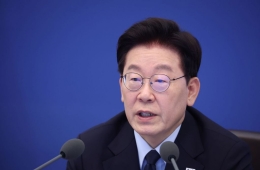
Lee Hyeong-il, Deputy Prime Minister and Minister of Finance and Economy, who is visiting Bangkok, Thailand, to attend the annual meetings of the International Monetary Fund (IMF) and World Bank (WB), the G20 Finance Ministers and Central Bank Governors Meeting, and the G7 Finance Ministers and Central Bank Governors Meeting, actively took part in discussions on easing global imbalances, a key issue facing the global economy, at his first international gathering since taking office. Global imbalances refer to a phenomenon in which large current account surpluses in certain countries lead to the accumulation of current account deficits in other countries. With concerns growing over trade pressure amid South Korea's expanding current account surplus, he took a measured approach, proposing comprehensive international cooperation rather than targeting any particular country.

Lee Hyoung-il (center left), Deputy Prime Minister and Minister of Finance and Economy, is visiting Bangkok, Thailand, to attend the IMF-World Bank Annual Meetings, the G20 Finance Ministers and Central Bank Governors Meeting, and the G7 Finance Ministers and Central Bank Governors Meeting. He meets with British Finance Minister John Healey at the Queen Sirikit National Convention Center (QSNCC) on October 15 (local time). Ministry of Finance and Economy.
View original imageOn the 15th (local time), Lee attended the G7 Finance Ministers and Central Bank Governors Meeting as an invited guest and discussed fundamental measures to address global imbalances. He said that broad-based macroeconomic policies and structural reforms, among other efforts, were needed to ease global imbalances. Lee also stressed that "comprehensive cooperation through G20 governance, as well as cooperation within the G7, is important," calling for close solidarity on a global scale.
Concerns have been raised that South Korea's rapidly widening current account surplus could provide grounds for trade pressure. According to the Bank of Korea's balance of payments statistics, the cumulative current account surplus through August this year was $279.2 billion, nearly four times the $69.67 billion recorded in the same period last year. South Korea currently has the world's second-largest surplus, after China. Last year, its surplus ranked fifth, behind those of China, Germany, Japan, and Taiwan. Against this backdrop, Lee made clear that global imbalances should be addressed not by pressuring specific countries, but by finding solutions through broad-based structural improvements.

Lee Hyung-il (right), Deputy Prime Minister and Minister of Finance and Economy, who is visiting Bangkok, Thailand, to attend the IMF-World Bank Annual Meetings, the G20 Finance Ministers and Central Bank Governors Meeting, and the G7 Finance Ministers and Central Bank Governors Meeting, poses for a photo while shaking hands with Asian Development Bank (ADB) President Kanda Masato ahead of their meeting at the Queen Sirikit National Convention Center (QSNCC) on October 15 (local time). Ministry of Finance and Economy.
View original imageSouth Korea, which is co-chairing the G20 Global Imbalances Study Group with Australia this year, has been deeply involved in related discussions. In a meeting with Australian Treasurer Jim Chalmers, Lee praised the strong teamwork the two countries had demonstrated in leading the study group. Recalling Australia's emergency assistance during the urea solution supply crunch in 2021, he reaffirmed the countries' key partnership in supply chains for energy and critical minerals. Lee also said at the G20 meeting that South Korea would contribute to stable growth in the global economy, as it is set to join the United States and the United Kingdom next year in the "troika" framework, which supports the smooth operation of the G20 and policy coordination. The troika is a cooperative arrangement among the previous, current, and next presidencies. In 2027, the United Kingdom will hold the presidency, while the United States will be the previous president and South Korea the next president.
Hot Picks Today
 "'A Shortcut to Ruining Your Health - I Never Buy These': 3 Foods a Doctor Says to Avoid"
- "Female Teachers Must Wear Skirts in Class"... Outrage Erupts Over Principal's Demand: What's Happening in North Korea?
- "I Put in 10 Million Won, but Only 2 Million Won Is Left" ... 77% Plunge Leaves Retail Investors in Samsung Electronics and SK hynix Leveraged ETFs Crying Out
- Japan at 15x, Korea at 4x... Samsung Electronics and SK hynix Back to Levels Seen 8 Years Ago
- "The leggings are all see-through. It's so embarrassing to look at," complaints prompt Lululemon to fire development staff.
Alongside his participation in multilateral meetings, Lee also conducted intensive bilateral diplomacy with major countries. In a meeting with German Vice Chancellor and Finance Minister Lars Klingbeil, they shared the view that combining artificial intelligence with traditional industries such as automobiles and chemicals - known as "physical AI" - is important. Lee also heard Germany's hopes of strengthening cooperation with South Korea, which is competitive in advanced industries. In a meeting with Indranee Thurai Rajah, Singapore's Second Minister for Finance, they discussed sharing the operational expertise of Singapore's Temasek in connection with South Korea's planned establishment of a strategic sovereign wealth fund. Rajah responded positively to the proposal, broadening the scope of financial diplomacy. A bilateral meeting with UK Finance Minister John Healey yielded strong agreement on the importance of close global coordination through the formation of the troika. In a meeting with Kanda Masato, President of the Asian Development Bank (ADB), Lee discussed advancing concrete cooperation projects in artificial intelligence and nuclear power as follow-up to Kanda's visit to South Korea last month. He also called for interest and support to help more outstanding South Korean talent take up positions at international organizations.
© The Asia Business Daily. All rights reserved. Unauthorized AI training and use prohibited.