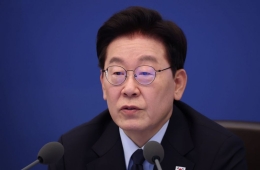
Experts Divided on Next Year's Rate Outlook over "Semiconductor Trickle-Down Effect"
Korea Financial Investment Association Holds 2026 Global Bond Forum on Oct. 15
Outlooks Diverge Over Trickle-Down Effects on Consumption and Government Finances
Experts are divided on their interest rate outlook for next year, depending on how they view the trickle-down effects of the semiconductor supercycle. They expect rapid growth at semiconductor companies such as Samsung Electronics and SK hynix to drive capital investment, employment and consumption, leading to GDP growth as well as inflationary pressure and interest rate hikes. However, those who see such effects as unlikely to materialize expect interest rates to turn lower.
Lim Jaegyun, a team leader at KB Securities, said at the Korea Premium Week 2026 Global Bond Forum, held at the Korea Financial Investment Association headquarters on October 15, that "the domestic bond market will enter a period of falling interest rates in 2027, supported by easing inflationary pressures, adjusted economic growth expectations and improved supply and demand for government bonds."

Im Jaegyun, team leader at KB Securities, speaks at the Global Bond Forum held at the headquarters of the Korea Financial Investment Association on the 15th. Photo by Kim Youngwon, reporter.
View original imageOn inflation, Lim said that performance bonuses at Samsung Electronics and SK hynix may not lead to trickle-down effects on consumption. "A trickle-down effect is needed for prices to rise further. If people receive large incentives, demand could be strong for home purchases, luxury goods at department stores and overseas travel," he said. "The trickle-down effect may be more limited than expected."
He also said that while the "semiconductor trickle-down effect" was one reason the Bank of Korea raised its 2027 growth forecast from 2.1% to 2.9%, it had yet to materialize. "Growth expectations have risen considerably, and a trickle-down effect from semiconductors is needed to exceed them," Lim said. "That effect should be reflected in increased capital investment and employment, as well as expanded consumption, but the number of employed people has declined so far."
Lim said that even if the U.S. Federal Reserve (Fed) raises interest rates further, this could have a positive rather than negative impact on the domestic bond market. "The Fed's rate hike has increased incentives for arbitrage trading in Korea," he said. "The bond market next year will not be as difficult as this year's, and we expect interest rates to fall."

Dr. Kwon Hyosung of Bloomberg speaks at the Global Bond Forum held at the Korea Financial Investment Association headquarters on the 15th. Photo by Kim Youngwon.
View original imageBy contrast, Dr. Kwon Hyoseong of Bloomberg said that the semiconductor supercycle would continue, contribute to GDP growth and generate trickle-down effects through government finances. "Supported by the semiconductor supercycle, the Korean economy is expected to post strong growth of 3.7% this year and 3.0% next year," Kwon said. "As strong semiconductor exports contribute to higher national income and expanded domestic demand and capital investment, underlying inflationary pressure is expected to persist, prompting the Bank of Korea to raise its benchmark interest rate to 3.50% by the first quarter of next year."
Hot Picks Today
 "I Invested KRW 10 Million, Only KRW 2 Million Is Left" ... 77% Plunge Sends Retail Investors Who Piled Into Samsung Electronics and SK hynix Leveraged ETFs Crying Out
- "There's a Drink Like This?"... Chinese Beverage With "Korean" in Its Name Rakes in 85 Million Won in Monthly Sales
- "Samsung Electronics at 70,000 won, SK hynix at 200,000 won"... Why the gloomy outlook despite 'record-breaking earnings'?
- "As Japan Ages, It May Even Run Short of Crematoriums"... Tokyo to Build Public Crematoriums Across Central Tokyo
- "No Need to Hire a Model"... The 25-Year-Old Woman Who Entered Social Media with a Face That Cost Just 1,500 Won [AI Content: The Bright and Dark Sides] 1
Kwon agreed that large performance bonuses were likely to be spent on luxury goods or real estate, but stressed that "the more important trickle-down effects come through government finances and investment." "Samsung Electronics and SK hynix are expected to pay 130 trillion won in corporate taxes this year, while the national average in previous years has been less than 90 trillion won," he said. "What matters is that the government uses this additional tax revenue to establish a Future Response Fund and increase fiscal spending next year." He added, "Even if less of the trickle-down effect goes toward consumption, sufficiently expansionary fiscal spending will substantially boost next year's growth."
© The Asia Business Daily. All rights reserved. Unauthorized AI training and use prohibited.