KOSPI Closes Down More Than 7% as Circuit Breaker Is Triggered
Heavy foreign selling
KOSDAQ also falls 7%
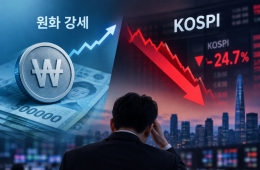
Both the KOSPI and KOSDAQ closed down more than 7%. As the markets fell during the session, a sell-sidecar was triggered, followed by a circuit breaker. Some analysts said concerns over the sustainability of AI investment and intensifying competition in memory chips had compounded the decline.
On October 15, the KOSPI closed at 5,554.22, down 454.59 points (7.57%) from the previous trading day. Seven minutes after the market opened lower, the Korea Exchange triggered a sell-sidecar. The decline continued, and a circuit breaker was triggered at around 12:38 p.m. The KOSDAQ also triggered a circuit breaker, marking the first simultaneous circuit breakers for both indexes in two and a half months, since July 29.
A Level 1 circuit breaker is triggered when an index remains at least 8% below its previous day's level for one minute. Once triggered, trading is suspended for 20 minutes. Order entry is also halted, except for cancellation orders. After trading resumes, orders are matched through a single-price auction for 10 minutes.
The market closed lower due to foreign investors' selling. Foreign investors recorded net sales of KRW 3.6241 trillion. Individual investors and institutions, by contrast, recorded net purchases of KRW 1.2886 trillion and KRW 1.693 trillion, respectively.

Wall Street's three major indexes closed mixed amid rising international oil prices as tensions in the Middle East escalated, and reports of technological advances by Chinese memory chipmakers.
Employees monitor stock prices and exchange rates in the dealing room at Hana Bank's headquarters in central Seoul on Oct. 15, as South Korean stocks opened lower following a plunge in semiconductor shares, including Samsung Electronics and SK hynix. The KOSPI opened at 5,673.01, down 335.8 points, or 5.59%, from the previous day's close of 6,008.81. Oct. 15, 2026. Photo by Jo Yongjun.
Among the KOSPI's largest companies by market capitalization, all but Samsung Biologics (up 5.5%), KT&G (up 3.9%), Celltrion (up 1.2%), Hana Financial Group (up 0.6%), Woori Financial Group (up 0.4%) and Industrial Bank of Korea (up 0.1%) fell. Samsung Electro-Mechanics dropped 15.3%, while Hyosung Heavy Industries fell 14.7%, Doosan 13.5%, LS ELECTRIC 12.1%, Hanmi Semiconductor 11.6% and SK hynix 11%. Samsung Electronics also fell 9.4%.
The KOSDAQ closed at 760.82, down 63.06 points (7.65%) from the previous trading day. The index opened lower, and a sell-sidecar was triggered 12 minutes later. The decline then continued, prompting a circuit breaker at around 12:23 p.m., earlier than the one on the KOSPI.
Individual investors and institutions recorded net sales of KRW 66.9 billion and KRW 163.1 billion, respectively. Foreign investors, by contrast, recorded net purchases of KRW 215.8 billion.
Top KOSDAQ companies by market capitalization also fell. Eugene Technology dropped 16.5%, while TES fell 16.3%, Wonik IPS 15.4%, ISC 15.3%, Jusung Engineering 14.9% and TSE 14.7%.
Hot Picks Today
 "Samsung Electronics at 70,000 won, SK hynix at 200,000 won"... Why the gloomy outlook despite 'record-breaking earnings'?
- "I Was Just Going Barefoot at Home"... "Absolutely Not": Why Doctors Warn Against It
- "25 to 1" Summer Storm and Flood Deaths Plunge... "Government Response Effective"
- "To Make His Girlfriend Think It Was His": Why He Demolished Someone Else's 2-Billion-Won Apartment
- "No Need to Hire a Model"... The 25-Year-Old Woman Who Entered Social Media with a Face That Cost Just 1,500 Won [AI Content: The Bright and Dark Sides] 1
Lee Kyung-min, a researcher at Daishin Securities, said, "Amid extreme volatility, including the triggering of circuit breakers, the KOSPI has fallen about 20% over the past six trading days. The burden of high interest rates coincided with concerns over the sustainability of AI investment and intensifying competition in memory chips. Foreign investors' selling and an imbalance in domestic market flows deepened the decline."
© The Asia Business Daily. All rights reserved. Unauthorized AI training and use prohibited.