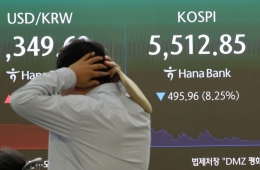
Why Did South Korean Stocks Plunge So Much? [Weekend Money]
Won strength also cited as a factor, alongside high inflation, high interest rates and AI concerns.

As South Korean stocks have recorded the steepest decline among markets worldwide since the second half of the year began, analysts say the won's strength is also one factor behind the market's weakness, alongside high inflation and concerns about the profitability of artificial intelligence (AI) investments.
According to iM Securities, the KOSPI has recently fallen more sharply than overseas markets such as the Nasdaq. As of the October 12 close, the Nasdaq Composite was up 3.9% from the end of June, while the KOSPI had plunged 24.7%. Given that Japanese stocks fell 1.4% and Taiwanese stocks rose 6.8% over the same period, the weakness of the South Korean market, or its divergence from other markets, is pronounced.
Park Sang-hyun, a senior research fellow at iM Securities, said, "Despite the same external uncertainties, including instability in international oil prices and the burden of a sharp rise in government bond yields, the domestic stock market is notably underperforming. This appears to reflect profit-taking after the KOSPI's steep rise since the second half of last year, as well as supply-and-demand conditions, which are also an important factor."
Park said, "Foreign investors' net sales of domestic stocks, which had eased somewhat in July and August, expanded sharply again from September, becoming a major factor exacerbating the divergence between the domestic market and other markets."
On why foreign investors' net selling of domestic stocks has intensified again, he said, "It is difficult to identify a clear answer," but added, "There are various reasons, including continued rebalancing, concerns that the semiconductor cycle may be peaking, concerns about China's push to build up its semiconductor industry, and shifting preferences among sectors within AI." He particularly noted, "The won's strength, or increased volatility in its value, also appears to be having a considerable impact on the expansion of foreign investors' net stock sales."
Park said, "The won fell 7.6% in value in the first half of the year, but its value surged by as much as 13.8% in the second half, as of October 12. The U.S. dollar has strengthened in the second half, but its value has risen by only 1.4%."
He said, "One reason foreign selling pressure is intensifying while the won is strengthening is the won's rapid appreciation and increased volatility. The won has strengthened against the currencies of competing countries, namely the yen and the New Taiwan dollar, but the sharp increase in currency volatility also appears to be fueling foreign investors' desire to sell domestic stocks."
Park noted, however, "The won alone clearly cannot explain why the KOSPI is diverging from other markets. Even in the U.S. stock market recently, AI momentum has broadly held up, but semiconductor-related stocks have been relatively weak."
Hot Picks Today
 "I Ate It Often Because It Tasted Good"... This Eating Habit Linked to 40% Higher Odds of Asymptomatic Cerebrovascular Damage
- "She's 7..." President Lee Left Speechless, Posthumously Awards Medal to Firefighter Killed in the Line of Duty
- Real Estate's "Unchallenged No. 1" Changes... Songpa Overtakes Gangnam [Real Estate A to Z]
- "We've gone this far to save on lunch"... Where office workers are flocking instead of restaurants
- "Can They Really Be This Sweet?"... The Story Behind Convenience Store Honey Sweet Potatoes [Foodie X-Files]
He said, "The divergence in the KOSPI may ease only if momentum in the global semiconductor industry strengthens again. To that end, instability in oil prices and government bond yields appears to need to be resolved." He also stressed that "calming volatility in the won is necessary to ease the KOSPI's divergence from other markets."
© The Asia Business Daily. All rights reserved. Unauthorized AI training and use prohibited.