"KOSPI Could Fall to 5,000... Foreign Selling Must Ease" [Weekend Money]
KOSPI plunges amid high inflation and concerns over AI profitability
The 5,000-point level may act as support

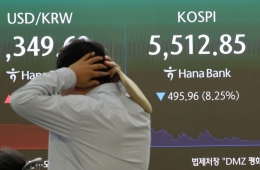
The KOSPI fell to the 5,400 level intraday, triggering a circuit breaker. On the 15th, a display in the dealing room at Hana Bank's headquarters in Jung-gu, Seoul, showed the KOSPI, KOSDAQ and won-dollar exchange rate. Photo by Cho Yongjun.
View original imageAs high inflation persists and doubts grow over the profitability of artificial intelligence (AI) investments, the KOSPI has plunged. Analysts now expect the index to find support around the 5,000-point level.
In a recent report titled "Background to the Market Correction and Outlook," Samsung Securities said the market correction was driven by inflation concerns and spreading credit risks among AI companies.
The brokerage first cited rising inflation concerns after the U.S. Consumer Price Index (CPI) for September came in above market expectations. The U.S. CPI, released on October 14, rose 3.7% year over year, exceeding the forecast of 3.6%. Core CPI, which excludes food and energy, also rose 2.6%, above the expected 2.5%. The report said that, amid a sharp rise in energy costs due to geopolitical tensions in the Middle East, broad-based price pressures were also evident across other categories.
High inflation has also strengthened demand for safe-haven assets. Immediately after the CPI release, the yield on 10-year U.S. Treasury notes briefly topped 5.3%. Samsung Securities noted that U.S. Treasuries, regarded as relatively safe assets, are offering high yields, weakening the relative investment appeal of emerging-market stocks.
A decline in the price of bonds issued by CoreWeave, a U.S. AI cloud company, has also brought credit risks across the AI industry into focus. Yields on the company's corporate bonds rose above 15%, while its credit default swaps (CDS) are pricing in a greater than 50% probability of default over the next five years. The report said this was not simply an issue specific to one company: concerns have mounted over the sustainability of AI infrastructure investment, as high interest rates increase interest burdens and the cost of raising additional funds.
Finally, Samsung Securities said the supply-demand imbalance was widening as foreign investors continued to sell Korean stocks, while institutions and individual investors had limited capacity to buy. Foreign selling has been concentrated in large-cap semiconductor companies, including Samsung Electronics and SK hynix, putting downward pressure on the index. The problem, the brokerage said, is that there are not enough buyers to absorb the shares being sold by foreign investors. As a result, the index's declines have become more pronounced when foreign investors sell.
Jo Ain, a researcher at Samsung Securities, said, "With investor sentiment sharply deteriorating, volatility could remain elevated in the short term." She added, "There is also a high risk that energy supply-and-demand uncertainty will worsen as disruptions to energy supplies from the Middle East persist and coincide with rising demand for heating in winter."
Hot Picks Today
 "I Used to Eat This All the Time in Korea..." What Is This Snack Winning Over Taste Buds Worldwide? [K-Holic]
- "Honestly, Korean Internet Users Really Are Disgusting"... Man Who Threatened to Kill Koreans Offers Absurd Excuse
- Roads Flooded in Several Parts of Gimpo... Reports Near Sau Station, Sau High School
- "This Country Has Completely Lost Its Way... The Country Is on the Brink of Collapse": Rapper Criticizes Childbirth Policies
- "RESCENE's Uncle" Reveals Three Hidden Faces... Ad Draws 2.07 Million Views
She forecast that the 5,000-point level would act as support for the KOSPI. "At that level, the 12-month forward price-to-earnings (P/E) ratio is 4.1 times and the price-to-book (P/B) ratio is 1.1 times, both lower than during periods of heightened stock-price volatility at the end of March and July this year," Jo said. However, she advised that "until foreign selling subsides and external uncertainties ease, it would be prudent to avoid aggressively increasing exposure and focus on risk management."
© The Asia Business Daily. All rights reserved. Unauthorized AI training and use prohibited.