"Samsung Electronics at 70,000 won, SK hynix at 200,000 won"... Why the gloomy outlook despite 'record-breaking earnings'?
"Memory Price Growth Slowing"... Third-Quarter Earnings Peak
"Semiconductor Exports Rose, but... Shipment Volume Fell"
"China's Catch-Up and AI Investment Payback"... Equipment Stocks in Focus
Experts have argued that it is difficult to be optimistic about the semiconductor industry despite improved earnings at Samsung Electronics and SK hynix. Although rising memory prices drove the earnings improvement, analysts say the current boom may be temporary, fueled by supply shortages caused by production cuts. The analyst put the fair stock prices of Samsung Electronics and SK hynix at 70,000 won and 200,000 won, respectively, and said investors should watch for the possibility that memory prices will turn downward.

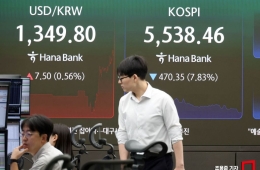
On the 15th, as the KOSPI and KOSDAQ indexes plunged more than 8%, triggering consecutive circuit breakers, the KOSPI and KOSDAQ indexes and the won-dollar exchange rate are displayed on an electronic board in the dealing room at Hana Bank's headquarters in Jung-gu, Seoul. Yonhap News Agency
View original image"Samsung Electronics at 70,000 won, SK hynix at 200,000 won"... Warning of a Peak in the Memory Market
A short-form video titled "Fair Stock Prices for the Two Semiconductor Leaders? Samsung Electronics at 70,000 won, SK hynix at 200,000 won" from the economic program "Money Show," recently released by SBS Biz, featured Industry analyst Lee Juwan's analysis of the share prices of Samsung Electronics and SK hynix and the state of the memory market.
The analyst, who appeared on the program, argued that it was uncertain whether the two companies' improved earnings would lead to sustainable growth. He said that increased profits resulting from higher memory prices did not necessarily signal a structural improvement in the industry, and that earnings could weaken if prices fall in the future.
He put the fair stock prices of Samsung Electronics and SK hynix at 70,000 won and 200,000 won, respectively. His analysis was that the two companies had cut production, creating supply shortages, and that the resulting rise in memory prices had been reflected in their earnings and share prices. However, he considered this trend unlikely to last. The prices were the guest's personal estimates presented on the program and do not represent current share prices or official target prices set by securities firms.
"The Third Quarter May Have Been the Peak"... Focus on Micron's Earnings
The analyst looked for signs of a peak in the memory market in U.S. memory chipmaker Micron's earnings announcement and its outlook for future profitability. Based on Micron's margin outlook, he interpreted the figures as indicating that the industry may have passed its peak and entered a downturn. He also argued that Samsung Electronics and SK hynix were likely to have reached their earnings peaks in the third quarter of this year.
He forecast that memory prices were likely to start falling in the fourth quarter. In his view, the upward momentum in memory prices was slowing even as domestic companies cut production.

The program also noted that Samsung Electronics had not yet released preliminary results broken down by business segment at the time. The analyst explained that total revenue and operating profit alone made it difficult to determine whether improved profitability came from the semiconductor business or was influenced by other business segments, such as mobile.
"Look at the Price Effect, Not Just Export Value"... Capacity Utilization Also a Key Indicator
The program also noted that South Korea's semiconductor exports exceeded $60 billion in September 2026. However, the analyst argued that an increase in export value alone should not be taken as proof of real growth in the semiconductor industry. When memory prices rise, export value can increase even if the volume of exports does not.
He said that, according to his own analytical model, assuming memory prices were unchanged from a year earlier, export-related indicators for DRAM and NAND flash had fallen by 40% and 60%, respectively, on a cumulative basis through August 2026.
Capacity utilization in semiconductor manufacturing was also presented as a key indicator. He said that his analysis of relevant data from August 2026 showed capacity utilization of approximately 78% to 81%, depending on the calculation method. He cited this as evidence that domestic semiconductor companies were cutting production. However, the program did not provide the specific calculation formula or the scope of the data used.
Supply Adjustments Identified as a Key Variable in the Memory Market
The analyst argued that, when assessing turning points in the memory market, changes in supply should be watched more closely than demand forecasts. He explained that while memory demand has grown over the long term, companies' investment levels and the timing of actual production from existing facilities determine whether supply is tight or excessive, affecting prices and profitability in turn.
He interpreted production cuts by Samsung Electronics and SK hynix as measures to prevent prices from falling amid weak demand. In contrast, he said Micron had already ended production cuts it had previously implemented to adjust its inventory. In his analysis, these differences in production adjustments also affected each company's market share and profitability.
He suggested that big tech companies may have entered into long-term supply contracts to secure the volumes they need before memory prices rise further.
AI Investment Returns and China's Catch-Up Also Pose Risks
Some also argued that the growth potential of the AI industry should be considered separately from the state of the memory market. The analyst said that while AI technologies and services are spreading, it remains uncertain whether end-user demand, in which users actually pay for services, has grown enough to support the scale of investment.
He described the data center investment cycle as consisting of approximately three years of investment spending followed by approximately three years of investment recovery. Based on this analysis, he forecast that the ability to recoup investments could come under serious scrutiny starting next year, in 2027. He argued that if AI companies fail to generate sufficient returns, expectations for growth in related industries could also be revised.
However, he emphasized that concerns about AI investment should be considered separately from the memory market. In his analysis, even if AI-related demand increases, changes in memory prices and company earnings are more heavily influenced by shifts in supply.

The advances of Chinese semiconductor companies were also cited as a variable. He said Chinese companies' market share had exceeded 10%, and assessed that China's semiconductor industry had already entered a stage of competition with South Korean companies.
He particularly emphasized that China is a major sales market for South Korean semiconductor companies. His analysis was that Chinese companies' expansion of their share in their domestic market alone could put pressure on South Korean companies' revenue and competitiveness.
He explained that earnings forecasts for semiconductor equipment companies tend to lag those for manufacturers by about one year. Based on an analysis of earnings trends over roughly the past 10 years, he said he had found that the earnings cycles of semiconductor manufacturers and equipment companies followed similar patterns, with equipment companies tending to move about one year later.
Hot Picks Today
 "Samsung Electronics at 70,000 won, SK hynix at 200,000 won"... Why the gloomy outlook despite 'record-breaking earnings'?
- "I Was Just Going Barefoot at Home"... "Absolutely Not": Why Doctors Warn Against It
- "I Was Proud He Finished His Homework Quickly"... Dad Shocked After Checking Son's YouTube History
- Just 13.9 Seconds to Wash Hands After Using the Restroom... "So Many" Use Water Alone, No Soap
- "No Need to Hire a Model"... The 25-Year-Old Woman Who Entered Social Media with a Face That Cost Just 1,500 Won [AI Content: The Bright and Dark Sides] 1
He explained that semiconductor materials companies are closely tied to production volumes, whereas equipment companies are linked to manufacturers' capital expenditures. Accordingly, he forecast that if semiconductor manufacturers' earnings peak this year, in 2026, equipment companies' earnings could improve further next year, in 2027.
© The Asia Business Daily. All rights reserved. Unauthorized AI training and use prohibited.