"What on Earth Is Happening to the Stock Market?" ... KOSPI and KOSDAQ Plunge 8%, Trading Halted (Comprehensive)
Circuit breakers triggered again, two and a half months after the late-July market plunge
High inflation persists as concerns over AI profitability emerge

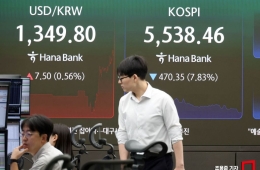
With the KOSPI at risk of falling below the 5,500 mark during intraday trading, a display board in the dealing room at Hana Bank headquarters in Jung-gu, Seoul, shows the KOSPI, KOSDAQ and won-dollar exchange rate on Oct. 15. The KOSPI opened at 5,673.01, down 335.8 points (5.59%) from the previous day's close of 6,008.81, and extended its losses. 2026.10.15 Photo by Cho Yongjun
View original imageCircuit breakers were triggered after the KOSPI and KOSDAQ markets plunged by more than 8%.
According to the Korea Exchange, a circuit breaker was triggered in the KOSDAQ market at around 12:23:13 p.m. on Oct. 15, halting trading for 20 minutes.
Fifteen minutes later, a circuit breaker was also triggered in the KOSPI market.
When a circuit breaker is triggered, trading is halted for 20 minutes, and the acceptance of orders is also suspended, except for orders to cancel. After trading resumes, single-price auction trading takes place for 10 minutes.
This was the first time circuit breakers had been triggered in both markets since July 29, about two and a half months earlier.
After U.S. inflation came in higher than expected the previous day and concerns about the profitability of the artificial intelligence (AI) industry also came to the fore, the KOSPI plunged to the low 5,500s on Oct. 15.
According to the U.S. Department of Labor, the Consumer Price Index (CPI) rose 3.7% in September from a year earlier. The increase was larger than August's 3.4%, and also exceeded economists' forecast of 3.6%. Core CPI rose 2.6% year over year, also above the forecast of 2.5%.
A negative outlook on returns from AI infrastructure investments released by global market research firm Gartner also put pressure on stock markets. Gartner forecast total investment of $7 trillion in AI infrastructure from this year through 2030. It estimated that revenue of $8.5 trillion would be needed by 2030 to generate a return on that investment, while actual revenue would reach only $3.6 trillion. This raised concerns that related companies could incur significant investment losses.
Hot Picks Today
 "I Was Just Going Barefoot at Home"... "Absolutely Not": Why Doctors Warn Against It
- "What on Earth Is Happening to the Stock Market?" ... KOSPI and KOSDAQ Plunge 8%, Trading Halted (Comprehensive)
- [Breaking] Hearing Report Adopted for Kim Jiyong, Nominee to Head Major Crimes Investigation Agency
- Just 13.9 Seconds to Wash Hands After Using the Restroom... "So Many" Use Water Alone, No Soap
- "No Need to Hire a Model"... The 25-Year-Old Woman Who Entered Social Media with a Face That Cost Just 1,500 Won [AI Content: The Bright and Dark Sides] 1

Samsung Securities viewed the 5,000 level on the KOSPI as a support level. Jo Ain, a researcher at Samsung Securities, explained, "At that level, the 12-month forward price-to-earnings ratio (PER) is 4.1 times and the price-to-book ratio (PBR) is 1.1 times, both lower than during periods of heightened share price volatility at the end of March and July this year." However, Jo advised, "Until foreign selling subsides and external uncertainties ease, it is appropriate to avoid actively increasing exposure and focus on risk management."
© The Asia Business Daily. All rights reserved. Unauthorized AI training and use prohibited.