Ministry of Unification: "New Yalu River Bridge Opening Is First Tangible Implementation of June North Korea-China Summit Agreement"
South Korea’s Ministry of Unification said on Oct. 15 that the newly opened New Yalu River Bridge is “expected to serve as important infrastructure for transportation and logistics between North Korea and China.” With a new trade route linking Sinuiju, North Korea, and Dandong, China, now open, attention is focused on whether it will expand cargo shipments and lead to the resumption of people-to-people exchanges, including group tours by Chinese visitors that were suspended after the COVID-19 pandemic.

Chinese trucks head toward North Korea across the New Yalu River Bridge, connecting Sinuiju, North Korea, and Dandong, Liaoning Province, China, on the 14th, a day before the bridge’s opening. Photo by Yonhap News.
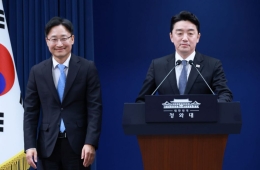
View original imageA Ministry of Unification official told reporters at the Government Complex Seoul that day that the bridge was “effectively the first tangible implementation of the agreements reached at the North Korea-China summit in June.” The official added, “We are watching to see whether this leads to substantive steps toward developing North Korea-China relations into a strategic partnership,” and said, “We will monitor changes in people-to-people and material exchanges between the two countries.”
The New Yalu River Bridge opened about 16 years after construction began and about 12 years after it was completed. Construction began on Dec. 31, 2010, and was completed around October 2014. Traffic had previously been delayed because of issues including inadequate connecting roads and customs facilities on the North Korean side.
According to China Central Television (CCTV) and other media, the opening ceremony for the New Yalu River Bridge was held at 10 a.m. local time that day. With the bridge officially opening, freight transport is expected to be spread across the two bridges once the new one becomes operational, as the existing Sino-Korean Friendship Bridge has both a railway and a single-lane road.
North Korea also opened a road bridge with Russia on Sept. 7. By expanding its logistics network with China in addition to its route to Russia, North Korea appears to be broadening the foundations for exchanges with both countries. Attention is also focused on how far the two countries will advance their agreement to fully reopen border crossings for trade, reached during the June summit between North Korean leader Kim Jong Un and Chinese President Xi Jinping. Before the COVID-19 pandemic, an estimated 200,000 to 300,000 Chinese tourists visited North Korea annually. If group tours between North Korea and China resume, the expansion of people-to-people exchanges following the bridge’s opening will also draw attention.
Asked about some concerns that the bridge’s opening could undermine the effectiveness of sanctions against North Korea, the official said, “Not all North Korea-China trade falls under sanctions against North Korea, so it would be difficult to say that the sanctions are collapsing. We will monitor the situation.”
Meanwhile, North Korea’s Korean Central News Agency reported that day that “the Missile Administration test-fired two types of submarine-launched strategic cruise missiles in the East Sea of Korea on Oct. 14.” The agency said the test “contributed to honing the Navy’s ability to carry out strategic missions” and claimed that it “had no negative impact whatsoever on the security of neighboring countries.”
Regarding the test, the official said, “This was the first such launch in two years and nine months; one was conducted in January 2024 with Kim’s attendance,” and added that authorities were “still determining which submarine was used in the launch.”
Hot Picks Today
 "Samsung Electronics at 70,000 won, SK hynix at 200,000 won"... Why the gloomy outlook despite 'record-breaking earnings'?
- "There's a Drink Like This?"... Chinese Beverage With "Korean" in Its Name Rakes in 85 Million Won in Monthly Sales
- Public Administration and Security Committee Adopts Confirmation Hearing Report on Kim Jiyong, Nominee for Agency Chief (Updated)
- "To Make His Girlfriend Think It Was His": Why He Demolished Someone Else's 2-Billion-Won Apartment
- "No Need to Hire a Model"... The 25-Year-Old Woman Who Entered Social Media with a Face That Cost Just 1,500 Won [AI Content: The Bright and Dark Sides] 1
North Korea’s decision not to say whether Kim attended the test, while emphasizing that it was a routine readiness inspection, is seen as an attempt to avoid excessive provocation abroad. However, some analysts say that the test, following the recent launch of a hypersonic missile and the display of strategic weapons at the National Defense Development Museum, was also intended to strengthen Pyongyang’s leverage in negotiations with the United States, with the possibility of North Korea-U.S. talks in mind.
© The Asia Business Daily. All rights reserved. Unauthorized AI training and use prohibited.