[Field Report] "It Wasn't Like This Five Years Ago"... The Cry of a Pine Forest Turning Red
Suspected dead trees scattered across slopes and ridges... Discolored forest captured by drone
Pine wilt damage in Jeonnam-Gwangju up 6.8-fold in two years... Fears of further spread grow
Expert: "More than 90% likelihood of pine wilt diseas
"We should have stopped it from the beginning. It wasn't like this just five years ago. Now it's spread so much that there's no way to stop it."
On the afternoon of October 13, in a village in Samgeo-dong, Gwangsan-gu, Jeonnam-Gwangju Integrated Special City, a resident who said they had lived there for many years clicked their tongue while looking at the mountain across the way.
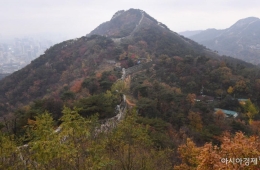
The mountain they pointed to was no longer its original green. Among the dark green trees were patches of trees that had turned reddish and grayish brown. Some pine trees had needles that had dried out completely, while others had been reduced to bare branches. Nearby, some pine trees were still green.

On the 13th, trees that had turned brown and grayish-brown were seen across hills near Samgeo-dong, Gwangsan-gu, Jeonnam Gwangju Special Integrated City. Green and discolored trees are interspersed across the slopes and ridgelines. Photo by Kim Wanjung.
View original imageThe view from above, captured by a drone, revealed an even wider area. Brown trees were scattered along the slopes and ridgelines. In some areas, several trees stood clustered together. Similar scenes were also observed on nearby mountain ridges.
A Gwangsan-gu forestry official at the site said the reddish and grayish-brown pine trees showed "typical symptoms" of pine wilt disease. However, infection cannot be confirmed based on appearance alone, and samples must be collected and tested to determine whether the trees are infected.
After reviewing photos from the site, arborist Kim Jungtae said he believed pine wilt disease was highly likely. "When pine trees suddenly turn red between September and October, there's a very high likelihood that it's pine wilt disease. It's rare for another disease to cause trees to die so quickly," he said. He added, "Taking into account the color and pattern of the damage, I'd put the likelihood of pine wilt disease at over 90%." This is an expert's estimate based on photographs; testing is needed for a definitive diagnosis.

On the 13th, a longtime resident of a village in Samgeo-dong, Gwangsan-gu, Jeonnam-Gwangju Integrated Special City, discusses changes in the surrounding forest, where pine wilt disease damage is suspected. Photo by Kim Wanjung.
View original imageThe resident worried that the damage had spread beyond Gwangsan-gu. They said forests in neighboring areas, including Naju, Hampyeong, and Jangseong, were likely in a similar situation. "It's spread so much. How are they going to stop it? There's no way to stop it," the resident lamented.
A 38-Year Record That Began at Geumjeongsan Mountain in Busan
In October 1988, 38 years ago, pine trees around Geumjeongsan Mountain in Busan began drying up and dying for unknown reasons. An investigation confirmed the first case of pine wilt disease in South Korea. A joint investigation at the time found infections in 1,589 of approximately 1,900 dead trees. The affected area had already reached 100 hectares.
The pine wood nematode is a tiny nematode about 1 mm long. It cannot travel long distances on its own. Instead, it is carried to other trees on the bodies of insect vectors, including the Japanese pine sawyer and the northern pine sawyer. The nematodes enter healthy pine trees when these insects feed on young branches. Once inside the tree, the nematodes multiply and disrupt the movement of water. The pine needles turn red, and the tree eventually dries out and dies.

Changes in areas affected by pine wilt disease. Data provided by the Korea Forest Service. Yonhap News Agency
View original imageSince it was first detected in South Korea, pine wilt disease has spread beyond the Yeongnam region to Honam, the Seoul metropolitan area, and Gangwon. In 2005, the government enacted the Special Act on the Control of Pine Wilt Disease. It established a national control system, including the removal of infected trees and restrictions on the movement of pine trees, but the spread could not be stopped.
In Gwangju, pine wilt disease was first confirmed in November 2013 in Sinnyong-dong, Gwangsan-gu. Six trees were infected. Control measures were carried out, but in 2015, 12 infected trees were found again in Gwangsan-gu.
According to Gwangsan-gu, the disease has spread to multiple areas within the district since its initial outbreak. The damage has been on the rise, particularly since 2022. Gwangsan-gu says the situation resembles the Korea Forest Service's pattern of a third major outbreak of pine wilt disease, and believes that several factors, including climate change, are acting together.
The scale of damage has recently grown sharply. According to data provided to this publication by Jeonnam-Gwangju Integrated Special City, as of May this year, 154,890 pine trees in the region had died from pine wilt disease, about 6.8 times the 22,826 trees recorded in 2024. A total of 96.6% of the damage was concentrated in four cities and counties: 46,216 trees in Yeosu, 37,937 in Suncheon, 33,176 in Gwangyang, and 32,252 in Jangseong. The reporting periods differ: the 2024 tally ended in April, while this year's tally runs through May.
Autumn, After Vector Insects Have Finished Their Activity, Leaves Dead or Suspected Trees Across the Region
A Gwangsan-gu forestry official said the Japanese pine sawyer, which transmits the nematode in the area, is mainly active from June to August. The disease is transmitted by the vector insects during this period, and in autumn, trees showing symptoms are surveyed and treated, the official said.
There is no established treatment that can revive a pine tree once the disease has taken hold. Forestry authorities cut down infected trees and either chip or fumigate them, while injecting preventive chemicals into healthy pine trees nearby. The aim is to reduce sources of infection and prevent further spread before the vector insects move to other trees.

On the 13th, pine trees stand with their needles turned reddish and grayish brown on a wooded hill in Samgeo-dong, Gwangsan-gu, Jeonnam-Gwangju Special City. The trees are suspected of being infected with pine wilt disease, but testing is needed to confirm the infection. Reporter Kim Wanjung.
View original imageHowever, removing infected trees does not stop pine wilt disease from spreading. New damage can occur if infected trees that have gone undetected remain, or if vector insects move in from surrounding areas.
Existing control methods also have limitations. Even if infected trees are cut down one by one or all pine trees are removed from a small area, additional infections can occur in nearby pine trees. A Gwangsan-gu official said, "Control measures are effective in the areas where they are carried out," but added, "It's difficult to express the overall results of control efforts in numerical terms."
Some say that control of vector insects must be strengthened to reduce repeated infections. "No matter how many trees infected with pine wilt disease are cut down, the damage will continue to spread if we can't eliminate the sawyers that transmit the disease," arborist Kim Jungtae said, stressing that "the control methods themselves need to change." He proposed preventive measures to reduce populations of vector insects, including the Japanese pine sawyer and northern pine sawyer, a review of aerial control in mountainous areas, and the use of both drone-based control and preventive injections in trees near residential areas. He also called for stronger oversight of chipping and fumigation after trees are felled and for more field involvement by specialists.
Protect the Pine Trees or Change the Forest?

Park Eunsik, chief of the Korea Forest Service, announces measures to strengthen the implementation of the national pest control strategy at Government Complex Daejeon on the 3rd. The Korea Forest Service.
View original imageThe government is also shifting the focus of its control policy. In a plan announced last September to strengthen implementation of its national control strategy, the Korea Forest Service said it would expand the area for forest conversion from the current level of 4,000 hectares to 100,000 hectares by 2030.
The plan is to protect pine forests with high conservation value intensively, while converting forests to other tree species in areas with severe damage. The aim is to move away from removing infected trees one at a time and instead manage the forest as a whole.
This year, Gwangsan-gu carried out a 3-hectare forest conversion project, focusing on pine monoculture areas. It plans to continue the project, prioritizing areas with severe damage, but has not yet determined the total additional area needed. Gwangsan-gu plans to decide the scale of the project after assessing the damage and conditions at each site.
Forest conversion also comes with practical challenges. As a rule, local governments must obtain the consent of forest owners before carrying out forestry projects on privately owned land. Felling trees, chipping them, planting new trees, and maintaining them afterward also require funding. Cutting down pine trees and cultivating a new forest are separate challenges.

On the 13th, trees turned reddish and grayish brown dot a wooded hill in Samgeo-dong, Gwangsan-gu, Jeonnam-Gwangju Integrated Special City, as seen from a drone. Photo by Kim Wanjung, reporter.
View original imageThe village resident also said forest conversion was necessary. "We need to plant trees that the pine wood nematode won't attack. It doesn't attack hinoki cypress or sawtooth oak, or trees like those. We need to change the species," they said.
Hot Picks Today
 'Big Investor' NPS Has Already Cut Its Losses... Sold Department Store Stocks in Q3 Despite Strong Earnings Outlook
- "There's a Drink Like This?"... Chinese Beverage With "Korean" in Its Name Rakes in 85 Million Won in Monthly Sales
- "Samsung Electronics at 70,000 won, SK hynix at 200,000 won"... Why the gloomy outlook despite 'record-breaking earnings'?
- "I Put in 10 Million Won, but Only 2 Million Won Is Left" ... 77% Plunge Leaves Retail Investors in Samsung Electronics and SK hynix Leveraged ETFs Crying Out
- "The leggings are all see-through. It's so embarrassing to look at," complaints prompt Lululemon to fire development staff.
After finishing, the resident pointed to one side of the mountain. Unlike the brown trees around them, some trees stood out as especially green. The resident explained that they were hinoki cypress planted when the family clan's mountain land was cleared and managed. "You see those especially green trees over there? Those are hinoki cypress," the resident added.
© The Asia Business Daily. All rights reserved. Unauthorized AI training and use prohibited.