Doubts Over "Can AI Make Money?" and Rising U.S. Inflation... KOSPI Plunges 7% on "Black Thursday"
Semiconductor Stocks Tumble... KOSPI Falls to the 5,500 Range
SK hynix Plunges 10%; Samsung Electronics Falls 7%
Higher-Than-Expected Inflation Also Weighs as U.S. Indexes Fall
"A Rebound Requires Easing AI Doubts Through Strong Big Tech Ear

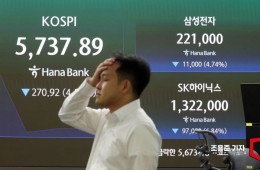
The KOSPI plunged to the 5,500 range as U.S. inflation came in above expectations and concerns mounted over the profitability of investments in the artificial intelligence (AI) industry. On Oct. 15, the KOSPI, Samsung Electronics and SK hynix share prices were displayed on an electronic board in the dealing room at Hana Bank's headquarters in Jung-gu, Seoul. The KOSPI opened at 5,673.01, down 335.8 points (5.59%) from the previous day's close of 6,008.81. 2026.10.15 Photo by Cho Yongjun
View original imageThe KOSPI plunged into the 5,500 range as U.S. inflation came in above expectations and concerns about the profitability of the artificial intelligence (AI) industry intensified. Samsung Electronics and SK hynix, the KOSPI's flagship stocks, were down more than 8%, as doubts about the sustainability of AI investment fueled concerns that profits in the memory semiconductor industry could deteriorate.
Semiconductor Stocks Tumble on AI Profitability Concerns... KOSPI Falls into the 5,500 Range
On Oct. 15, the KOSPI opened down 5.59% from the previous trading day's close and extended its losses, trading at 5,552.06, down 7.60%, as of 10:18 a.m. The KOSPI has fallen for seven consecutive trading days through today. It has not declined for seven or more consecutive trading days since September 2024, nearly two years ago. The KOSDAQ also opened down 4.79% from the previous session at 784.45, then fell further to trade at 763.21.
Amid the sharp losses early in the session, sell-sidecars were triggered in succession on the KOSPI and KOSDAQ markets. The two markets had not both triggered sell-sidecars on the same day since July 29. Foreign investors continued to be net sellers on the KOSPI for an eighth consecutive trading day, pulling the index lower.
South Korea's stock market was also affected by the overnight sell-off across New York markets, driven by concerns about high inflation and the profitability of AI investments. The Dow Jones Industrial Average fell 0.09%, while the S&P 500 fell 1.11%. The tech-heavy Nasdaq Composite also dropped 1.88%. According to the U.S. Department of Labor, the Consumer Price Index (CPI) rose 3.7% in September from a year earlier. The increase was greater than August's 3.4% and exceeded the 3.6% forecast by economists. Core CPI also rose 2.6% year over year, above the forecast of 2.5%.

Negative projections from global market research firm Gartner on returns from AI infrastructure investments also weighed on stocks. Gartner forecast total AI infrastructure investment of $7 trillion from this year through 2030. It estimated that $8.5 trillion in revenue would be needed by 2030 to generate a return on that investment, while actual revenue would reach only $3.6 trillion. This raised concerns that companies involved could incur substantial investment losses.
Seo Sang-young, an executive at Mirae Asset Securities, said, "Gartner's announcement is a long-term projection based on assumptions and does not mean that companies will actually go bankrupt or that losses are certain." He added, "It has nevertheless heightened concerns that even if demand for AI grows rapidly, large-scale capital expenditures may not translate into sufficient returns."
With inflation coming in higher than expected and concerns about AI investment profitability adding to the pressure, neocloud company CoreWeave plunged 15.46%. Major semiconductor companies also fell across the board, including Nvidia (-3.16%), Broadcom (-3.10%), Micron (-4.08%), SanDisk (-5.33%), Western Digital (-4.36%) and Seagate (-4.50%). SK hynix's American depositary receipts (ADRs) also plunged 6.06%, closing at $147.55 and falling below their $149 offering price at the time of their Nasdaq listing in July. The Philadelphia Semiconductor Index also fell 4.3%, extending its losses to a sixth consecutive trading day.
Semiconductor stocks are also falling sharply in South Korea. As of 10:05 a.m., SK hynix was trading at KRW 1,271,000, down 10.43% from the previous session. Samsung Electronics was also trading at KRW 214,250, down 7.65% from the previous trading day. SK Square (-10.09%) and Samsung Electro-Mechanics (-14.63%) were also sharply lower. Other large-cap stocks outside the semiconductor sector were also clearly weaker, including LG Energy Solution (-4.86%), Hyundai Motor (-5.74%), KB Financial Group (-0.57%) and Samsung Life Insurance (-5.68%).

With the KOSPI falling below 5,600 intraday, the KOSPI, KOSDAQ and won-dollar exchange rate are displayed on an electronic board in the dealing room at Hana Bank's headquarters in Jung-gu, Seoul, on Oct. 15. The KOSPI opened at 5,673.01, down 335.8 points (5.59%) from the previous day's close of 6,008.81, and extended its losses. Oct. 15, 2026. Photo by Cho Yongjun
View original imageRebound Hinges on Easing AI Concerns After Strong Big Tech Earnings
Analysts see the KOSPI's previous low of around 5,593, recorded in late July, as its first support level. They say that if the index falls close to that level, bargain hunters could step in and prompt an attempted rebound. However, as the index was already below 5,593 this morning, the support level could move lower.
Kim Min-gyu, an analyst at KB Securities, said, "The biggest factor behind the KOSPI's decline is the contraction in semiconductor sector multiples, or falling valuations." He explained, "Concerns about funding and profitability at big tech and AI companies have begun to cast doubt on the sustainability of AI investment, naturally widening into doubts about the semiconductor sector's ability to generate sustained profits." Kim added, "The KOSPI is likely to find support at a level similar to that of October 2025, when semiconductors were valued as a cyclical industry. That would put the KOSPI at around 5,600, corresponding to a forward price-to-book ratio (PBR) of 1.1."
Analysts say several key turning points will need to emerge for the KOSPI to exit its bear market and sustain a meaningful rebound, including stabilizing inflation and interest rates, improving investor sentiment toward semiconductor stocks, and foreign investors returning to net buying. More fundamental external changes are needed, such as an end to the war between the United States and Iran that stabilizes international oil prices, or a decline in U.S. Treasury yields. Analysts also say foreign investors need to turn to net buying after selling more than KRW 200 trillion worth of KOSPI stocks this year alone and dragging the index lower.
Kim Yong-gu, an analyst at Yuanta Securities, said, "For foreign investors to return to net buying on the KOSPI, there needs to be a growing belief that high inflation and interest rates in the United States have passed their peaks." He emphasized, "Further increases in investment by AI-related hyperscalers and semiconductor companies' earnings growth exceeding market expectations are also needed."
Hot Picks Today
!["At This Rate, South Korea Could Be Left with Nowhere to Stand"... Chinese Cars Break Through Tariff Barriers and Spread Worldwide [China Shock, K Industry on the Brink | Automobiles] (3)](https://cwcontent.asiae.co.kr/asiaresize/93/2026101315460059161_1791873960.png) "At This Rate, South Korea Could Be Left with Nowhere to Stand"... Chinese Cars Break Through Tariff Barriers and Spread Worldwide [China Shock, K Industry on the Brink | Automobiles] (3)
"At This Rate, South Korea Could Be Left with Nowhere to Stand"... Chinese Cars Break Through Tariff Barriers and Spread Worldwide [China Shock, K Industry on the Brink | Automobiles] (3)
- Doubts Over "Can AI Make Money?" and Rising U.S. Inflation... KOSPI Plunges 7% on "Black Thursday"
- "Shall We Grab a Drink?" KRW 30,000 a Round... Young Adults: "Prices Make My Hands Shake; I Can't Drink Out"
- "My prejudice is gone... He looks cool": Huge reaction to citizen who stopped Incheon knife attack
- "No Need to Hire a Model"... The 25-Year-Old Woman Who Entered Social Media with a Face That Cost Just 1,500 Won [AI Content: The Bright and Dark Sides] 1
Lee Jin-woo, head of the research center at Meritz Securities, said, "The market seems to have entered a kind of panic as anxiety about AI profitability remains unresolved." He added, "For the stock market to rebound, big tech earnings ultimately need to exceed expectations, and uncertainty surrounding AI investment must also be removed. The guidance provided in upcoming earnings announcements from big tech companies could offer a clue."
© The Asia Business Daily. All rights reserved. Unauthorized AI training and use prohibited.