Content Industry AI Use at Around 40%... "Once They Start Using It, They Keep Using It"
Korea Creative Content Agency Report
40.6% of Workers and 41.9% of Freelancers Use AI
Key Challenge: "The Ability to Evaluate AI Output"
Generative artificial intelligence (AI) is rapidly making inroads into content production. Four out of 10 industry workers use AI in their work, and around 80% of users say they intend to continue using it. Yet only a tiny fraction of companies have specialized staff and in-house systems. As AI becomes an essential tool for improving production efficiency, people still play the key role in judging the quality of AI-generated output and bringing it to completion.

According to a report recently published by the Korea Creative Content Agency titled “Who Uses AI in the Content Industry, and How?”, AI adoption rates in publishing, comics, webtoons, music, film, animation and character businesses were 40.6% among industry workers, 41.9% among freelancers and 34.1% among businesses. Although the figures remain below half, adoption is rising rapidly. In a separate survey by the agency, the rate of generative AI use among content businesses jumped from 7.8% in 2023 to 13.2% in 2024 and 32.1% in the fourth quarter of 2025.
There was also a clear tendency for people to continue using AI once they had adopted it. The intention to continue using AI among existing users reached 84.1% for industry workers and 79.3% for freelancers. By contrast, the intention to use it in the future among non-users stood at 50.2% and 40.2%, respectively. This shows a marked difference in attitudes depending on whether AI has already been adopted.
Companies have been unable to keep pace with the spread of AI. Among businesses that officially use AI, only 11.8% had specialized staff. In most cases, these were existing employees assigned through organizational restructuring or staff reassignment (70.3%), while new hires accounted for just 3.8%. Only 2.9% of companies had built their own generative AI systems.

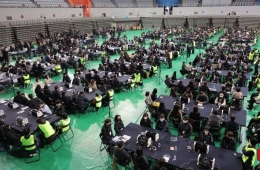
The Korea Cartoonists Association held a public hearing on AI training and protecting creators' rights at the CKL Business Support Center in Jung-gu, Seoul, on the 1st of last month./Korea Cartoonists Association.
View original imageKim Jihyun, a senior researcher at the Korea Creative Content Agency, explained, “With commercial services becoming widespread, conditions are now in place for companies to use AI without their own technology or specialized staff.” The analysis suggests that a “distributed AI-use structure” is taking hold, with companies’ official adoption of AI occurring alongside individual use by industry workers.
How AI was used varied by employment status. Company employees mainly used it to explore, search and analyze information (34.4%), while freelancers primarily used it for 3D modeling (35.5%) and 2D image creation (34.7%). For freelancers, who often handle multiple stages of production on their own, AI served as a work tool spanning everything from planning to delivery.
The main purpose of adopting AI was to improve productivity rather than creativity. “Improving efficiency and productivity” was the most frequently cited reason, at 55.7% among industry workers and 54.9% among freelancers. “Reducing routine tasks” ranked second, at 38.0% and 33.1%, respectively. By contrast, “coming up with new ideas and gaining insights” was cited by only 11.0% and 10.6%.
In practice, AI was mainly used for first drafts and repetitive tasks. In publishing, people combined dozens of titles suggested by AI to create a final version, while webtoon creators used it to restore backgrounds hidden behind speech bubbles. In the music industry, artists re-recorded and rearranged music based on AI-generated accompaniment. In film, AI was used to add editing and color correction to basic footage.

A video’s colors and exposure transformed by the automatic color correction feature in AI video editing software Filmora 16 / Wondershare.
View original imageProduction roles, rather than planning, were identified as the areas where AI use is expected to expand most in the future. Among businesses surveyed, the proportions selecting the character sector (81.2%) and animation sector (79.2%) were particularly high. As a result, the ability to assess the accuracy and completeness of AI-generated output is also expected to become increasingly important.
Hot Picks Today
 "Two Spend 500,000 Won in a Flash, Yet Wait Two Hours?" ... 'Dreamland' Shunned by Kids and Foreign Tourists
- The Era of Getting 200 Million Won After 30 Years Is Over... A Japanese Bank's "Perpetual Department Head" Who Just Clocked In Cries Out
- Spain Hit by Its Worst Tragedy... Lee Kangin, Moreno and Real Madrid Join Soccer World in Mourning
- They Said, “Make It Your Home for Life” - Then Suddenly Kicked 200 Passengers Off... What Happened to the Around-the-World Cruise?
- "130 Rice Bowls Sold Out in a Day"... 'Unfiltered Face' Adds 8 Million Won to Night Market Sales: China's Bungeunwoo
“We should not only teach people how to use the tools; we also need to help them develop the ability to determine whether AI-generated output is accurate and suitable for their work,” Kim emphasized.
© The Asia Business Daily. All rights reserved. Unauthorized AI training and use prohibited.