Lim Kwanghyun, Architect of Lee's 'Meoksanism' Tax Pledge ... From DPK Recruit to Blue House Chief of Staff
Political ties began ahead of the 2024 general election
Built trust while shaping tax pledges for "Meoksanism"
Entered the Blue House after an unprecedented appointment as National Tax Service chief while still a proportional-representation lawmaker
Praised for both expertise and political acumen
President Lee Jae-myung’s surprise appointment of National Tax Service Commissioner Lim Kwanghyun as his new chief of staff on Oct. 14 has drawn attention to the relationship between the two. Although their political ties date back less than three years, Lim’s career path—from being recruited by the Democratic Party of Korea (DPK) to serving as a lawmaker, National Tax Service commissioner and now chief of staff at the Blue House—is seen as embodying President Lee’s pragmatic approach to appointments.

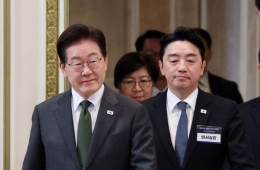
National Tax Service Commissioner Lim Kwanghyun, who was appointed as the new presidential chief of staff, delivers remarks at a press conference at the Blue House on Oct. 14, introduced by his predecessor, Chief of Staff Kang Hunsik. 2026.10.14. Yonhap News.
View original imageTheir political relationship dates back to February 2024. At the time, Lee, then leader of the DPK, recruited Lim as the party’s No. 22 talent ahead of the general election. A former deputy commissioner of the National Tax Service, Lim was a career economic official recognized for his expertise in tax audits. At the recruitment ceremony, Lee stressed that professional public officials form the foundation of national governance and expressed hopes for their participation in politics.
Lim entered the National Assembly that year as No. 4 on the proportional representation list of the Democratic Alliance for Korea, the DPK’s satellite party. He later served as the DPK’s deputy floor leader and standing vice chair of its Policy Committee, supporting President Lee’s key economic policies. In particular, he played a central role in tax policy as the party developed the policy underpinnings of Lee’s “Meoksanism.”
Prominent examples include reforms to inheritance and earned income taxes. While serving as a lawmaker, Lim sponsored bills to raise the general inheritance tax deduction from 500 million won to 800 million won and the minimum spousal inheritance deduction from 500 million won to 1 billion won. These proposals aligned with the direction of inheritance tax reform championed by Lee, who argued for easing the tax burden on the middle class. Lim also led efforts to reduce the earned income tax burden while serving as secretary of the DPK’s “Paycheck Defense Force.” He is credited with translating Lee’s pragmatic approach into policy: emphasizing tax fairness while reducing the actual burden on the middle class and ordinary people.
Lee’s trust in Lim was reflected in an appointment in June last year. Less than a month after taking office, Lee nominated Lim to become the first National Tax Service commissioner of his new administration. It was an unprecedented move to appoint a sitting lawmaker as commissioner. Lim gave up his Assembly seat and returned to his former agency, the National Tax Service. At the time, his expertise in tax administration and ability to communicate smoothly with the president were both cited as reasons for the appointment. During his tenure as commissioner, he supported Lee’s efforts to achieve tax fairness by addressing high-value tax delinquencies and real estate tax evasion, and improving convenience for taxpayers.

President's Chief of Staff Kang Hoon-sik introduces National Tax Service Commissioner Lim Kwanghyun, who was appointed as the new chief of staff, at a press briefing at the Blue House on Oct. 14, 2026. Yonhap News Agency
View original imageHowever, the success of the second chief-of-staff system will likely depend on whether Lim, who entered politics less than three years ago, can reconcile the complex interests within the National Assembly and the ruling camp, and offer the president the candid advice he needs. The relationship that began with their shared focus on policy expertise is now being tested to see whether it can develop into a political partnership in which they jointly take responsibility for governing the country.
Hot Picks Today
 "Even New York Taxi Drivers Are Talking About the KOSPI; South Korean Market to Top 9,000 Again Within a Year"... 'Wall Street's Stock-Picking Ace' Names His Picks
- “Made 2 Billion Won in One Year in Prison,” PPP Lawmaker Retorts: “If You’re Jealous, Go There Yourself”
- “Washing Dishes and Folding Clothes 200 Times a Day”... China’s “Robot Trainers” Earn Up to 1.2 Million Won a Month
- One Night Out Costs 30,000 Won... People in Their 20s and 30s: "I Can't Even Grab a Casual Drink Out Anymore"
- Idol Member Posts Letter Saying "Suspending Activities Due to Pregnancy"... Turns Out She's AI?
A Blue House official described the appointment as “the selection of a hands-on official with strong drive,” adding, “Having experience in both the National Assembly and the government, he is the right person to better reflect the public’s voice in national affairs and accelerate results through cooperation among the party, government and Blue House.” A ruling-party official said, “If he works at the Blue House the way he did at the National Tax Service, its staff will have to stay on their toes and step up their efforts,” adding, “Expectations are high for an economic official who will prove himself through his work and results.”
© The Asia Business Daily. All rights reserved. Unauthorized AI training and use prohibited.