'Political Strategist' Kang Hoonsik's Successor: 'Tax and Administration Expert' Lim Kwanghyun; Lee Focuses on Livelihood Gains and Tangible Results
Successor Named 23 Days After Kang Hoonsik Offered to Resign
Key Appointments to Revamp the Blue House Complete
Economic Official with Experience in Both the National Assembly and Government Appointed
Move Aims to Strengthen Policy Implementation
President Lee Jae-myung’s decision on Oct. 14 to appoint Lim Kwanghyun, commissioner of the National Tax Service and a former economic bureaucrat with extensive expertise in tax administration, as chief of staff to replace Kang Hoonsik, a three-term lawmaker known for his strategic skills, is seen as an effort to restore momentum to his administration by strengthening policy implementation and making its effects more tangible to the public. Analysts say the move also aims to bolster cooperation among the ruling party, the government and the presidential office by placing someone with experience in both the National Assembly and the government at the top of the Blue House staff, while restoring the administration’s weakened coordination functions following a series of recent personnel and policy missteps.

National Tax Service Commissioner Lim Kwanghyun, who was appointed the new presidential chief of staff, listens to remarks by his predecessor, Kang Hoonsik, at a press conference at the Blue House on Oct. 14, 2026. Yonhap News Agency
View original imageKang briefed reporters at the Blue House on Oct. 14, announcing that President Lee had appointed Lim as the new chief of staff. Lim will officially take up the post at the Blue House on Oct. 15. Kang, who is handing over the baton after 499 days in office as of Oct. 15, described his successor as “a former economic bureaucrat turned politician with extensive administrative experience and political acumen,” adding that Lim is “the right person to give the public’s voice greater weight in government affairs and accelerate results through cooperation among the ruling party, the government and the presidential office.”
The appointment comes 23 days after Kang offered to resign on Sept. 21. At the time, he said he was taking overall responsibility for controversies surrounding personnel appointments, including declining government approval ratings and the successive withdrawals of ministerial nominees. President Lee, however, did not immediately accept his resignation and took time to consider a successor.
One notable aspect of the appointment is Lim’s career background. A graduate of the 38th class of the Higher Civil Service Examination, Lim is a career tax official who served as director of the Investigation Bureau at the Seoul Regional Tax Office, director of the Investigation Bureau at the National Tax Service, commissioner of the Seoul Regional Tax Office and deputy commissioner of the National Tax Service. He served as head of an investigation bureau at the National Tax Service six times and was widely regarded as a leading expert in tax investigations. After entering politics in 2024 as a talent recruit for the Democratic Party, he served as a member of the 22nd National Assembly, as well as a deputy floor leader and standing vice chair of the party’s Policy Committee. At the National Assembly, he served on the Strategy and Finance Committee and the Steering Committee, and helped advance tax policies aligned with President Lee’s pragmatic approach.
While Kang, a politician whose strengths lay in election strategy and political coordination, focused on launching the administration and stabilizing the Blue House organization, Lim is seen as someone able to combine his experience implementing policy in the field of public administration with the political acumen he developed in the National Assembly. The Blue House’s emphasis on both Lim’s experience in the legislature and his record of contributing to tax fairness appears to reflect this assessment.
Lim’s appointment was unexpected, given that lawmakers close to President Lee and senior opposition lawmakers with extensive government experience had initially been mentioned as possible successors. Appointing a sitting lawmaker would have raised concerns about a by-election following their resignation from the National Assembly, but Lim, who had already left his seat, is free of that burden. This is why the appointment is seen as prioritizing expertise and experience in implementing policy, as much as political weight.
The appointment also completes a reorganization of the Blue House’s policy and political command structure. On Oct. 1, President Lee promoted Senior Secretary for Economic Growth Ha Jun-kyung to replace former Policy Chief Kim Yong-beom and appointed Vice Minister of Trade, Industry and Energy Moon Shin-hak as the new senior secretary for economic growth. By completing appointments for both the policy chief and chief of staff in succession, the administration has effectively reorganized its governing structure.
While Ha will be responsible for linking economic growth, reducing polarization and social policy, Lim will oversee the Blue House organization as a whole and coordinate cooperation among the ruling party, the government and the presidential office to ensure policies deliver tangible results. Both officials share the task of translating improvements in macroeconomic indicators, such as growth and investment, into changes in people’s lives in areas including housing, jobs and welfare. Lim will also need to make policies more tangible to the public, address criticism over shortcomings in the Blue House’s vetting of appointees, and reorganize its internal decision-making system.

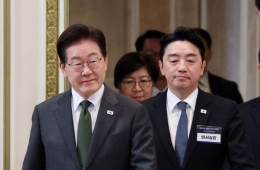
Presidential Chief of Staff Kang Hoon-sik enters the Blue House press briefing room with National Tax Service Commissioner Lim Kwang-hyun, who has been appointed as the new chief of staff, on Oct. 14, 2026. Yonhap News Agency
View original imageHe also faces the task of managing increasingly severe divisions within the ruling camp. Differences between President Lee and hard-line factions in the ruling camp have recently come to the fore over issues including prosecution reform and the appointment of the head of the Serious Crimes Investigation Agency. As President Lee has increasingly intervened directly in major political debates through social media, questions have also mounted about the Blue House staff’s ability to coordinate political affairs. The key question is whether Lim, whose experience in the National Assembly is relatively limited, can navigate the complex interests within the ruling camp and offer the president the candid advice he needs.
Hot Picks Today
 "Even New York Taxi Drivers Are Talking About the KOSPI; South Korean Market to Top 9,000 Again Within a Year"... 'Wall Street's Stock-Picking Ace' Names His Picks
- “Made 2 Billion Won in One Year in Prison,” PPP Lawmaker Retorts: “If You’re Jealous, Go There Yourself”
- “Washing Dishes and Folding Clothes 200 Times a Day”... China’s “Robot Trainers” Earn Up to 1.2 Million Won a Month
- One Night Out Costs 30,000 Won... People in Their 20s and 30s: "I Can't Even Grab a Casual Drink Out Anymore"
- Idol Member Posts Letter Saying "Suspending Activities Due to Pregnancy"... Turns Out She's AI?
“My mission is to continue the achievements of the Lee Jae-myung administration and bring about changes in people’s lives that they can truly feel,” Lim said. “People’s lives are desperate day by day, so every day at the Blue House must be just as urgent.” The success of the new chief-of-staff team will likely depend on whether it can turn the recent personnel shake-up into tangible results and support the president’s strong leadership with stable cooperation among the ruling party, the government and the presidential office.
© The Asia Business Daily. All rights reserved. Unauthorized AI training and use prohibited.