Cisco: "South Korea Scores 58 in Cyber Defense, Below Average... Security Operations Reach an Inflection Point"
Cisco's Relentless Defense Report
Departmental silos slow rapid response
An analysis has found that South Korea's cyber defense capabilities fall short of the global average.

Cisco released its "Relentless Defense Report" on October 13, saying that companies worldwide scored an average of 64 out of 100 for cyber defense capabilities, while South Korea scored 58. The report analyzed companies' security response capabilities based on a survey of 8,000 security professionals in 30 countries worldwide.
"Relentless Defenders," the group Cisco classified as having the highest level of security capabilities, accounted for 8% of respondents overall but just 1% in South Korea.
More than 8 out of 10 respondents worldwide, including those in South Korea, said that using artificial intelligence (AI) had improved their threat detection and response capabilities by at least 25%. However, while one-third of respondents said they had widely adopted AI agents in actual corporate security operations, the figure in South Korea was only about one-fifth. Just 37% of South Korean respondents said they could detect and respond to a breach of an AI agent, well below the global figure of 54%.
Cisco cited friction within organizations as an obstacle to rapid response. It said that unclear roles and responsibilities across departments, complicated approval processes, and poor data sharing between departments were delaying responses to cyber threats and making it difficult to build security systems that use AI.
The share of respondents who said their security, networking, and IT teams shared visibility and tools and worked together as one team was 41% globally, compared with 24% in South Korea. Meanwhile, 44% of South Korean respondents said they spent more time collecting data scattered across multiple systems than responding to threats, higher than the global figure of 40%.
Cybersecurity incidents are also having real-world consequences. The share of respondents who said they had experienced a cybersecurity incident that had a material impact on their business in the past year was 91% globally and 80% in South Korea. More than one in three of these incidents were found to involve attacks using AI.
Hot Picks Today
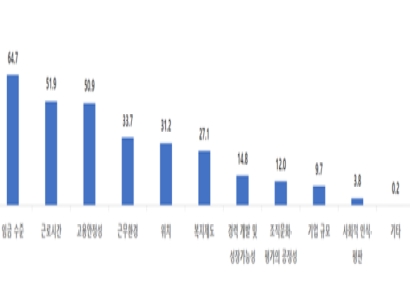 "Please Pay Me at Least 3 Million Won a Month": More Than Half of Young People Today Prioritize "Working Conditions" Over Company Size
- Selling Like Crazy Every Year... 30-Year-Old Hetbahn Takes on a New Challenge: Tastes Better Than "Mom's Home Cooking" [On-Site Report]
- I Thought Only 'Old Guys' Ate It... Young People Are Hooked on This 'Unusual Food' at Risk of Disappearing? [Delicious Stories]
- "Hey, Lady, Teach Your Kids to Behave!" ... 300,000 Won in Cash and a Bodily Injury Claim Demanded Over Child's Door Ding
- Beachgoer Finds 'Plastic' That Turns Out to Be Perfume Ingredient Worth More Than Twice as Much as Gold
Carl Solder, chief technology officer (CTO) for Cisco Australia and New Zealand, said, "The adoption of AI in networks was an inevitable shift," adding that "security operations are reaching the same inflection point." He added, "Organizations that are leading the way are not merely using AI as a chatbot added to the security operations center (SOC); they are using the network fabric itself as a sensor and policy enforcement engine within the security stack."
© The Asia Business Daily. All rights reserved. Unauthorized AI training and use prohibited.