[2026 Audit] Oh Taeseok: "Foreign Launch Vehicles Inevitable for Building an Independent Satellite Communications Network"
Up to 512 Satellites Under Consideration by 2035; Domestic Launch Vehicles Insufficient for Initial Deployment
Reusable Launch Vehicle Targeted for Completion by 2032; Fairness of Second Space Center Site Selection Challenged
South Korea is expected to have to use foreign launch vehicles for the low Earth orbit satellite communications network it aims to build by 2035. The government is considering plans to deploy as many as 512 satellites, but it will be difficult to establish the initial network using only the domestically developed launch vehicles currently planned. The government plans to develop a reusable next-generation launch vehicle by 2032, but it still faces numerous challenges, including expanding launch infrastructure and establishing a basis for testing space components under real-world conditions.
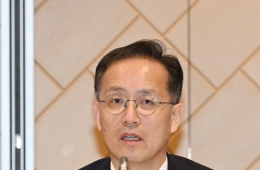
On October 13, at a National Assembly audit of the Science, ICT, Broadcasting and Communications Committee, Korea Aerospace Administration (KASA) Administrator Tae seog Oh responded to a question from Democratic Party of Korea lawmaker Lee Yeon-hee about plans to build a low Earth orbit satellite communications network. "The biggest bottleneck for a low Earth orbit satellite communications network is launch vehicles," he said. "The Nuri and next-generation launch vehicles currently planned will not be enough to build the initial satellite network, so we will have to use foreign launch vehicles."

Researchers conduct final inspections of the Next-Generation Medium-Sized Satellite 3 and CubeSat deployment tubes mounted on the third stage of the Nuri rocket at the Satellite Testing Building of the Naro Space Center in Goheung, South Jeolla Province. Provided by the Korea Aerospace Research Institute.
View original imageIn July, the government announced at the National Space Committee that it would build an independent low Earth orbit satellite communications network by 2035. It is considering three options for deploying 128, 256 or 512 satellites.
Citing materials submitted by KASA, lawmaker Lee asked whether South Korea had the domestic industrial capacity to manufacture and launch hundreds of satellites. Administrator Oh replied, "Companies are preparing mass-production facilities for satellites, so I believe production will be fully feasible."
However, he acknowledged that launch capacity is limited. Lawmaker Lee presented his own estimate that, based on domestic launch vehicle schedules, only about 62 satellites could be launched, and asked how the remaining satellites would be launched. Administrator Oh responded that even a network of 128 satellites would be difficult to deploy initially using only domestic launch vehicles.
Demand for replacement satellites must also be considered. Administrator Oh explained that the number of satellites the government is considering refers to the operational satellites that make up the communications network, and that one to two reserve satellites would also be needed for each orbit. Assuming a lifespan of about five years for low Earth orbit communications satellites, replacement launches would also need to be carried out on an ongoing basis.
Reusable Launch Vehicle to Be Completed by 2032; Test Demonstration Planned for 2028
The development schedule for the next-generation launch vehicle, intended to enhance the competitiveness of domestic launch vehicles, was also revealed.
In response to a question from Democratic Party of Korea lawmaker Lee Jeong-heon, Administrator Oh said, "We will complete a next-generation launch vehicle that is reusable in terms of its hardware by 2032."
KASA plans to develop a test vehicle about 12 meters long and demonstrate reusable technology in 2028. After the vehicle carries out a lunar landing mission in 2032, the plan is to further advance the technology through practical use.

The successfully recovered first-stage rocket booster. Screenshot from SpaceX's website.
View original imageThe next-generation launch vehicle was originally scheduled to be developed as a disposable rocket fueled by kerosene, but the project direction was changed last year to a reusable rocket fueled by methane. The change prompted controversy over delays to the development schedule and the procedures for changing the project.
"We did lose a lot of time during the change last year," Administrator Oh said. "We are now moving quickly through the design phase to fulfill the mission originally intended."
At the audit, lawmakers also raised concerns about costs and contract issues related to delays in the overseas launch of the Korea Multipurpose Satellite (Arirang) 6.
Lawmaker Lee Yeon-hee said the launch of Arirang 6 had been postponed several times and pushed back to the second quarter of 2027, resulting in additional costs of about 3.8 billion won. Asked whether compensation would be provided for the delay, Administrator Oh replied, "We are currently discussing compensation for the delay in accordance with the terms of the contract."
Lawmaker Lee stressed that, given the unavoidable reliance on foreign launch vehicles, standard guidelines for overseas launch contracts for national satellites were needed to address launch delays, substitute launches and contract termination. Administrator Oh said he would review the relevant guidelines and report back to the National Assembly.
Fairness of Site Selection for Second Space Center Challenged; Funding for Verification Satellites Also Inadequate
Questions were also raised about the fairness of the process to select a site for the second space center, part of efforts to expand launch infrastructure.
People Power Party lawmaker Lee Jin-sook alleged that the application process for the second space center may have effectively favored a particular region, saying that of the two participating locations, Goheung in South Jeolla Province and Seogwipo on Jeju Island, only Goheung could meet the site requirement of about 5.62 million square meters (1.7 million pyeong).
Lawmaker Lee also pointed out that representatives of companies and institutions involved in the space industry had taken part in the site selection committee, and questioned whether sufficient safeguards against conflicts of interest were in place.
Administrator Oh responded that Goheung was the location that met the basic physical requirements, while explaining that the selection committee would determine whether it was ultimately suitable.

The Nuriho, South Korea's homegrown launch vehicle, is secured to the launch pad at the Naro Space Center in Goheung County, Jeonnam-Gwangju Integrated Special City, on the 6th, ahead of its fifth launch. Provided by Yonhap News.
View original image"The next-generation launch vehicle needs not only a launch site but also a landing site and assembly facilities for a return to land," he said. "That much land is needed when demand for private launch vehicles is also taken into account."
Lawmakers also noted delays in testing space components and artificial intelligence (AI) technology in the space environment.
Lawmaker Lee Ju-hee stressed that domestic space components must establish a track record of operating successfully in orbit, known as "space heritage," to enter overseas supply chains, and called for the verification satellite program to be brought forward.
Administrator Oh responded, "The market for space AI data centers is growing, so we need to conduct tests quickly. The K-Moonshot program has very little funding for related work, and no funding for verification satellites has been included." He then requested support during the National Assembly's budget deliberations.
Hot Picks Today
 "Jealous of Koreans" - Now a Must-Do on Every Trip... The Place Where Foreigners Spent KRW 229.8 Billion
- [Why&Next] Why NAVER Is Doubling Down on Membership with 'Nepe Festa'
- "I thought getting into a big company was the goal"... The 'position' only 1 in 121 employees reaches
- "'No! Dad, Run!'... Father Moved by 5-Year-Old Son Who Shielded Him from Ghost at Korean Folk Village"
- "Please Let Me Go Home"... Customers Trapped in Department Store Parking Lot for 5 Hours Vent Their Anger
Operational issues within KASA were also raised. Administrator Oh explained that when the agency opened in 2024, it had no choice but to expand the recruitment of fixed-term civil servants because it was difficult to secure specialists. He added that, now that the organization has stabilized, fixed-term civil servants are recruited mainly for the Mission Directorate.
© The Asia Business Daily. All rights reserved. Unauthorized AI training and use prohibited.