Lee: "We must avoid submissive or deferential attitudes in diplomacy... Differences may arise between countries"
Amid recent controversy over "strains in the ROK-U.S. alliance"
President Lee: "Differences themselves cannot be treated as a problem"
Praised Foreign and Trade Ministries for strategic investment negotiations with the U.S.
"South Korea reached t
President Lee Jae Myung stressed on the 13th that South Korea should maintain the ROK-U.S. alliance as a central pillar of its diplomacy while avoiding subservient or overly deferential attitudes toward major powers. Amid recent signs of strain surrounding the alliance, he praised the efforts of the diplomatic and trade officials who led strategic investment negotiations with the United States and called for a foreign policy guided by practical principles and the national interest. Domestically, he instructed the government to focus its resources on three key social policies—housing supply, job security, and inclusive finance—to ensure that the gains from rapid economic growth improve people’s lives.
At a Cabinet meeting he chaired that day at Cheong Wa Dae, President Lee said, "The Republic of Korea’s diplomatic policy is clearly one of practical diplomacy centered on the national interest," and called for "diplomacy that serves only the Republic of Korea and protects its national interests." He added, "We must avoid subservient or overly deferential attitudes in relations between countries." He continued, "Differences are inevitable between countries," adding that "the mere existence of differences cannot be treated as a problem."

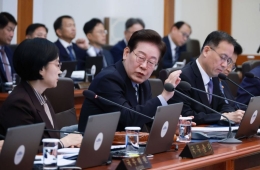
President Lee Jae Myung speaks during a Cabinet meeting at Cheong Wa Dae on Oct. 13, 2026. Yonhap News.
View original imagePresident Lee’s remarks appear to have been made with the recent controversy over "signs of strain in the ROK-U.S. alliance" in mind. The United States has restricted the sharing of information about North Korean nuclear facilities with South Korea since March, citing Unification Minister Chung Dong-young’s remarks about the "Kusong nuclear facilities." The opposition says this has caused a rift in the alliance and that Minister Chung should be dismissed. President Lee appeared to back Minister Chung directly that day, saying that "differences themselves are not a problem."
He also made clear that the national interest must not be sacrificed in negotiations with other countries. "If we are not careful, we could end up sacrificing our national interests in competition between countries," President Lee said, encouraging the Ministry of Foreign Affairs and the Ministry of Trade, Industry and Energy, which took part in negotiations with the United States. He said, "Of the many countries identified as targets for strategic investment [by the United States], South Korea negotiated the longest and reached the conclusion most aligned with its national interests." Regarding the U.S. side’s description of the South Korean negotiating team as "tough," he said, "That reflects [the United States’] frustration, but it is also a compliment," adding, "You worked incredibly hard and did a great job."
President Lee also instructed officials to carefully address polarization, which concentrates the fruits of economic growth among certain groups. He said that some institutions forecast South Korea’s economic growth rate at 4%, but added, "The brighter the glow of growth, the more carefully we must examine the shadows it casts." He expressed concern, saying, "If we continue to leave these problems unaddressed, they could have a major impact on the entire economy, and the door to new growth that we are working so hard to open could soon close again." He also said, "Now is the time to join forces to bridge the widening divide and lower the barriers of inequality for greater growth and sustainable development," and called on the government to "focus its resources on implementing three key social policies: housing supply, job security, and inclusive finance."
He stressed that social policies must also support the success of three major projects underway, centered on semiconductors, physical artificial intelligence (AI), and AI data centers. "Economic growth and reducing disparities are two sides of the same coin, and are both necessary and sufficient conditions for a Republic of Korea where people live together," President Lee said, urging officials to "step up efforts to develop concrete, achievable policies."

President Lee Jae-myung applauds while speaking at a Cabinet meeting at the Blue House on October 13, 2026. Yonhap News, October 13, 2026.
View original imageHe signaled a shift away from requiring people to apply for welfare benefits. Pointing out that similar tragedies have continued even after the case of the three women from the same family in Songpa, President Lee said, "We must move away from an application-based system, in which support is provided only after people ask the state for help, and shift to a model of automatic welfare support, in which the state proactively identifies people in need and provides assistance." He told the relevant ministries that "welfare is not charity but a right to which the people are entitled," and called for them to address gaps in welfare coverage by revising subordinate laws and strengthening cooperation among agencies.
Regarding the results of the Arctic route’s test voyage, President Lee spoke positively about its commercial potential while emphasizing the need for follow-up preparations. Referring to the successful trial voyage of the Panstar Acro, which returned to Busan on the 11th, he called for officials to "accumulate navigation data through continued test voyages and verify the route’s economic viability and safety." In particular, he stressed the need to move quickly to secure icebreaking vessels and provide insurance and financial support, while expanding Busan Port’s infrastructure, building Gadeokdo New Airport, and improving the rail freight network. He also called for diplomatic efforts to maintain stable relations with countries near the Arctic route.
Hot Picks Today
 "Expensive, Smelly and Scary"... What's Happened to the "Honeymooners' Paradise" Tourists Have Abandoned?
- "I Want to Eat Like Koreans..." Foreigners Who Once Opened Ramen Packs Now Keep Gochujang in Their Pantries
- Women Who Say "A Husband's Annual Salary of 100 Million Won Is a Given"... Matchmaking CEO: "They Talk About It Like It's Nothing"
- [Gyeonggi Provincial Audit] Choo Mia: "Official Residence Was Not Lavish... I Responded to Resignation Petition by the Rules"
- "They Said Today Was the Cheapest..." "Let's Get Wedding Jewelry!" Why Did the Luxury Brand Crowds Flocked To Cut Prices by 1.08 Million Won?
Meanwhile, President Lee instructed the relevant authorities to thoroughly investigate whether their initial responses were appropriate in cases involving relationship-based crimes, including stalking and domestic violence, that recently occurred in Seoul. "We must never allow victims’ suffering and fear to go unaddressed on the grounds that there are gaps in the system," he said, calling for legal and institutional improvements to effectively prevent perpetrators from approaching victims. He also addressed allegations that workers at an automobile battery manufacturing plant were given injections described as "vitamin shots" under false pretenses, when they were actually injections intended to remove heavy metals. Calling this "treating workers like objects," he ordered a prompt investigation into the facts and strict legal action.
© The Asia Business Daily. All rights reserved. Unauthorized AI training and use prohibited.