Lee Changes the "Rules of Reform" ... Effectively Breaks with Ruling Party Hard-Liners
Lee posts up to 12 times a day on social media in October
Takes on hard-liners, stresses Lee-style reform
Foreign affairs, policy and government promotion... directly enters political debates
Coordination among the ruling party, gover
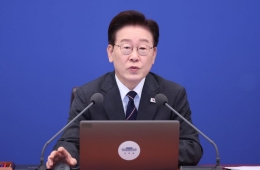
President Lee Jaemyung is changing the rules of reform. While prioritizing tangible results over political clarity, he is also continuing to break with convention in his communication with the public. He is expected to intervene more frequently and directly in political debates, using social media to weigh in on everything from sharp remarks by hard-liners within the ruling camp about prosecutorial reform to other political controversies. Some have voiced concern that this could diminish the role of presidential aides, who are supposed to coordinate between the ruling party, the government and Cheong Wa Dae.

Lee Jaemyung, the Democratic Party presidential candidate, greets his wife, Kim Hyekyung, after delivering his victory speech on a stage set up in front of the National Assembly in Yeouido, Seoul, on June 4, the day after the 21st presidential election, as his victory became all but certain. 2025.6.4 Photo by Kim Hyunmin
View original imageA notable recent change in President Lee's social media activity is that he has begun directly setting the direction and pace of reform. In particular, he has publicly pushed back against an internal contest within the ruling camp over who can take the clearest stance on prosecutorial reform. According to Cheong Wa Dae on October 12, President Lee wrote on X, formerly Twitter, on October 4: "Reform is for the people and the country, not for someone's political achievements or applause," stressing what he called "pragmatic reform." On October 5, he warned, "No one should use prosecutorial reform as a pretext to let personal interests dictate personnel appointments or even specific investigations and prosecutions." His remarks came as hard-liners in the ruling camp, including Gyeonggi Province Governor Choo Mi-ae and Democratic Party of Korea lawmaker Kim Yong-min, continued to oppose the appointment of Kim Jiyong as a candidate to head the Serious Crimes Investigation Agency.
On October 9, he stepped up his criticism of hard-line views. Sharing an opinion piece by former Seoul Superintendent of Education Cho Hee-yeon, he wrote: "It is more problematic when people who lack the ability to handle major positions demand them and try to dictate personnel appointments and national policies, then, when that does not work, invoke lofty causes to call for radical reform and attack those within their own camp." Although he did not name anyone, his remarks were interpreted as targeting the hard-line reform faction that has clashed with the government over prosecutorial reform and personnel issues.
These messages reflect President Lee's determination not to rely on hard-line slogans and rallying his supporters to establish the legitimacy of reform. They can also be read as a warning against letting the demands of particular political factions or hard-line supporters dictate personnel decisions and policy.
This shift has led to a sharp increase in his social media activity. President Lee's posts on X, formerly Twitter, rose from 37 in August to 116 in September, more than tripling. By October 11, he had already posted more than 60 times that month. In just 11 days, he surpassed his total for all of August, averaging about six posts a day. On October 5 alone, he posted 12 times: five posts promoting policy, four about real estate and three about prosecutorial reform. The president is increasingly stepping into the forefront of political debate, going beyond routine promotion of government activities to rebut criticism of policies and respond to disagreements within the ruling camp.
He is also using social media to address a wider range of issues. On the night of October 10, President Lee said he had ordered the agency responsible for transnational crime to take measures to physically destroy and shut down illegal pornography and gambling websites hosted overseas if they could not be legally closed or blocked. On October 11, he explained his policy to normalize housing supply and criticized those in power who enjoy luxuries funded by taxpayers while cutting welfare budgets for ordinary people. In effect, social media has become a platform for him to express views on personnel and policy, issue specific government directives and discuss issues affecting people's livelihoods.
President Lee has made clear that he will not back down despite concerns about this style of communication. On October 10, referring to former President Roh Moo-hyun's exchanges with the public through online comments, he said he would continue visiting sites and communicating through social media, "even if people criticize me by saying it lacks dignity and authority." On October 11, he said, "The essence of politics is who wins the empathy and consent of more sovereign citizens," and urged his supporters to engage in fact-based, rational debate and persuasion rather than verbal abuse, profanity or mockery.
This direct communication is expected to expand further. On October 11, Cheong Wa Dae Senior Secretary for Public Relations and Communication Sung Ki-hong wrote on X that, aboard his official plane returning from a state visit to Mexico last month, President Lee had said, "I reflected on myself. From now on, I should work harder to communicate with the public and communicate more directly." Sung said social media was one of several channels of communication, and that the president's aim was not simply "social media politics" but dialogue that would narrow the distance between the president and the public. The plan is also to expand other forms of direct communication, including press conferences, interviews and town hall meetings.

The concern, however, is that as the president's direct communication expands, the coordinating role of the ruling party, the government and Cheong Wa Dae could be relatively weakened. The president's public remarks are taken not merely as personal views, but as the government's policy direction or de facto instructions. In matters involving sharply divided interests, such as personnel appointments and economic policy, if the president states his position first, it may become more difficult for relevant ministries and aides to review and coordinate the issue before or after the fact.
Some also say that having the president personally engage with conflicts within the ruling camp has both advantages and disadvantages. It can clarify the president's intentions more than conveying messages indirectly through the party leadership or Cheong Wa Dae aides, but it can also turn policy disagreements into questions of support for or opposition to the president. If aides fail to adequately serve as a buffer by mediating political disputes and refining the president's messages, the burden of running the government will inevitably fall back on the president.
Hot Picks Today
![Claims That "Daiso Is Being Shut Down to Save AliExpress and Temu" Spread Widely... A Fact-Check [Why&Next]](https://cwcontent.asiae.co.kr/asiaresize/93/2023121315590987574_1702450749.jpg) Claims That "Daiso Is Being Shut Down to Save AliExpress and Temu" Spread Widely... A Fact-Check [Why&Next]
Claims That "Daiso Is Being Shut Down to Save AliExpress and Temu" Spread Widely... A Fact-Check [Why&Next]
- "We invested on the government's assurances"... The 'Valley of Death' drags on [Hydrogen, Broken Ladder] ②
- "All He Did Was Reheat and Eat Fried Rice Made the Day Before"... Man in His 20s Nearly Needed a Liver Transplant
- President Lee's Approval Rating Falls 2.2 Percentage Points to 35.2% [The Asia Business Daily-Realmeter Poll]
- "Looks Like They're Having an Affair": What If You Opened a KakaoTalk Chat, Filmed It, and Shared the Video With Coworkers?
A senior ruling-party official said, "The key going forward will be whether the government can lower the barriers to communication while maintaining the aides' vetting role and the function of consultations between the ruling party and the government." The official added, "As the president's messages become more frequent, the importance of coordinating government affairs to turn them into concrete policies and take responsibility for the results must also grow."
© The Asia Business Daily. All rights reserved. Unauthorized AI training and use prohibited.