Choi Tae-won: "If China and the U.S. Expand Capacity Faster, Our Market Share Will Shrink... We Need to Hurry, Too"
SK Invests 80 Trillion Won in China Over 35 Years
Plans to Establish AI R&D Center in Shanghai
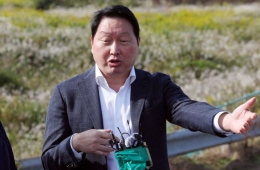
SK Group Chairman Chey Tae-won said on October 11 (local time) that "we, too, need to do something as quickly as possible" regarding the Honam semiconductor cluster project.

SK hynix Chairman Choi Taewon answers reporters' questions after completing an on-site visit on the 9th to the former military airport site in Seo-gu, Jeonnam-Gwangju, where a semiconductor industrial complex is set to be built. Yonhap News
View original imageChey spoke with Yonhap News Agency at the venue of the 38th Shanghai International Business Leaders Advisory Council meeting, held in Shanghai, China, saying, "We need to expand as quickly as possible. If Chinese companies or U.S. company Micron expand capacity faster, our country's market share will fall."
He said capacity expansions must continue not only in Gwangju but also elsewhere, explaining, "There is enormous demand, and the problem is if we can't expand our factories." Asked about the possibility of expanding plants overseas, including in Japan, he said the matter was "under study."
On October 9, Chey visited the site of the Gwangju military airport, where the Honam semiconductor cluster is planned, and said, "If I think the conditions are right to build, I will build as much as possible at the fastest pace." He also said semiconductor demand is growing rapidly and that circumstances may require building a new fab, even in parallel with the Yongin semiconductor cluster.
The global boom in artificial intelligence (AI) has ushered in a semiconductor industry boom, but Chinese companies are rapidly catching up in the memory market led by Samsung Electronics and SK hynix. These include ChangXin Memory Technologies (CXMT) in DRAM and Yangtze Memory Technologies (YMTC) in NAND flash. Some observers say that aggressive capacity expansions by these companies, which receive support from the Chinese government, could increase supply.
On the Chinese companies' catch-up, Chey said, "If you leave them alone, they'll catch up in every area. They're coming after us at a fast pace." He added, "We need to compete fiercely, but we haven't been able to expand in the Chinese market, so we're not competing very effectively there."
He added, "It doesn't seem very wise to think that we can stop China's semiconductor industry," noting that "CXMT and YMTC keep advancing at a frightening pace."
At the meeting, held under the theme "Promoting Innovation and Development in Shanghai's Service Sector," Chey said, "SK has invested around $60 billion (approximately 80.6 trillion won) in China in areas including semiconductors, batteries and petrochemicals," adding that it "has grown into the largest foreign investor in China over the past 35 years."
According to materials from the organizers, a statement issued under Chey's name said SK is pursuing plans to establish an AI research and development (R&D) center in Shanghai. The center is expected to conduct research on AI data centers, physical AI and biopharmaceuticals. Regarding long-term cooperation and investment, SK said, "The Shanghai government can play an important role in increasing transparency and predictability in policy and review processes."
Hot Picks Today
![Claims That "Daiso Is Being Shut Down to Save AliExpress and Temu" Spread Widely... A Fact-Check [Why&Next]](https://cwcontent.asiae.co.kr/asiaresize/93/2023121315590987574_1702450749.jpg) Claims That "Daiso Is Being Shut Down to Save AliExpress and Temu" Spread Widely... A Fact-Check [Why&Next]
Claims That "Daiso Is Being Shut Down to Save AliExpress and Temu" Spread Widely... A Fact-Check [Why&Next]
- "Three-Star Rooms at 980,000 Won a Night, Five-Star at 2 Million"... Busan Fireworks Festival Seats Cost 100,000 Won, but Hotel Views Bring Another Price-Gouging Row
- [Exclusive] IBK Allocates 15% of IT Budget to Security... Plans Dedicated GPU to Extend 15-Year Incident-Free Record
- "All He Did Was Reheat and Eat Fried Rice Made the Day Before"... Man in His 20s Nearly Needed a Liver Transplant
- "Looks Like They're Having an Affair": What If You Opened a KakaoTalk Chat, Filmed It, and Shared the Video With Coworkers?
Shanghai Party Secretary Chen Jining and Shanghai Mayor Zhu Zhongming attended the event. This was Chey's second time attending, following last year.
© The Asia Business Daily. All rights reserved. Unauthorized AI training and use prohibited.