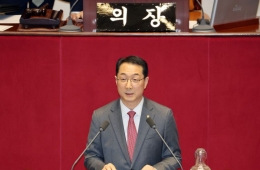
'KOSHA's First Woman' Standing Auditor Jeong Hyeseon Leads Audit Innovation With Occupational Safety and Health Expertise
Five months after taking office as the first female standing auditor at the Korea Occupational Safety and Health Agency
Expanding the Audit Advisory Committee and strengthening the Ombudsman's role
Broadening the scope of audits, from AI and big data to serious accident prevention
Building a "field-focused audit" system while strengthening integrity and internal controls
Jeong Hyeseon, the first woman to serve as a standing auditor since the Korea Occupational Safety and Health Agency was established, has been broadening the scope of her work by actively applying her expertise in occupational safety and health to auditing, just over five months after taking office. She is expanding the scope of audits, from strengthening audit functions with the help of external experts and building audit capabilities using artificial intelligence (AI) and big data to preventing serious accidents and fostering a culture of integrity.

When she took office on May 15, the standing auditor said, "I will establish a risk-based audit system to enhance internal controls and actively support efforts to strengthen workplace accident prevention programs." Her career as an occupational safety and health expert—including a doctorate in public health from Seoul National University, a professorship in preventive medicine at the Catholic University of Korea, the presidency of the Korean Federation of Occupational Safety and Health Organizations, and service as an occupational health expert committee member at the Ministry of Employment and Labor—made her distinct approach to auditing stand out.
The most notable change since she took office has been the establishment of a system that actively brings external expertise into audits. In July, the agency appointed 10 new experts in six fields—safety, health, environment, law, public administration, and artificial intelligence (AI)—to its Audit Advisory Committee, expanding it to 14 members, including existing members. The move aims to incorporate perspectives from a range of professional fields into internal audits and to pursue data-driven audits using AI.
The agency is also strengthening the role of the KOSHA Ombudsman, an external oversight body. At its second meeting, held in July, the ombudsman reviewed a public service for hazardous and risk prevention plans in the manufacturing sector, the operation of the Occupational Safety and Health Research Committee, a system for disclosing companies' safety and health status, and an evaluation system for private accident prevention organizations. At its third meeting, held on August 29, it again reviewed the implementation of institutional improvement measures and closely examined the effectiveness of the "Company Safety and Health Status Disclosure System," which is scheduled to launch in earnest next year. In particular, the focus is on turning the ombudsman's work into institutional improvements that enhance the transparency and fairness of the agency's programs, rather than limiting it to external advice. The agency is also pursuing rule revisions to improve the fairness of the Research Committee and the evaluation system for private organizations.

The agency has also expanded cooperation with specialized audit organizations. In August, it signed a business agreement with Korea District Heating Corporation to strengthen audit expertise and internal controls, and agreed to share audit techniques using AI and big data, as well as best practices in occupational safety and health. Cooperation will also include support from specialized personnel and cross-audits.
In September, the agency joined forces with the Korea National Park Service and the Korea Tourism Organization to share audit techniques for preventing serious accidents and for safety and disaster management, audits of large-scale facility construction and procurement and contracting, and AI-based audit techniques. The aim is to strengthen internal controls by combining the audit capabilities and experience of other public institutions, with occupational safety and health at the center. The agency is also pursuing initiatives to make integrity part of its organizational culture.
From September 14 to 18, the agency held an intensive practice week under the theme "Integrity: Let's Rise Together!" The program included mock conflict-of-interest reporting exercises, discussions of integrity-related concerns, and a personal pledge by each employee to uphold integrity and safety, helping employees apply integrity principles in their day-to-day work. Standing Auditor Jeong said, "It is important not just to know the rules on integrity, but to put them into practice through sound judgment and conduct in our daily work. I will make the principles clear and communicate with an open mind to deliver audits that earn people's trust."
Hot Picks Today
 "I Came to Korea and Easily Made 3.3 Million Won a Month"... The "Easy Gig" Everyone's Talking About Among International Students Turns Out to Be...
- More Than 900 Schools Shut One After Another... Japan in Turmoil Over 'Infectious Disease' Outbreak
- North Korean Landmine Incident... Angry Male Support for Ruling Party Falls 10.5 Points [Asia Business Daily-Realmeter Poll]
- "Hand in Your Resignation and Get a Year's Salary"... This Country Pushes Early Retirement for Civil Servants
- "Oh Eunyoung's Consultation Fee: Millions of Won? Not Expensive"... Yonsei Professor's Sharp Rebuke over "300,000-Won Lecture Fee"
Standing Auditor Jeong Hyeseon said, "By establishing a risk-based audit system and enhancing internal controls, I will support the agency in achieving its management goals and actively help strengthen workplace accident prevention programs," adding, "I will do my utmost to help the agency become an institution trusted by the public through transparent audit administration."
© The Asia Business Daily. All rights reserved. Unauthorized AI training and use prohibited.