Why President Lee Said "I Reflected on Myself" Right After His Mexico Visit
Senior Secretary Seong Gi-hong reveals president's remarks on return flight
Mexican president's press conferences draw attention
"The era of others interpreting and repackaging the president's intentions is over"
"Ways of communicating with the public will become more diverse"
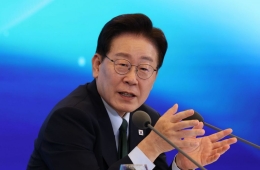
President Lee Jaemyung reportedly said he would step up direct communication with the public, telling reporters aboard the presidential aircraft on his way home after a state visit to Mexico last month, "I reflected on myself. Going forward, I should work harder to communicate with the public." The Blue House stressed that the president's approach to communication is not simply "SNS politics," but part of governing in a way that brings him closer to the public.

South Korean President Lee Jae-myung and Mexican President Claudia Sheinbaum shake hands after a joint press statement at the National Palace in Mexico City on the 24th (local time). Sept. 25, 2026. Yonhap News Agency
View original imageSeong Gi-hong, senior presidential secretary for public relations and communication, made the remarks in a post titled "The President's Communication" on X (formerly Twitter) on October 11. He cited President Lee's remarks during his attendance at the United Nations General Assembly in New York and his state visit to Mexico last month.
According to Seong, President Lee said on the flight back to Seoul after his visit to Mexico, "I reflected on myself. Going forward, I should communicate more earnestly with the public. I should communicate more directly."
Seong said the president's remarks were related to the communication style of the local leader he observed during his trip to Mexico. Mexican President Claudia Sheinbaum holds a press conference called "Mañanera" at the National Palace every day at 7:30 a.m., where she directly explains key policies and answers questions from the public. Key remarks are made into short videos and shared online.
Seong noted that former Mexican President Andrés Manuel López Obrador, Sheinbaum's predecessor, also held 1,438 morning press conferences during his six years in office, adding that he "devoted his energy to explaining policies directly to the public and correcting misinformation."
He also strongly pushed back against criticism of the president's use of social media. "In an era when people engage with new media, the public has the right to learn the president's views directly, without someone else interpreting and editing them," Seong said. "The era in which the president stood behind a curtain of authoritarianism or mystique, while someone else conveyed, interpreted, and repackaged his intentions, is over."
"In modern politics, social media is an important tool for leaders to show their sincerity to the public without an intermediary," he said, explaining that political leaders' communication styles are changing along with the media environment.
He also cited examples of leaders abroad. UK Prime Minister Andy Burnham uses TikTok and Instagram to share key policies, while Indian Prime Minister Narendra Modi communicates directly with the public through social media and "Mann Ki Baat," his monthly radio program.
Seong also mentioned how U.S. President Franklin D. Roosevelt explained his policies to the public through his "fireside chats" on the radio during the Great Depression, President John F. Kennedy used television, and President Barack Obama expanded digital communication through social media.
Seong said President Lee had also used social media to engage with residents and explain policies during his time as mayor of Seongnam and governor of Gyeonggi Province. He added that since taking office as president, Lee has continued his established approach to communication by explaining the purpose of policies directly on social media and gauging public reaction.
However, Seong clarified that the president's direct communication is not limited to social media. "Of course, social media cannot be the entirety of the president's communication," he said, pointing to various other formats, including press conferences, media interviews, conversations with the public, town hall meetings, and meetings with people directly affected by policies.
"Sometimes a lengthy explanation is needed, and sometimes a short, quick message is needed," he said. "What matters is not staying on any one platform, but expanding the spaces for communication to reach wherever the public is." He said the president's direct communication would become even more diverse going forward.
Hot Picks Today
![Claims That "Daiso Is Being Shut Down to Save AliExpress and Temu" Spread Widely... A Fact-Check [Why&Next]](https://cwcontent.asiae.co.kr/asiaresize/93/2023121315590987574_1702450749.jpg) Claims That "Daiso Is Being Shut Down to Save AliExpress and Temu" Spread Widely... A Fact-Check [Why&Next]
Claims That "Daiso Is Being Shut Down to Save AliExpress and Temu" Spread Widely... A Fact-Check [Why&Next]
- "Didn't Know This Trick?" 84-Sq.-M. Mixed-Use Unit Sells for 2.14 Billion Won... Indirect Buying Demand Spreads [One Year of Land Transaction Permit Zones Across Seoul]
- "The '20,000-Won Happiness' That Makes You Forget Short-Form Dopamine"... China's Gen Z and Millennials Hooked on Grandma's Hobby [China.zip]
- Trump Enraged After Nobel Peace Prize Snub: "I Deserved Eight"
- "I Hate Dog Meat and Skate, Love Pizza" ... "Let's Meet" Frenzy Over Beautiful 41-Year-Old Nurse, But There's a Twist
Seong stressed, "What the president seeks is not simply 'SNS politics.' It is dialogue that narrows the distance between the public and the president, and communication that lowers the barriers between government and the public."
© The Asia Business Daily. All rights reserved. Unauthorized AI training and use prohibited.