[Exclusive] "We Warned You Four Times"... Another Defect Found in Bathroom at LH Happy Housing Site
Used "Noncompliant Materials" Even After Four Warnings
LH Sites Flagged Even Top-10 Contractors
385 Quality Deficiency Notices Issued to 252 Companies Over 3 Years and 8 Months
66 Companies Cited at Least Twice... Including for Failing to Rep
Companies contracted to carry out projects commissioned by Korea Land and Housing Corporation (LH) have repeatedly delivered substandard work despite receiving successive warnings. Even large construction companies ranked among the top 10 in construction capability assessments were no exception. At sites repeatedly cited for delays, the use of noncompliant materials was also confirmed, prompting calls for LH to follow through and verify that contractors take corrective action after receiving warnings.
According to data submitted by LH for a parliamentary audit, LH issued 385 Quality Deficiency Notices to 252 companies over the three years and eight months from January 2023 through August 2026, Rep. Heo Young of the Democratic Party of Korea, a member of the National Assembly’s Land, Infrastructure and Transport Committee, said on the 10th.
The most common issue was the use of noncompliant materials, accounting for 57 cases (14.8%). This was followed by inadequate performance in regular evaluations of maintenance contractors, with 53 cases (13.8%), and delays or failures in handling defects and repairs, with 52 cases (13.5%). Of the 252 companies, 26% (66 companies) received two or more notices. Among the 23 sites where Quality Deficiency Notices were issued repeatedly, two were cited four times for poor site management.
![[Exclusive] "We Warned You Four Times"... Another Defect Found in Bathroom at LH Happy Housing Site](http://www.asiae.co.kr/news/img_view.htm?img=2023073107570824314_1690757828.png)
Quality Deficiency Notices are a system operated by LH, the project owner, to promptly address problems identified during construction and defect repairs.
Upon receiving a first notice, a contractor must suspend the work, fully repair the cited area, and then proceed with subsequent work. A second notice warns that penalties may be imposed from the third notice onward, including replacing the site representative or restricting the contractor from bidding on LH-commissioned projects. Such penalties are specified in notices issued for the third or subsequent time.
The system is intended to flag poor site management even when it does not constitute a serious violation under the Construction Technology Promotion Act and to use accumulated citations as grounds for restricting bidding, thereby screening out underperforming companies.
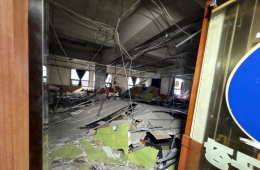
At one Happy Housing site—public rental housing for young people, including young adults and newlyweds—the joint contractors received a first notice in May 2023 for missing an interim construction progress management deadline. A month later, they received a second notice for the same reason. In January 2024, the following year, some companies received third and fourth notices, respectively, for slow progress. In November of that year, it was confirmed that the contractors had used noncompliant materials for the finish of the site’s prefabricated bathroom system.

Quality Deficiency Notices Issued by Korea Land and Housing Corporation (LH), January 2023-August 2026. LH and Rep. Heo Young's Office
View original imageThere were also cases in which different deficiencies emerged at the same construction site year after year. One contractor received its first notice in July 2023 for shortcomings in quality, safety, and site management, and a second notice in April 2024 for missing an interim construction progress management deadline. In September 2025, it failed to meet the minimum score in a customer quality assessment, making it subject to a Quality Deficiency Notice for the third consecutive year.
At one site, repeated notices ultimately led to a downgrade in the quality management rating for the entire complex. The site received a Quality Deficiency Notice in April 2023 after falling short of the required score in a repair verification assessment. In November of the following year, it was confirmed that noncompliant materials had been used for the finish of the prefabricated bathroom system. In June 2025, it received another Quality Deficiency Notice after being classified as a “district with deficiencies three or more times” under the ongoing defect management system.
Large construction companies were also targeted by quality warnings. Among general contractors ranked in the top 100 during the period covered by the data, 37 received Quality Deficiency Notices from LH. Two were ranked in the top 10. One received a total of three notices for falling short of the required score in a repair verification assessment and for issues including quality and site management. Another received two notices for inadequate defect management and failing to meet the minimum score in a repair verification assessment.
Deficiencies also continued to emerge at sites run by large companies ranked in the top 20. One company received three consecutive Quality Deficiency Notices for using noncompliant materials for the finish of a prefabricated bathroom system. Another company ranked in the top 20 was cited separately for failing to carry out defect repairs and for inadequate management of concrete pouring and curing.
Public housing projects operate under different conditions from private housing developments, where contracts are awarded after considering factors such as brand and construction track record. Residents of public housing have no say in choosing their contractor. Because a large share of the construction work is carried out by small and midsize companies, it is also difficult to ensure the same level of in-house quality assurance as at large firms. On-site quality is checked by resident inspectors in accordance with applicable laws, while LH, as the project owner, separately issues Quality Deficiency Notices directing contractors to make corrections. LH’s quality management guidelines require project directors and others to verify the results of corrective actions for issues identified during site inspections. If deficiencies are not caught during construction, residents are left to bear the consequences of unresolved defects.
Hot Picks Today
![[Exclusive] "We Warned You Four Times"... Another Defect Found in Bathroom at LH Happy Housing Site](https://cwcontent.asiae.co.kr/asiaresize/93/2023073107570824314_1690757828.png) [Exclusive] "We Warned You Four Times"... Another Defect Found in Bathroom at LH Happy Housing Site
[Exclusive] "We Warned You Four Times"... Another Defect Found in Bathroom at LH Happy Housing Site
- "Eerily Similar to the COVID-19 Crisis"... Mysterious Death at Russian Research Institute Revives 'Pandemic Nightmare' [Current Affairs Show]
- "Busan Is in Big Trouble"... One Cockroach Can Produce 350 Nymphs; Establishment Confirmed, Causing Alarm
- "Older people won't be able to tell"... Gang targets convenience stores with counterfeit 50,000-won notes printed on A4 paper
- "I Hate Dog Meat and Skate, Love Pizza" ... "Let's Meet" Frenzy Over Beautiful 41-Year-Old Nurse, But There's a Twist
Rep. Heo said, “The purpose of a Quality Deficiency Notice system is not simply to issue warning letters; it is to correct problems at construction sites. LH must follow through to confirm that problems have actually been addressed and focus its management capabilities on ensuring that its quality management system works properly on the ground.” Rep. Heo also raised concerns during a 2020 parliamentary audit about contractors that continued to win LH projects even after repeatedly receiving Quality Deficiency Notices.
© The Asia Business Daily. All rights reserved. Unauthorized AI training and use prohibited.





![AI Investment and Inflation Pressures... U.S. Rates to Rise Again? [Weekend Money]](https://cwcontent.asiae.co.kr/asiaresize/307/2026071504434646114_1784058227.jpg)