Canadian Poet Anne Carson, Who Bridges Classics and Modernity, Wins 2026 Nobel Prize in Literature (Roundup)
A 76-year-old writer spanning poetry, classics, and translation
The Swedish Academy: "A playful dialogue with classical tradition... creating new forms for contemporary literature"
Autobiography of Red, The Beauty of the Husband, Nox and other works published in Korea
Ancient Greek poet Sappho, Geryon, the monster killed by Hercules, Catullus's elegy, and Marilyn Monroe. In Anne Carson's books, names separated by more than 2,000 years come alive in the same moment. Rather than keeping classical works in a museum, she brings them into the present and has broken down the boundaries between poetry, fiction, essays, criticism, and translation. Canadian poet and classicist Anne Carson, 76, has been awarded this year's Nobel Prize in Literature.

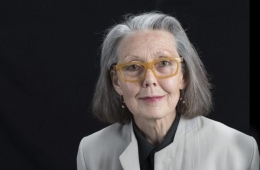
Canadian writer Anne Carson has been selected as the 2026 Nobel Prize in Literature laureate. ©Don J. Usner
View original imageOn Oct. 8, the Swedish Academy selected Carson as the 2026 Nobel Prize in Literature laureate, citing her "bold and original body of work that playfully engages with the classical tradition and creates new forms for contemporary literature." The prize is worth 12 million Swedish kronor. Carson is the 19th woman to receive the Nobel Prize in Literature.
The brief citation captures nearly everything about Carson's writing. She has done more than render ancient works in modern language. She has taken fragments of the classical world that survive and reconnected them with contemporary questions of desire and heartbreak, gender and violence, memory and grief. In the process, distinctions such as "poetry or fiction," "translation or original writing," and "scholarship or literature" have repeatedly collapsed.
This also accords with the key criteria for the literature prize that the Academy has publicly outlined over the years. Literary achievement comes first, while "experimentation, invention, and refinement" that advance world literature are also important. Carson is less a writer who has perfected her work within a single genre than one who has continually shifted the boundaries of genre itself. The "new forms" emphasized by the Academy this year can be read as a judgment on four decades of such work.
Her starting point was the poet Sappho. Born in Toronto, Canada, in 1950, Carson grew up in several small Ontario towns as her father, a banker, moved for work. In high school, her Latin teacher taught her ancient Greek during lunch breaks, and that was when she first encountered Sappho. Carson later recalled that ancient Greek was like "a strange but always welcoming harbor."
She studied classics at the University of Toronto and learned ancient Greek from the renowned classicist Kenneth Dover at the University of St Andrews in Scotland. In 1981, she earned a doctorate from the University of Toronto for her research on Sappho. She later taught classics at several universities. It was characteristic of Carson that her official author biography long consisted of little more than the sentence, "She was born in Canada and teaches ancient Greek for a living." She is known as a writer who prefers to put her books ahead of her own life.

The cover of the English-language edition of Anne Carson's first book, *Eros the Bittersweet*. Drawing on ancient texts by Sappho, Plato, and others, the book explores the relationship between love, desire, and lack. It is considered the starting point of Carson's body of work, which crosses the boundaries between classical studies and literature. Princeton University Press.
View original imageHer first book, Eros the Bittersweet (1986), grew out of her doctoral dissertation. Drawing on ancient texts, including works by Sappho and Plato, she explored how love and desire arise not from fulfillment but from "lack." It is scholarly research that reads like poetry, and criticism that moves like a work of literature. It marked the beginning of the formal hybridity Carson would continue to pursue. A Korean translation by Hwang Yuwon was published in 2025.
The work that brought her international renown was Autobiography of Red (1998). It reimagined the myth of Geryon, sung by the sixth-century BCE poet Stesichorus. In the original, Geryon is a monster whom Hercules must kill as part of his tenth labor. Carson turned the camera away from the hero and toward the monster. She recast the story as a coming-of-age novel in which Geryon, a boy with red wings, falls in love with Hercules, is abandoned by him, and searches for his own identity. She did so in the unfamiliar form of a "verse novel." In Carson's hands, the monster on the margins of a heroic tale became a person capable of love and heartbreak.
Even the subtitle of The Beauty of the Husband (2001) reveals her view of literature: "A Fictional Essay in 29 Tangos." The book consists of 29 tangos about a marriage to a beautiful but deceitful husband and its collapse. The distinction between poetry, essays, and autobiographical narrative has little meaning here. Carson became the first woman to receive the United Kingdom's T.S. Eliot Prize for this work.
Carson did not erase the "gaps" in the original when translating classical works. In If Not, Winter (2002), her translations of Sappho's surviving poems leave words and lines lost to papyrus damage in brackets and blank spaces. Rather than filling in what is missing, she shows readers what has been lost. The concern at the heart of her first book - the idea that lack is a condition of love - thus carried over into her approach to translation.

A view of the Korean edition of Anne Carson's *Nox*. Mourning the death of her older brother, Carson weaves together photographs, letters and fragments of memory with her translation of a poem by Catullus. The work is distinguished by its unusual format: a long sheet of paper folded like an accordion and placed in a box. Bomnal Books
View original imageThe book in which her formal experimentation is most dramatic is Nox. It is a book of mourning, created after her brother Michael, who left home in 1978 and had almost no contact with the family, died in Copenhagen in 2000. Carson translated, one word at a time, poem 101 by the Roman poet Catullus, who mourned his brother's death in a distant land, and brought together photographs and letters from her own brother, stamps, drawings, and fragments of memory. The finished book abandoned conventional binding: a single long sheet of paper was folded accordion-style and placed in a box. For Carson, translation became both the work of carrying a dead language across time and a way of speaking to someone who could never return.
The Korean edition of Nox also preserves the physical form of the original. In 2022, the independent publisher Bomnal Books drew attention in the publishing world by making it in accordion form, joining long strips of paper by hand. Carson's later book Float went a step further. It consists of 22 pieces - including poems, prose, plays, criticism, and lecture transcripts - each made into a separate booklet and placed in a PVC box. Even the order of the pages is not fixed. The sequence of the "book" changes depending on which piece the reader takes out first.
Bringing classical works into collision with popular culture is another technique Carson often uses. In Norma Jean Baker of Troy (2019), she puts Euripides' Helen alongside Marilyn Monroe. Placing Helen, the beauty whose abduction led to the Trojan War, onstage with Monroe, the sex symbol created by 20th-century popular culture, Carson asks how "beautiful women" are made into objects of desire and scapegoats in male-centered narratives.
Even after turning 70, Carson has not stopped experimenting. Her 2024 book Wrong Norma brings together 25 prose poems and images she drew herself, mixing subjects that seem unrelated - Joseph Conrad, Flaubert, Guantanamo, snow, poverty, fathers, and Saturday night. The book was a finalist for the National Book Award in Poetry and won the National Book Critics Circle (NBCC) Award for Poetry.

Anne Carson, the Canadian poet and classicist selected as the 2026 Nobel Prize in Literature laureate, has built a distinctive body of work grounded in ancient Greek literature that blurs the boundaries between poetry, fiction, criticism, and translation.
View original imageMajor literary prizes awarded before the Nobel recognized much the same qualities. In 2020, the jury for the Princess of Asturias Award said Carson had developed an innovative poetics that began with the study of Greco-Roman classics and made sense of the complexities of the present. The following year, the judges for the PEN/Nabokov Award described her as a writer who "rejects, questions, and redefines inherited forms and genres," and one who brings together the classical and the avant-garde. The judges for the Griffin Poetry Prize had already noted 25 years earlier that she "continues to redefine what a book of poetry can be." The Nobel Committee's reference this year to "new forms" was therefore not praise that came out of nowhere.
Readers in Korea can find a number of her books in translation. Autobiography of Red and its sequel, Red Doc, as well as The Beauty of the Husband, were published by Hankyoreh Publishing, while Bomnal Books published Nox and Float. Nanda has recently introduced a series of Carson's early works, including Eros the Bittersweet and Short Talks.
With this award, Carson follows Han Kang as another woman to receive the Nobel Prize in Literature. But in its citation, the Academy emphasized "form" rather than gender or nationality: that classical works are not relics of the past, but a living language capable of speaking to love and loss in the present; and that the shape of books and genres can be remade to express them. That is what Carson has done for 40 years.
When she heard the news of the award, she was in Iceland. According to the Associated Press, Carson gave a brief reply when asked what she had been doing at that moment.
Hot Picks Today
 "South Koreans Are All Buying It to Take Home"... This "Drug" Costs 350,000 Won in Korea but Just 80,000 Won in Japan
- "Buy While It's Cheap"... Retail Investors Snap Up KRW 30 Billion in Bank Gold Bars as Prices Fall, Flocking In at a Frenzy
- "I Won't Be Able to See My Own Funeral When I Die"... U.S. Grandmother Holds "Living Funeral" for Her 80th Birthday
- "After Calculating Our Bonuses, It's at Least 3 Billion Won; Feels Like We've Escaped the Working Class"... Samsung Electronics DS Couple's Post
- "Bride Lee Dogyeong, Groom Lee Dogyeong"... Couple Share the Same Name and Date of Birth: "This Must Be Fate"
© The Asia Business Daily. All rights reserved. Unauthorized AI training and use prohibited.