Lee Eog-weon on Criticism of National Growth Fund's Honam Concentration: "Impact of Infrastructure Investments, Including Shinan-Wui Offshore Wind Farm" [2026 Parliamentary Audit]
Raise the share of investment in provincial areas to more than 40%
Consider further raising the risk weight for mortgage loans
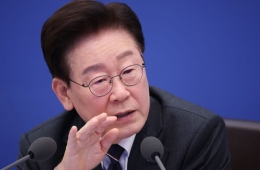
Lee Eog-weon, chairman of the Financial Services Commission, said on Oct. 8 that the concentration of National Growth Fund investments in the Honam region reflected the inclusion of large-scale infrastructure projects.

Financial Services Commission Chairman Lee Eokwon answers lawmakers' questions during a parliamentary audit of the Financial Services Commission and other agencies at the National Assembly on Oct. 8, 2026. Photo by Yoon Dongju.
View original imageAt a parliamentary audit of the Financial Services Commission and other agencies by the National Assembly’s Political Affairs Committee, Assemblyman Song Eonseok of the People Power Party pointed out that the fund’s approved amounts varied widely by region, with 28.7% allocated to Honam and 7.9% to Yeongnam. Lee said, “That is because Honam has large-scale projects, such as the Shinan-Wui offshore wind farm,” adding, “We will raise the share of investment in provincial areas to more than 40%.”
According to data released by the Financial Services Commission on Sept. 17, the National Growth Fund approved financial support for 35 projects worth a total of 18 trillion won from January to September this year. Of this, support for provincial areas totaled 24 projects worth 8 trillion 50 billion won, accounting for 44.7% of the total approved amount. The Seoul metropolitan area received 9 trillion 980 billion won, or 55.4% of the total. Among areas outside the metropolitan region, Honam received the most, at 5 trillion 170 billion won (28.7%). It was followed by Yeongnam at 1 trillion 430 billion won (7.9%), Chungcheong at 1 trillion 360 billion won (7.5%), and Gangwon and Jeju at 80 billion won (0.4%).
Lee also left open the possibility of further raising the risk weight (RWA) for mortgage loans to prevent financial resources from becoming concentrated in real estate. “We will consider raising the RWA while monitoring market conditions,” he said. In September last year, the Financial Services Commission raised the minimum RWA for new mortgage loans issued by banks from 15% to 20%.
Lee said the lending restriction capping mortgage loans at 600 million won had helped curb rising home prices.
Hot Picks Today
 "Sharing Credit Card Statements Could Spell Trouble for Couples"... Conflict Erupts Over 2.2 Million Won in Weekly Beauty Spending - What Happened?
- [Exclusive] Daiso Draws Shoppers for "3,000-Won Cosmetics"... and Also Boosts Sales at Nearby Olive Young
- "Only in Seoul," Foreigners Rave... Then Seoul Beats Tokyo to Claim 'World's Best Big City' Title
- "I'm Struggling Financially," He Confided at His Parents' Graves... A 'KRW 2 Billion Stroke of Luck' Came Soon After
- Woman Buys All 196 Apartment Parking Spaces, Installs Locks... Then Faces Lawsuit
Responding to criticism that apartment prices in Seoul continued to rise despite stringent lending restrictions, Lee said, “It would probably have been even worse if we hadn’t taken those measures,” adding, “At the time, high-priced homes in the Gangnam area were driving the overall rise in home prices. Most people believe the measure capping loans at 600 million won was effective.”
© The Asia Business Daily. All rights reserved. Unauthorized AI training and use prohibited.