"Now They'll Catch Every AI-Written Personal Statement"... A 'Secret Fingerprint' Embedded in Sentences [Into the AI World]
Identification markers in text as well as images
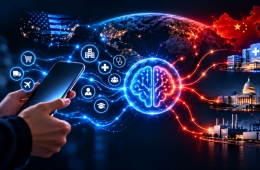
Global artificial intelligence (AI) companies are successively introducing watermarking technology that can identify text written using generative AI. Just as markers are embedded in AI-generated images to indicate that they are AI-created, companies are looking to apply similar watermarks to text. As the European Union (EU), South Korea and jurisdictions around the world have legislated the use of watermarks for AI-generated content, the scope of their use is expected to expand gradually.
According to the AI industry on October 9, OpenAI announced on October 5 local time that it would introduce Textgrain, a technology that identifies whether text was generated by AI. OpenAI plans to apply the technology to ChatGPT and Codex in Europe within the next few weeks.
!["Now They'll Catch Every AI-Written Personal Statement"... A 'Secret Fingerprint' Embedded in Sentences [Into the AI World]](http://www.asiae.co.kr/news/img_view.htm?img=2026100717050553759_1791360305.jpg)
Textgrain embeds subtle statistical signals as an AI model selects words while generating text. By applying specific statistical rules when choosing words, it creates a kind of "pattern" throughout the text that can indicate whether AI was used. Because the method does not insert hidden characters or special symbols into sentences, the text can still be identified even if it is copied and pasted elsewhere.
OpenAI said that applying the technology would make no material difference to the quality, performance or readability of AI responses. However, because of how Textgrain works, its detection rate may be lower for short passages or text that uses few words. The detection rate also falls if users change some of the words or expressions in AI-generated text.
OpenAI is also accepting requests for access and will initially provide a tool for detecting Textgrain to approved researchers and professional institutions. Those given access to the tool will be able to determine whether text was generated by AI.
Global AI leaders, including Anthropic and Google, have already introduced similar text watermarking technology. Anthropic introduced a text watermarking feature using a similar method in August. Google has also applied SynthID-Text, a text watermarking technology developed by Google DeepMind, to text generated through Gemini since May 2024.
The EU's AI Act is behind the adoption of text watermarking technology by global companies. Similar to South Korea's AI Basic Act, the EU law includes a provision requiring transparency for generative AI. It requires technically detectable watermarks or identifying markers in text as well as media content such as images, video and audio.
Hot Picks Today
!["What Becomes of the Geniuses Who Devoted Their Lives?"... 722 Papers Released in Just 3 Hours Spark 'Shock and Awe' [Reading Science]](https://cwcontent.asiae.co.kr/asiaresize/93/2026100816554855490_1791446147.jpg) "What Becomes of the Geniuses Who Devoted Their Lives?"... 722 Papers Released in Just 3 Hours Spark 'Shock and Awe' [Reading Science]
"What Becomes of the Geniuses Who Devoted Their Lives?"... 722 Papers Released in Just 3 Hours Spark 'Shock and Awe' [Reading Science]
- JYP Bought a 75.5 Billion Won Site, Only to Face an 18-Story Building Right in Front? ... SH's "Surprise Rezoning" Makes JYP Pull Out
- "I Thought It Was a Stock Pullback and Sold..." U.S. Shopping Season Is Near, and K-Beauty's Big Four Are Riding the Wave [Weekend Money]
- "'Assassin(s)' Actors: Is This Why They Won't Apologize?" Joo Jinwoo Reveals Incentive Deal
- "I Want to Look Like Glowing Koreans" ... The Trend Is Taking the World by Storm, but Experts Warn Against It
The measures were introduced as AI-generated content becomes more sophisticated, increasing the risk that it could be exploited for deepfakes, cybercrime and the spread of false or manipulated information. With concern about AI safety also growing amid calls to slow the pace of development in response to recent advances in AI models, the prevailing view is that the use of watermarking technology will expand.
© The Asia Business Daily. All rights reserved. Unauthorized AI training and use prohibited.