[2026 National Assembly Audit] Jin Youngseung: "Never Once Thought the 'North Korean Landmine' Incident Was Not a Provocation... Some U.S. Intelligence Sharing Restricted"
Chairman of the Joint Chiefs of Staff Jin Youngseung said on the 8th, regarding the incident in which South Korean troops were injured by mines planted by North Korean forces south of the Military Demarcation Line (MDL), "With one of my subordinates seriously injured, there was not a moment when I thought it was not a provocation." He said that although some U.S. intelligence sharing on North Korea is restricted, this has not affected the military's readiness, but the restrictions should be lifted as soon as possible.

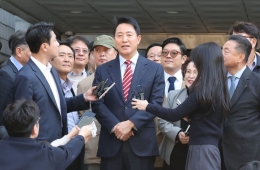
Chairman of the Joint Chiefs of Staff Jin Youngseung answers questions during a parliamentary audit of the Joint Chiefs of Staff by the National Assembly's National Defense Committee at the Ministry of National Defense in Yongsan-gu, Seoul, on Oct. 8, 2026. [Photo by the National Assembly Photojournalists Association] Yonhap News
View original imageJin made the remarks during a parliamentary audit of the Joint Chiefs of Staff by the National Assembly's National Defense Committee at the Ministry of National Defense that day. He was responding to a question from Rep. Im Jong-deuk of the People Power Party about why the word "provocation" was omitted from the announcement of the findings of the investigation into the "land mine incident." Jin added, "I did not pay close enough attention to the fact that the term 'provocation' was not included."
Opposition lawmakers also continued to criticize the military's response to North Korea's mine-laying and the wording of its announcement. Rep. Im said, "Whether it is a provocation or not changes how our military responds. It changes the level of our response," adding, "That is why the Joint Chiefs of Staff is political."
Rep. Cheon Ha-ram of the Reform Party also cited remarks by the president and Unification Minister Chung Dong-young and asked whether the incident was a provocation. On Oct. 1, President Lee Jae-myung described the mine incident as an "unfortunate accident" in his Armed Forces Day commemorative address. At a parliamentary audit by the National Assembly's Foreign Affairs and Unification Committee on Oct. 7, Chung also said, "I do not think we can yet identify it specifically as a mine attack," adding, "We are basically defining it as a land mine explosion accident."
In response, Jin stressed, "One of our troops was seriously injured by an enemy mine south of the Military Demarcation Line, as recognized by the United Nations Command," adding, "Regardless of whether it was intentional, it was clearly a provocation." Earlier, in his opening remarks at a work briefing, he had also called it "a clear violation of the Armistice Agreement and a provocation."
Rep. Kang Sun-young of the People Power Party asked how many of the areas south of the Military Demarcation Line where North Korean mines were suspected of having been planted, and which the military had described as "changes in terrain," the military considered to require an on-site inspection with the United Nations Command. Jin replied, "We conducted an internal review of the term 'changes in terrain' and determined that it was not appropriate," adding, "Because it could cause misunderstandings, we will change it to a clearer term, such as 'area suspected of mine-laying.'"
While asking when the site inspection area was changed from the Army's 21st Infantry Division to the 25th Infantry Division, Rep. Kang also criticized military commanders for their lack of awareness of the situation. When Jin said he did not know the exact timing, she called in the Army Ground Operations Commander and rebuked him, asking, "What on earth happened? Aren't you keeping track of the situation?"
Restrictions on intelligence sharing with the United States also became an issue. After Unification Minister Chung Dong-young publicly mentioned a uranium enrichment facility in Kusong, North Korea, in March, the United States was reportedly restricting some of the intelligence on North Korea it provides to South Korea.
Asked by Rep. Seong Il-jong of the People Power Party whether key information related to North Korea's nuclear program was being shared, Jin replied, "Some information is restricted, but this does not affect our readiness." When Seong said, "They say important information is not being provided," Jin countered, "I do not think that is the case." He added, "It is not that information about imminent signs or various situations is not being shared," and said, "I think the best course is to resolve this situation quickly, and we are working to do so."
Hot Picks Today
 "The Transfer Failed, but 'Ding-Dong,' Money Came In"... KRW 32.5 Billion Financial Incident at Toss Bank
- Tearful Oh Sehoon Acquitted on Appeal: "Thanks to Those Who Believed in My Innocence" (Update)
- "Made 12 Billion Won Cleaning Up Other People's Dog Poop With Just a Rake"... 'Poop Scoop Millionaire' Is All the Rage in the U.S.
- "My Blood Vessels Got Cleaner Just by Drinking It"... Surprise: The "Tea" Even Doctors Make Sure to Drink
- 'Hangover Legend' Returns After 11 Years... Lee Sunmin Hyung's 'Captain Q' Sells Out
Rep. Yoo Yong-won of the People Power Party also asked again whether intelligence sharing was restricted. Jin acknowledged that "the sharing has not been fully restored," but said this was not affecting the military's current nuclear- and missile-related missions.
© The Asia Business Daily. All rights reserved. Unauthorized AI training and use prohibited.