Earnings Set to Soar Further Next Year... Samsung Electronics Posts Record Operating Profit of "KRW 100 Trillion," Fueling Hopes for Record Shareholder Returns
Mass Production of Sixth-Generation HBM4 Ramps Up, 'IDM Synergies' Bear Fruit
Shrugging Off 'Peak-Out' Concerns, Earnings Outlook for Next Year Brightens
Earnings Surge Expands Financial Capacity to Enhance Shareholder Value
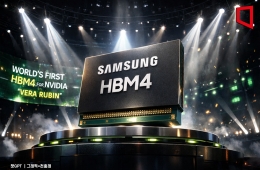
Behind Samsung Electronics' record quarterly operating profit of KRW 100 trillion in the third quarter of this year is an unprecedented memory supercycle, driven by artificial intelligence (AI) semiconductors. Analysts say that, beyond rising prices for conventional memory, the sixth-generation high-bandwidth memory (HBM4), which entered mass production for the first time in the world, was a key factor behind the strong results. The market expects this "memory-led dominance" to continue into next year, supported by robust demand for AI memory.

On October 8, Samsung Electronics said in its preliminary third-quarter earnings announcement that operating profit had surged 782.5% from a year earlier to KRW 107.4 trillion on a consolidated basis. In just one quarter, the company surpassed its previous record operating profit of KRW 89.5 trillion, set in the second quarter, becoming the first Korean company to post quarterly operating profit of KRW 100 trillion.
Synergies Between HBM4 and Foundry
Samsung Electronics' latest results were underpinned by a global shortage of memory semiconductors and a sharp rise in product prices. According to market research firm DRAMeXchange, the average price of PC DRAM reached a record $26 last month. NAND flash prices for memory cards and USB drives also continued to rise for the 21st consecutive month, averaging $30.6. Memory demand is growing rapidly as investment in AI servers expands, while supply is unable to keep pace, cementing the upward trend in prices. TrendForce forecast that in the fourth quarter, conventional DRAM prices would rise by an additional 10-15% quarter over quarter, while NAND prices would climb 15-20%.
HBM4, the next-generation HBM, is also believed to have contributed to the strong results. As HBM4 mass production gathers pace, Samsung's integrated device manufacturer (IDM) competitiveness across DRAM and foundry services is translating into financial results. HBM4 is considered a product that requires not only advanced DRAM processes but also base-die design and foundry process capabilities. Analysts say that Samsung's in-house production of 1c DRAM and 4-nanometer base dies has improved performance and power efficiency, allowing the company's accumulated expertise in integrated semiconductor technologies to begin bearing fruit in HBM in earnest.
"As expected, earnings in the HBM business are growing significantly, while profitability in the foundry business is also improving, driven by mass production of HBM4 base dies and increased production of the Exynos 2700," said Park Yuak, an analyst at Kiwoom Securities. Choi Boyoung, an analyst at Kyobo Securities, also forecast: "Expanded HBM4 sales and rising demand for high-capacity server memory are driving earnings improvements. Meanwhile, the shift in production capacity toward HBM is limiting conventional DRAM supply, which will keep prices strong."

"No Earnings Decline Even in 2027"... HBM4 Market Share Forecast at 40%
The prevailing view in the market is that Samsung Electronics' earnings outperformance will continue beyond the fourth quarter of this year and into next year. Some have raised concerns about "peak-out," or a downturn after reaching a peak, arguing that competition for market share against latecomers such as China's ChangXin Memory Technologies (CXMT) and Yangtze Memory Technologies Co. (YMTC) in the conventional memory market could increase downward pressure on prices. However, experts believe the supply shortage will take longer than expected to ease, taking into account factors such as memory demand driven by the spread of AI inference.
Samsung Electronics' influence in the next-generation HBM market is expected to expand rapidly. The market expects Samsung's HBM4 selling price to more than double from this year, an increase of over 100%, and its share of the HBM market next year to climb to around 40%.
Accordingly, securities firms are sharply raising their forecasts for Samsung Electronics' annual revenue next year to KRW 999 trillion and operating profit to around KRW 606 trillion. Analysts say that robust selling prices for AI memory and increased shipments will drive earnings despite the adverse impact of a weaker won against the U.S. dollar. "Even if the pace of memory price increases slows somewhat, tight supply and demand conditions will continue through 2027," said Baek Gilhyun, an analyst at Yuanta Securities. "Demand for high-capacity memory, driven by the spread of the AI inference market, is delaying the resolution of supply constraints." Han Donghee, an analyst at SK Securities, likewise forecast: "With strong demand for AI memory, worsening supply shortages and rising HBM selling prices will go hand in hand. The scenarios the market fears, such as falling memory prices or declining earnings, will not materialize."
Launch of Record-Setting Shareholder Returns
With earnings soaring to record levels, the market's attention is turning to expanded shareholder returns. Samsung Electronics currently has a policy of returning 50% of its free cash flow (FCF) generated over the three-year period from 2024 to 2026 to shareholders. The sharp increase in earnings has boosted the company's cash-generating capacity, giving it greater financial flexibility to enhance shareholder value.
The market believes Samsung Electronics is likely to use its cash reserves to increase its year-end dividend and launch large-scale share buybacks and cancellations. The board must decide on the specific measures, but business circles and securities firms expect shareholder returns to reach a record level. "The increased cash-generating capacity resulting from the sharp improvement in earnings will provide a stronger foundation for shareholder returns," said Park Junyoung, an analyst at Hanwha Investment & Securities. "A virtuous cycle has taken shape in which improved earnings directly enhance shareholder value."
Hot Picks Today
![[Exclusive] Daiso Draws Shoppers for "3,000-Won Cosmetics"... and Also Boosts Sales at Nearby Olive Young](https://cwcontent.asiae.co.kr/asiaresize/93/2026100810042954657_1791421469.jpg) [Exclusive] Daiso Draws Shoppers for "3,000-Won Cosmetics"... and Also Boosts Sales at Nearby Olive Young
[Exclusive] Daiso Draws Shoppers for "3,000-Won Cosmetics"... and Also Boosts Sales at Nearby Olive Young
- [Exclusive] 800,000 Took 'Samsung-Hynix Leverage' Training, but There Were No 'Wrong-Answer Notes'
- "I'm Struggling Financially," He Confided at His Parents' Graves... A 'KRW 2 Billion Stroke of Luck' Came Soon After
- "I thought I wouldn't be able to buy it anymore"... 'Gold' enjoys record-breaking boom during China's longest holiday.
- Woman Buys All 196 Apartment Parking Spaces, Installs Locks... Then Faces Lawsuit
Kim Unho, an analyst at IBK Investment & Securities, also said: "Shareholder returns through dividends are expected to reach a record level. The scale would be comparable to that of leading global IT companies, and since no memory company has ever returned more than KRW 100 trillion to shareholders, this will serve as a very positive catalyst for the share price going forward."
© The Asia Business Daily. All rights reserved. Unauthorized AI training and use prohibited.