Government to Provide 1,000 Trillion Won, Private Sector to Invest 220 Trillion Won in 'Green Grand Transformation'; Lee: 'We Must Be Market Designers, Not Followers' (Comprehensive)
200 trillion won in fiscal support and over 790 trillion won in climate financing by 2035
Lee Hyungil: "We will pool all our resources"
President Lee: "The government could proactively take on the risks of industrial transition"
Calls to ease bur
The government plans to support the Korean Green Transformation (K-GX) with 1,000 trillion won in combined fiscal and policy financing by 2035, while the private sector will invest 220 trillion won. The initiative aims to move climate action beyond the realms of cost and regulation and turn it into a source of competitiveness for advanced industries and a driver of future growth. President Lee Jae-myung even laid out the principle that the government could share the risks of early-stage investment in green industries with businesses, stressing, "We must break away from the practice of following others and become designers and leaders of the green market, shaping it ourselves."

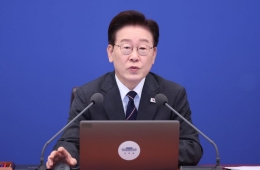
President Lee Jaemyung listens to remarks at a public briefing on the Korean Green Transformation (K-GX) strategy in Seoul on Oct. 7, 2026. Yonhap News
View original imagePresident Lee chaired a public briefing on the Korean Green Transformation strategy at the Korea Chamber of Commerce and Industry in Jung-gu, Seoul, on Oct. 7. Deputy Prime Minister and Minister of Finance and Economy Lee Hyungil announced the K-GX strategy, saying, "There is only one choice: whether to move ahead or fall behind. We will pool all the strength of the government and private sector to drive the green transformation." From 2026 to 2035, the government will provide support totaling around 1,000 trillion won, including 200 trillion won in fiscal funding and more than 790 trillion won in climate financing through five major policy financial institutions. The private sector will pursue 220 trillion won in investment, focusing on 10 K-GX signature projects.
The government's 1,000 trillion won in support is intended to serve as seed funding that reduces uncertainty in the green transition and attracts private capital. The government will expand the Climate Response Fund and establish the institutional framework for issuing green bonds by the first half of 2027. Of the more than 790 trillion won in policy financing, at least 50% will go to regional areas and at least 70% to small and midsize businesses, so that the benefits of the industrial transition are not concentrated in the Seoul metropolitan area and large corporations. The government will introduce domestic production tax credits for key components and equipment for solar power, wind power and secondary batteries, and pursue the designation of small modular reactors (SMRs) as a national strategic technology.
The K-GX strategy is built around three pillars: "K-GX as a New Growth Engine," which seeks technological innovation and a head start in emerging markets; "K-GX for All," which extends the benefits of the transition to regions and vulnerable groups; and "Sustainable K-GX," which promotes private investment through government support and policy consistency. Public-private joint projects will pursue decarbonization in key industries such as steel and petrochemicals, self-reliance in clean-energy supply chains, the electrification of transportation, and the green transformation of residential spaces.
In his opening remarks, President Lee said the green transition was an industrial strategy, not an environmental policy. "Taking the lead in the green transition is a clear strategy for the future: it will secure international competitiveness while protecting people's lives and livelihoods from the climate crisis," he said. "The green transformation is an essential prerequisite for maintaining our advanced industries' overwhelming technological edge and ensuring the success of three mega-projects." He went on to call for securing key green technologies ahead of others, drawing on world-class research and development (R&D) capabilities, to gain an early lead in future markets.
During an open discussion, the president spelled out the government's role in greater detail. When participants noted that early-stage companies running deficits could not manage investment risks with production tax credits alone, which are available only once a company becomes profitable, President Lee proposed an advance-support approach as one possibility: paying subsidies upfront and deducting them from future tax credits. "If we believe that this particular industry must absolutely be developed, we can take on those risks proactively," he said. Deputy Prime Minister Lee replied, "We will look into it."
In response to a request to expand opportunities for domestic wind turbine manufacturers to demonstrate their products, President Lee raised the need for institutional safeguards to ensure that public officials are not deterred from actively supporting industry by the prospect of audits or penalties. He specifically noted that officials who adopt relatively expensive domestic products to foster local industry could later face accusations of breach of trust or responsibility for losses to the state, with questions such as, "Why didn't you use a cheaper foreign product?"
"Shouldn't we create a system that allows public officials to do this without the burden of penalties, audits or disciplinary action?" President Lee said. "Frontline officials don't want to take on that burden. We need to eliminate all those risk factors." His point was that, while the government should create a market for demonstration projects as domestic technologies catch up with leading overseas companies, it should also protect the policy judgments of the public officials who implement them.
President Lee also emphasized the importance of policy consistency in the energy industry, which requires long-term investment. He said past solar power policies had "swung between extremes," and noted that domestic GX had been delayed for years in part because of "policy shifts that came close to outright suppression." On debates over nuclear power and solar energy, he said, "Energy is one of the areas of national policy most affected by politics," adding, "Politicizing policy is truly dangerous."
The private sector also responded with large-scale investments. Hanwha Qcells will work to localize next-generation perovskite tandem solar cell technology; POSCO Holdings will build a decarbonized industrial ecosystem based on steel GX; and Samsung Electronics and LG Electronics will pursue the green transformation of residential spaces across the country.

Deputy Prime Minister and Minister of Finance and Economy Lee Hyungil (left) and Minister of Climate, Energy and Environment Kim Seonghwan talk at a public briefing on the Korean-style Green Transformation (K-GX) strategy, chaired by President Lee Jae-myung, at a venue in Seoul on October 7, 2026. Yonhap News
View original imageChey Tae-won, chairman of the Korea Chamber of Commerce and Industry, said, "Businesses hesitated to invest in carbon neutrality not because they lacked the will, but because it was difficult for them to shoulder the risks of investments spanning decades on their own amid uncertainty over technology, markets and policy. Regulation can bring companies up to the baseline, but rewards are what drive them beyond it." He described the artificial intelligence transformation (AX) and green transformation (GX) as "twin national strategies that must be designed and pursued together," adding, "We will carry out the 220 trillion won in investments, including the signature projects, without a hitch and demonstrate results on the ground."
Hot Picks Today
 "Wasn't It Supposed to Be Gone? Alarming Surge in Cases Leads US to Declare Disaster Emergency"
- " Korean versions of Wegovy and Mounjaro are coming"... Hanmi Science Surges More Than 10% in After-Hours Trading
- After 17 Tardies, AI Says, "We Should Fire This One, Right?" ... Outcry as U.S. Puts Brakes on 'Robot Bosses'
- "Abandoned in Prison for Five Years"... Lee Hwa-young's Side Urges President Lee to Grant Parole
- "Mom, You Didn't Throw Away My Old Clothes, Right?"... 20-Something and 30-Something Women Rediscover 20-Year-Old Fashion Styles
In his closing remarks, President Lee said, "South Korea's current challenges are recovery and growth. The most fundamental task is solving the problem of making a living." He continued, "We can expand opportunities only by restoring growth, and more opportunities can ease conflicts among members of society. Businesspeople and workers involved in production are all the cornerstones of national development. We will work together to build a country where all members of society can live well in harmony."
© The Asia Business Daily. All rights reserved. Unauthorized AI training and use prohibited.