Lee: "Domestic Green Tech Should Be Supported Without Fear of Audits"... Calls for Policy Uncertainty to Be Resolved
"System Needed to Shield Public Officials from Punishment and Audits While Fostering Green Technologies"
"Move Beyond Following Others and Become Architects of the Green Market"
Also Stresses the Need for Consistent Energy Policy
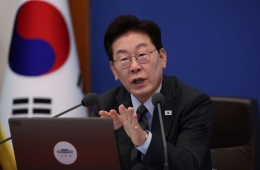
On Oct. 7, President Lee Jae Myung called for institutional safeguards to ensure that public officials do not hesitate to make policy decisions out of concern that they could face charges of breach of trust, audits or disciplinary action as the government works to foster homegrown green technologies. He also warned that allowing green industry policies to shift with the political climate could undermine national competitiveness, saying, "The politicization of policy is truly dangerous." His view is that, to make the green transition a key driver of industrial competitiveness and renewed growth—not merely a response to the climate crisis—the government needs not only technology development but also consistent policies and a willingness to share risks.

President Lee Jae Myung delivers closing remarks at a public briefing on the Korean Green Transformation (K-GX) strategy at a conference venue in Seoul on Oct. 7, 2026. Yonhap News.
View original imageDuring an open discussion at the National Briefing on the Korea Green Transformation (K-GX) Strategy in Seoul, President Lee heard a domestic wind turbine manufacturer's call for more opportunities to demonstrate its technology. "The government needs to use domestic products, and there need to be demonstration projects, if we are to help develop the technology of domestic industries and companies," he said.
He noted that officials who select relatively expensive domestic products on policy grounds could later face criticism such as, "Why did you use an expensive domestic product when there were cheaper foreign products? That's a breach of trust and a loss to the national treasury." "Shouldn't we create a system that allows public officials to do this without the burden of punishment, audits or disciplinary action?" President Lee said. "We need to remove all those risk factors."
He also stressed the importance of consistent energy policy. President Lee said policies for the solar industry had swung from "one extreme to the other" in the past, and that policy changes that "came close to persecution" had contributed to years of delays in the country's green transition. Referring to debates over nuclear power and solar energy, he said, "Energy is one of the areas of national policy most affected by politics," adding, "The politicization of policy is truly dangerous."
Earlier, in his opening remarks, President Lee identified the green transition as a future industrial strategy. "Proactively pursuing the green transition is a sure strategy for the future: it will secure international competitiveness while protecting the lives and livelihoods of our people from the climate crisis," he said. "We must break away from the practice of following others and become the architects and leaders of the green market, shaping it ourselves."
He emphasized that "the green transition is essential to maintaining our advanced industries' technological edge and ensuring the success of our three major mega-projects." He called for the country to leverage its world-class research and development (R&D) capabilities to gain an early lead in key green technologies and future markets. He also said the green transition should become a regional growth driver by linking regional industrial complexes with renewable energy, and that aging industrial complexes, vulnerable industries and low-income groups should not be left behind in the transition.

President Lee Jaemyung delivers closing remarks at the National Briefing on the Korea Green Transformation (K-GX) Strategy, held at a venue in Seoul on Oct. 7, 2026. Yonhap News Agency
View original imageHe also discussed specific ways the government could share risks. In response to industry concerns that loss-making companies would struggle to benefit immediately from production tax credits, President Lee cited a system under which some subsidies would be paid in advance and later deducted from tax credits. "If we believe that this particular industry must be developed, we can take on that risk in advance," he said. Lee Hyeong-il, Deputy Prime Minister and Minister of Finance and Economy, said the government would study the proposal.
In his closing remarks, President Lee said, "South Korea's current tasks are recovery and growth," adding, "The most fundamental task is to solve the problems people face in making a living." He reiterated that restoring growth is necessary to expand opportunities, ease social conflict and pursue social policies with greater force.
Hot Picks Today
 "Kim Jong Un Dies of Brain Hemorrhage, Body Secretly Transferred": Death Rumors Rock World... North Korea's Photos Tell a Different Story
- "It Wasn't Jeju or Busan"... 'Santorini of Korea' Draws Crowds of Travelers in Their 20s and 30s Lately
- "Fend Off Google's Onslaught"... Domestic Map Apps Counter With Upgraded Services
- “I Thought It Was Just Inflammation”: 70 Men Have Died of Breast Cancer in This Country in 5 Years
- "Korean Beef for Dinner Tonight" - Drawn in by Half-Price Deals, but... "What Else Is There to Buy?" at 'Empty' Homeplus
Meanwhile, Choi Tae-won, chairman of the Korea Chamber of Commerce and Industry, said, "AX (AI transformation) and GX are not two separate strategies to pursue independently; they are twin national strategies that must be designed and implemented together." He added, "We will carry out investments totaling 220 trillion won, including signature projects, without a hitch and demonstrate the results on the ground."
© The Asia Business Daily. All rights reserved. Unauthorized AI training and use prohibited.