Steel Bets on Hydrogen-Reduction Ironmaking, Semiconductors on Decarbonization... Companies Rally Behind 220 Trillion Won "K-GX" Projects (Comprehensive)
POSCO's Hydrogen-Reduction Ironmaking and SK hynix's Decarbonization Transition Center
Private Sector Joins Government's 10-Year Strategy with 220 Trillion Won in Investment
Projects Get Underway in Offshore Wind, SMRs, Power Grids and Heat Pumps
Major domestic companies, including Samsung Electronics, LG Electronics, Hanwha Qcells and POSCO, will invest in eco-friendly technologies and expand their businesses in line with the government's Korean Green Transformation (K-GX), with total investment amounting to 220 trillion won. Over the next 10 years, they will accelerate the commercialization of technologies to reduce carbon emissions, ranging from next-generation solar cells and hydrogen-reduction ironmaking to the electrification of residential heating using heat pumps.
Relevant ministries, including the Ministry of Finance and Economy and the Ministry of Climate, Energy and Environment, held a public briefing on October 7 at the Korea Chamber of Commerce and Industry in Jung-gu, Seoul, and announced the K-GX strategy. Major companies also outlined their green transition plans by sector and disclosed detailed business road maps at the event.

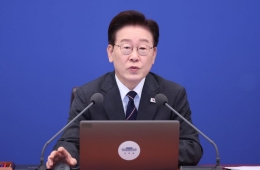
President Lee Jaemyung delivers closing remarks at a public briefing on the Korea Green Transformation (K-GX) strategy, held at a meeting venue in Seoul on the 7th. Yonhap News.
View original imageHanwha Qcells: "Mass Production of Tandem Solar Cells to Begin in Late 2028"
Hanwha Qcells will begin full-scale mass production of perovskite tandem solar cells, a next-generation solar technology, in late 2028. The company plans to build a production facility in Jincheon, North Chungcheong Province, with an annual capacity of 1 gigawatt (GW), and complete domestic and overseas demonstrations and preparations for mass production by 2028.
Tandem solar cells are made by layering perovskite, a new material, on top of conventional silicon solar cells. They can absorb light across different wavelengths and convert it into electricity, enabling them to generate more power than conventional silicon solar cells over the same area. Their advantages include raising power generation efficiency, lowering generation costs and making efficient use of limited land.
Hanwha Qcells plans to expand the use of tandem solar cells to building-integrated photovoltaics (BIPV), satellites and artificial intelligence (AI) data centers, among other applications. In a presentation on October 7, Hanwha Qcells President Park Seung-deok said, "If we supply 1 GW of tandem modules annually, we could reduce carbon emissions by about 600,000 tons each year, create around 1,000 jobs and generate revenue in the 1 trillion won range. Drawing on Hanwha Qcells' accumulated solar technology and manufacturing capabilities, we will help implement the government's green transformation policy early by bringing tandem technology into mass production."
POSCO Holdings: "Building Hydrogen-Reduction Ironmaking Facilities in the Southeastern Region"
In the steel industry, POSCO is accelerating its green transition with a focus on hydrogen-reduction ironmaking. Since the steel industry accounts for about 15% of domestic greenhouse gas emissions, a key challenge is to shift from production centered on conventional blast furnaces to low-carbon processes.
POSCO Holdings President Lee Jutae said, "A hydrogen-reduction steelworks that operates around the clock needs stable and affordable clean energy. A green premium market must also be established, one that recognizes the environmental value of low-carbon steel in economic terms."

Key Details of the K-GX Signature Project. Joint Materials from Relevant Ministries.
View original imageTo this end, POSCO began operating a large electric arc furnace at its Gwangyang Steelworks this year, with an annual capacity of 2.5 million tons, and broke ground in Pohang on a demonstration facility for Korean-style hydrogen-reduction ironmaking with an annual capacity of 300,000 tons. The company aims to complete the demonstration facility by 2028 and finish developing commercial technology for Korean-style hydrogen-reduction ironmaking, known as HyREX, by 2030.
POSCO will also establish a southeastern regional cluster connecting Pohang with the Ulsan industrial complex. The plan is to build an ecosystem that uses clean hydrogen produced nearby at steelworks and links low-carbon steel production with demand.
POSCO expects this initiative to generate about 6 trillion won in economic benefits in the southeastern region, create 11,000 jobs and deliver an additional annual carbon reduction of 560,000 tons. The company will later expand the model to the southwestern region, centered on Gwangyang. POSCO expects that once hydrogen-reduction ironmaking ecosystems are established in both regions, the steel industry will generate demand for about 1 million tons of clean hydrogen and enable an additional annual carbon reduction of 14 million tons.
Samsung Electronics and LG Electronics: "Developing Large-Capacity Heat Pumps"
LG Electronics and Samsung Electronics are seeking to expand the heat pump market, which replaces fossil fuels with electricity for residential heating. Since domestic home heating relies heavily on fossil fuels, including gas boilers, the companies aim to reduce carbon emissions from buildings by increasing heat pump adoption.
LG Electronics is promoting "energy-independent modular homes" that combine heat pumps with solar power and energy storage systems (ESS). Solar panels generate electricity, which is stored in an ESS and a thermal storage system and then used by home appliances, electric vehicles and heat pumps. A home energy management system integrates the management of energy production, storage and consumption.
LG Electronics plans to establish a domestic heat pump supply system based at its Changwon plant and expand to other local governments a demonstration project on the electrification of heating and cooling conducted at a multi-unit housing complex on Jeju Island. It will then develop energy-independent residential complexes in distributed energy special zones and youth housing in South Jeolla Province, before expanding the scope of application over the long term to public rental housing and private multi-unit residences.
LG Electronics expects that electrifying building heating will reduce carbon emissions by about 3 million tons by 2035 compared with 2024 levels. Lee Jae-sung, head of LG Electronics' Eco Solution (ES) Business Division, said, "At the national level, linking energy storage with demand response will increase the capacity to accommodate renewable energy and help stabilize the power grid. By balancing energy production and consumption, we will also help realize carbon-neutral residential environments."
Park Seung-hee, Samsung Electronics' president for corporate relations (CR), said, "Unlike detached houses, 65% of all housing in Korea consists of apartments, and the outdoor-unit spaces are too narrow to install both air conditioners and heat pumps. We need a Korean-style solution to address this challenge."
Samsung Electronics will expand its integrated heating and cooling heat pumps for apartments, designed to suit domestic housing types. A single outdoor unit provides summer cooling, winter underfloor heating and hot water. The system can reduce the installation space required by 46% compared with installing an air conditioner and a heat pump separately.
The system will also use heat generated by outdoor units in summer to produce hot water, a technology that reduces power consumption by about 20%. Samsung Electronics plans to connect the system to SmartThings and, over the long term, link it with solar power, ESS and home appliances to manage household energy use in an integrated way.
Samsung Electronics is also expanding its domestic production base. The company began producing heat pumps in Korea last month and will build a supply chain with about 40 partner companies. After establishing design and installation standards suited to domestic climate conditions, it plans to conduct demonstrations in carbon-zero apartments and expand distribution to general housing and public buildings.
SK hynix's "Decarbonization Transition Center" and Hyundai Motor Group's "Transition to Eco-Friendly Vehicles"
Other sectors, including semiconductors and automobiles, are also joining the green transition. SK hynix will establish a Decarbonization Transition Center to reduce carbon emissions from semiconductor production. The company will set up the center in Yongin, Gyeonggi Province, by the end of this year, focusing on AI infrastructure and the semiconductor ecosystem, and will develop and demonstrate technologies to reduce emissions throughout semiconductor processes. It will also support small and medium-sized partners in strengthening their carbon competitiveness.
Hyundai Motor Group will build electric vehicle and key-component production facilities, as well as autonomous driving infrastructure, with a focus on Ulsan and Hwaseong. The government said it would support the transition to future mobility and set a goal of making eco-friendly vehicles account for 70% of new car sales in Korea by 2035. It will also pursue improvements in the performance of key electric vehicle components and develop technologies to stabilize supply chains, including drive motors that do not use rare earths.
HD Hyundai Energy Solutions is targeting the next-generation solar cell market. The company aims to commercialize tandem cells and modules that combine silicon and perovskite by 2030.
GS Entec and Hanwha Ocean are among the companies participating in the expansion of the offshore wind supply chain. Seven companies, including GS Entec, will build production capacity for key offshore wind components and develop it into an export hub by 2030. Hanwha Ocean will build a dedicated 15-megawatt (MW) offshore wind installation vessel by 2028 to meet demand for large-scale offshore wind installations.
Doosan Enerbility will build an SMR production base. The company will construct a dedicated SMR foundry at its Changwon site, creating the capacity to produce more than 20 units a year from 2026 to 2030. Korea Hydro & Nuclear Power will pursue the construction of one 680-MW SMR and new nuclear power plants.
Hot Picks Today
 "Wasn't It Supposed to Be Gone? Alarming Surge in Cases Leads US to Declare Disaster Emergency"
- [Exclusive] "We Thought Bigger Debts Would Hurt More..." Business Owners With Less Than 100 Million Won Loans Have Higher Delinquency Rates Than Those With Over 500 Million Won
- "Cash Equal to Your Baby's Weight"... Japanese Bank Offers a Surprising Perk for New Parents
- "This Isn't Right, Someone Could Throw Out Their Back"... Triple-Layered Garbage Bags Tightly Bound with Tape
- "Mom, You Didn't Throw Away My Old Clothes, Right?"... 20-Something and 30-Something Women Rediscover 20-Year-Old Fashion Styles
Power equipment companies, including Taihan Cable, are targeting the next-generation power grid market. Five companies, including Taihan Cable, will develop technologies for next-generation power equipment, such as transformers and cables, and expand production facilities, with plans to increase related production capacity by 2035. The government will also pursue the domestic production of key equipment for gigawatt-scale, high-voltage direct current (HVDC) submarine cables.
© The Asia Business Daily. All rights reserved. Unauthorized AI training and use prohibited.