Nuri's Fifth Launch a Success... HD Hyundai Heavy Industries Lends Support
HD Hyundai Heavy Industries Supports Launch Pad Operations
Building Private-Sector Experience Ahead of the Sixth Launch
Following the successful fifth launch of the Korea Space Launch Vehicle II (KSLV-II), also known as Nuri, HD Hyundai Heavy Industries gained experience in the transition to private-sector-led space development by participating in launch pad operations and the production and operation of the launch vehicle.

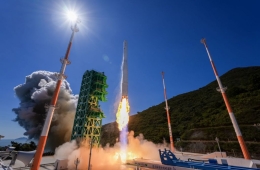
On the morning of the 7th, the Nuri rocket is standing at the second launch pad of the Naro Space Center, preparing for launch. Provided by the Korea Aerospace Research Institute
View original imageHD Hyundai Heavy Industries said on October 7 that it supported launch pad system operations for Nuri's fifth launch, including pre-launch inspections and tests. The company oversaw the design, production, and construction of Nuri's launch pad system and also supported operations for the first four launches.
Building on its experience constructing the launch pad for the Korea Space Launch Vehicle I (KSLV-I), known as Naro, HD Hyundai Heavy Industries won a contract from the Korea Aerospace Research Institute in 2016 to develop Nuri's launch pad system. It subsequently built the dedicated second launch pad for Nuri and designed, produced, and installed the full launch pad system, including the Mechanical Ground Support Equipment (MGSE), Fuel Ground Support Equipment (FGSE), and Electrical Ground Support Equipment (EGSE). The localization rate for the related process technologies has now reached 100%.
The company's experience in building and operating launch pads is being extended to the next-generation launch vehicle program. In September, HD Hyundai Heavy Industries was selected as the preferred negotiating party for the Korea Aerospace Research Institute's detailed design technical services contract for the next-generation launch vehicle's launch pad system. The next-generation launch vehicle is expected to be developed at approximately 70.8 meters in height and 530.6 metric tons in weight.
Hot Picks Today
 "Wasn't It Supposed to Be Gone? Alarming Surge in Cases Leads US to Declare Disaster Emergency"
- After 17 Tardies, AI Says, "We Should Fire This One, Right?" ... Outcry as U.S. Puts Brakes on 'Robot Bosses'
- With a Trembling Voice, "One Bowl of Jajangmyeon, Please"... 9-Year-Old Saves Mother From Assault
- Park Jinyoung: "I've Never Worked for President Lee or the Democratic Party... A Valuable Opportunity for Our Sons, Daughters and Nieces and Nephews" [2026 National Assembly Audit]
- "South Korea's Rep, Born in 1991, Is 35"... 'Married or Divorced? Still OK': Miss Universe Removes Age Limit
"The successful fifth launch of Nuri once again demonstrated the stability and operational capabilities of the launch pad system we built using our own technology," an HD Hyundai Heavy Industries official said. "We will contribute to the development of South Korea's space industry by drawing on the experience we gained with Naro and Nuri, as well as our capabilities in the detailed design of next-generation launch pads."
© The Asia Business Daily. All rights reserved. Unauthorized AI training and use prohibited.