President Lee: "We Must Become Designers, Not Followers, of the Green Market"... Chey Tae-won: "Companies to Invest 220 Trillion Won"
Korean-style Green Great Transformation Strategy National Report Meeting
"Essential Strategy for Securing Technological Superiority in Advanced Industries"
"Climate Crisis Response Must Go Hand in Hand with National Competitiveness"
Calls to Take the Lead in Green Technologies
Chey Tae-won: "AI and Green Transformation Are Twin Strategies"
President Lee Jae-myung stated on October 7, "We must break away from the old pattern of being followers and instead become designers and leaders shaping the green market ourselves." He emphasized his commitment to approach climate crisis response not just as an environmental policy, but as a national strategy for boosting competitiveness in advanced industries and creating engines for future growth. He specifically identified the Green Transformation as a prerequisite for maintaining technological superiority in advanced sectors and ensuring the success of the three major mega projects, urging the development of core green technologies and the need to take the lead in securing new markets.

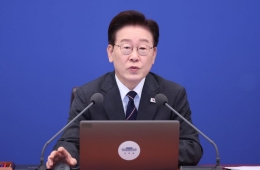
President Lee Jae-myung is speaking at the Korean-style Green Transformation (K-GX) Strategy National Report Meeting held at a conference hall in Seoul on October 7, 2026. Photo by Yonhap News
View original imageIn his opening remarks at the Korean-style Green Great Transformation (K-GX) Strategy National Report Meeting held in Seoul that afternoon, President Lee said, "Taking a proactive approach toward green transformation is a sure-fire future strategy, as it both secures international competitiveness and robustly protects our people's lives and foundation from the climate crisis."
President Lee pointed out, "The climate crisis is no longer a distant issue, but an imminent reality threatening the very survival of humanity." He cited estimates that over 35,000 additional deaths occurred in Europe compared to the annual average due to heatwaves this year, and referenced domestic incidents such as a record-high temperature of 42.5°C in Yangsan, South Gyeongsang Province, and torrential rainfall of 124.5mm per hour in Geoje. He stressed, "Responding to the climate crisis is no longer about giving up either the environment or growth, but rather requires a transformation that provides a practical solution for boosting both industry and national competitiveness."
He especially focused on the fact that carbon reduction is becoming a new global standard of competition within international trade norms. President Lee observed, "Carbon trade barriers, including Europe's carbon border tax, are rising rapidly, and foreign companies are making strong demands for carbon reduction in the products they buy." He analyzed that reducing carbon emissions is no longer just a matter of corporate choice, but has emerged as a core determinant of export competitiveness and access to global supply chains.
President Lee stated, "The Green Great Transformation is an essential prerequisite for maintaining the technological edge of our high-tech industries and ensuring the success of the three major mega projects." He added, "We must take the lead in the future green market by leveraging world-class research and development capabilities to secure key green technologies ahead of others."
He also stressed the importance of linking the Green Great Transformation to revitalization of the regional economy. President Lee said, "We must seek ways for the green transformation to become a new driver of regional growth by actively utilizing local industrial complexes and renewable energy." He further called for policy support to ensure that aging industrial complexes, vulnerable sectors, and low-income groups are not marginalized during the transition process.
Hot Picks Today
 "Wasn't It Supposed to Be Gone? Alarming Surge in Cases Leads US to Declare Disaster Emergency"
- After 17 Tardies, AI Says, "We Should Fire This One, Right?" ... Outcry as U.S. Puts Brakes on 'Robot Bosses'
- With a Trembling Voice, "One Bowl of Jajangmyeon, Please"... 9-Year-Old Saves Mother From Assault
- "South Korea's Rep, Born in 1991, Is 35"... 'Married or Divorced? Still OK': Miss Universe Removes Age Limit
- Park Jinyoung: "I've Never Worked for President Lee or the Democratic Party... A Valuable Opportunity for Our Sons, Daughters and Nieces and Nephews" [2026 National Assembly Audit]
This National Report Meeting was organized to connect the Korean-style Green Great Transformation—one of the three main visions of the 'K-Initiative' presented by President Lee at last month's United Nations General Assembly—into concrete industrial and investment strategies. The government prepared the strategy through a public-private task force involving 13 ministries and 17 economic organizations and associations. Core projects under the K-GX Signature Projects include domestic production of next-generation solar cell technology by Hanwha Qcells, the establishment of a decarbonized steel industry ecosystem by POSCO Holdings, and residential green transformation initiatives led by Samsung Electronics and LG Electronics.

President Lee Jae-myung is listening to the remarks of Choi Tae-won, Chairman of the Korea Chamber of Commerce and Industry, at the Korea-style Green Transformation (K-GX) Strategy National Report Meeting held at a conference hall in Seoul on October 7, 2026. Photo by Yonhap News
View original imageChey Tae-won, Chairman of the Korea Chamber of Commerce and Industry, announced that companies would faithfully carry out their investment plans amounting to 220 trillion won. Chairman Chey explained, "The reason companies have hesitated to pursue carbon-neutral investments was not a lack of will, but rather the difficulty of bearing long-term investment risks alone amid uncertain technologies, markets, and policies." He added, "Regulations can bring companies up to the baseline, but the power to go beyond the baseline comes from incentives," highlighting the significance of a combined strategy of government investment support, infrastructure expansion, and regulatory improvement.
Chairman Chey described the transition to artificial intelligence (AX) and the green transformation (GX) as the country's "twin strategies." SK has also announced it will establish an AI Environmental Research Institute to take the lead in the semiconductor ecosystem and green transformation. Chairman Chey said, "We will faithfully execute the 220 trillion won investment, including the Signature Projects, and deliver tangible on-site results," stressing, "The Korea Chamber of Commerce and Industry and companies will lead the way so that carbon neutrality becomes not a burden but a new opportunity for growth."
© The Asia Business Daily. All rights reserved. Unauthorized AI training and use prohibited.



![[2026 Nobel Prize] Frenchman Henri Kagan and Japanese Kenso Soai Share Nobel Prize in Chemistry for "Homochirality Research" (Updated)](https://cwcontent.asiae.co.kr/asiaresize/307/2026100719503053971_1791370230.jpg)