1,000 Trillion Won Investment by 2035: Government Launches 'K-GX' for Decarbonization of Semiconductors and Steel
The government will invest more than 1,000 trillion won in fiscal resources and climate finance by 2035 to promote decarbonization across industries and foster the growth of green industries. This initiative includes overhauling production processes in high greenhouse gas-emitting sectors—such as steel, petrochemicals, and cement—while aiming to achieve 100GW of renewable energy capacity by 2030 and converting more than 70% of new vehicles to electric or hydrogen-powered models by 2035.
On October 7, related ministries—including the Ministry of Economy and Finance and the Ministry of Climate, Energy and Environment—announced this 10-year plan at the National Report on the Korean Green Transformation (K-GX) Strategy, held at the Korea Chamber of Commerce and Industry in Jung-gu, Seoul. The K-GX aims to achieve both carbon neutrality and economic growth from this year through 2035.

Chairman Chey Tae-won of the Korea Chamber of Commerce and Industry (left), Deputy Prime Minister and Minister of Strategy and Finance Lee Hyung-il (right), and Minister of Climate, Energy and Environment Kim Sung-hwan are seen conversing before the start of the Korea-style Green Transformation (K-GX) Strategy National Report held at a conference room in Seoul on the 7th. Photo by Yonhap News Agency
View original imageFrom Steel and Petrochemicals to Renewable Energy: Industrial Transition
The government will transition the main processes of five major high-emission sectors—steel, petrochemicals, cement, semiconductors, and oil refining—to decarbonized alternatives. For steel, Korea will conduct a demonstration of 300,000-ton-scale hydrogen reduction ironmaking by 2030, targeting the world's first commercial-scale hydrogen steel production. In petrochemicals and oil refining, the government will expand R&D in electric naphtha cracking technology and promote the use of eco-friendly fuels. The cement industry will focus on developing low-carbon technologies such as multi-component blended cement, while the semiconductor and display industries will pursue the development of process gases with low global warming potential to replace current materials.
For renewable energy, the goal is to secure 100GW of capacity by 2030. Efforts will be made to identify sites for solar and wind generation, secure business sites, and reduce generation costs. The transmission grid will be upgraded with high-capacity power lines to expand transmission volume, and the government will foster direct current (DC) power transmission and distribution industries to enable direct supply of power produced at renewable energy clusters to consumers.
In the transportation sector, over 70% of newly registered vehicles will be converted to electric or hydrogen vehicles by 2035. The scope of electrification will expand to include railways, buses, motorcycles, construction equipment, ports, and ships. The government will also intensively nurture 10 key green industries, including electric vehicles, batteries, solar power, wind energy, small modular reactors, electrical equipment, power semiconductors, heat pumps, hydrogen, and carbon capture, utilization and storage (CCUS). This includes supporting technology development and commercialization and introducing domestic production tax credits to strengthen domestic manufacturing foundations.

1,000 Trillion Won Investment: Advancing Green Transition Across Regions and Workers
To reduce market uncertainties related to the green transition, the government will invest a total of approximately 1,000 trillion won—including 200 trillion won in fiscal spending and over 790 trillion won in climate finance—between 2026 and 2035. The government will expand the Climate Response Fund and establish a system and detailed measures for green bonds by the first half of 2027.
Of the 790 trillion won in policy finance, funding will be concentrated on local governments and small- to midsize enterprises (SMEs and mid-tier companies), allocating over 50% to regional areas and over 70% to SMEs and mid-tier companies. Transition finance to support eco-friendly transformation in high-emission sectors will also be actively implemented. The government will offer stage-specific R&D and demonstration support for climate tech startups and provide package support of up to 10 billion won for promising companies. Legislation to nurture a climate tech ecosystem will also be pursued.
Regionally, customized green transition models will be developed based on the "5 poles and 3 specialized areas" structure. In Naju, as an energy-specialized city, a tech development, investment, and entrepreneurship ecosystem will be established, while on Jeju Island, a carbon-neutral model will be implemented by converting all new vehicles to electric vehicles by 2035.

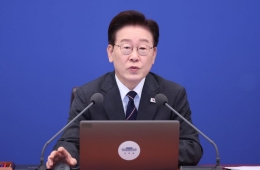
Lee Hyungil, Deputy Prime Minister and Minister of Finance and Economy, is making a presentation at the Korea-style Green Transformation (K-GX) Strategy National Report held under the chairmanship of President Lee Jae-myung at a conference hall in Seoul on the 7th. Photo by Yonhap News
View original imageWorker protection measures will be implemented during the industrial transition process. The government plans to designate "Just Transition Zones" within this year to support vocational training and incentives. For workers at coal-fired power plants scheduled for closure, the government will prepare a "2040 Coal Power Plant Transition Roadmap" and related legislation.
The government will introduce a domestic production tax credit for key components and equipment for solar power, wind power, and secondary batteries and promote the designation of small modular reactors as national strategic technology. Additionally, new special regulatory zones related to green transition will be established, and a fast-track approval process will be provided for companies possessing core technologies.
Hot Picks Today
 "Wasn't It Supposed to Be Gone? Alarming Surge in Cases Leads US to Declare Disaster Emergency"
- [Exclusive] "We Thought Bigger Debts Would Hurt More..." Business Owners With Less Than 100 Million Won Loans Have Higher Delinquency Rates Than Those With Over 500 Million Won
- [Breaking] Space Administration Chief: "Nuri Rocket's 6th Launch Targeted for Second Half of Next Year"
- "Do They Give Refunds for This?"... Online Buzz as Rest Area Robot Shows 'Scallion Ramen Failure'
- "Mom, You Didn't Throw Away My Old Clothes, Right?"... 20-Something and 30-Something Women Rediscover 20-Year-Old Fashion Styles
The private sector will pursue 10 K-GX signature projects across four major areas: establishing independent clean energy supply chains, decarbonizing major industries, electrifying transportation, and greening residential spaces. Hanwha Q CELLS, POSCO Holdings, LG Electronics, Samsung Electronics, and others have announced related projects.
© The Asia Business Daily. All rights reserved. Unauthorized AI training and use prohibited.